
As a Tunisian, I could not be happier to announce that there is now solid hope in my people’s full independence and prosperity: That hope is summarized in the Tunisian Constitution of 2014.
1881 marked the start of the occupation by imperialist France (facilitated by other European colonial powers). Since then, Tunisians walked in the desert 133 years under the wrath of dictatorship, direct and indirect occupation. The constitution of 2014 officially-and legally- puts an end to that era and solidly re-introduces Tunisians to the management of their own affairs.
This constitution is the Tunisian revolution’s utmost accomplishment thus far, ending a shaky path where interim laws barely sustained an unstable political process. For that we can rejoice! The revolution lives on in Tunisia.
The new constitution will hopefully reign over the Tunisian state, making it one that respects and guarantees human rights for all. It theoretically contains safeguards against the return of tyrannical rule and all the provisions that will ensure the building of a democratic Tunisia. Of course, nothing less is expected from the revolution’s constitution. The Arab revolution (Arab spring) was indeed sparked in Tunisia, to then spread and toppled a generation of Dictators.
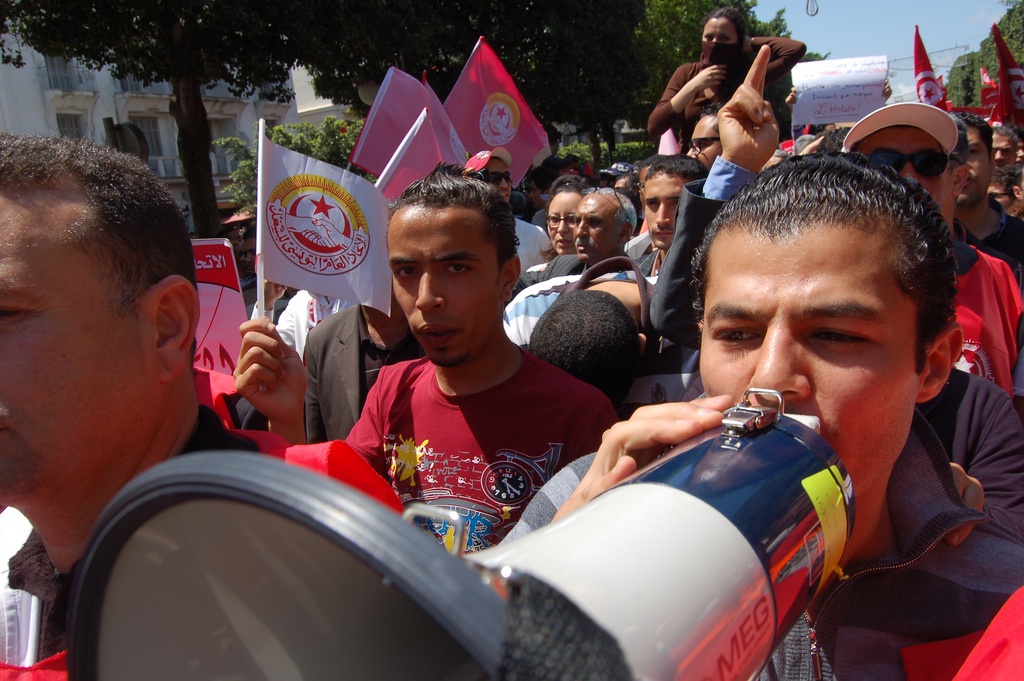
1st of May protest, Tunis, Tunisia, 2012. Image credit: scossargilbert
Revolutionary Prospects looked much dimmer just months ago as the world sat and watched the military coup in Egypt slaughter its people and the democratic process. Syrians, now a people largely displaced due to the regime’s unscrupulous war machine, had to know for themselves that the “international community” will not intervene to stop slaughter (or protect democracy) unless enough global powers deem it within their interests. Yemen’s revolution turned into a “national dialogue” sponsored by theocratic monarchies and the UN…
These revolutionary setbacks weaken the revolution in its cradle: Tunisia. In the least, they morally encourage reactionary forces. In an unusual parallel, a Tunisian “Soft Coup” is underway in the midst of “constitutional euphoria”.
“Egypt is different than Tunisia.” Boast many Tunisians both aligned with the post-revolution elected government and its opposition. There is deep structural and historical differences: Re-establishing a tyranny to rule an 80 million strong post-revolutionary Egypt requires a strong institution like the military, but a coup in Tunisia can indeed be soft and gradual. Our festivities shouldn’t abstract the facts: the same forces that supported (and maybe planned) the reactionary backlash in Yemen and the military coup in Egypt couldn’t have left Tunisia’s resolution at peace!
In fact, Tunisian reactionary forces did not hide their desire/intent to replicate the Egyptian Sisi-model in Tunisia. Following 2 political assassinations, Essebsi (now a prominent political figure) openly called for the dissolution of the elected constitutional assembly (and the government as well). He currently presides over the “Nidaa Tounes” political party, which is widely regarded as the representative of Ben-Ali’s men and women and their largest re-organization after the revolution. The -unreformed- Tunisian media continues to boast his image as a potential presidential candidate (at the age of 88).
The reactionary coup threat in Tunisia has crystallized after an unelected government was instilled at the end of a so called “national dialogue”. Supposedly a technocrat (which is a euphemism for unelected officials), Mehdi Jomaa’s government was sworn in office this -late- January. Thus, one major component of any democratic system, respect for election results, was fully disregarded for the first time following Tunisia’s fair and free elections. What else is a coup d’etat exactly?
The ex-ruling Islamist party, Nahdha (with its weak 2 secular allies) claims that the power-transition was voluntary. Such a claim falls on deaf ears given the international resilience to denounce general Sisi’s slaughter of Islamistsand anti-coup protesters. Such resilience is nothing short of complicity and at least acceptance. Nahdha party is an indirect offshoot of the Egyptian Muslim Brotherhood (violently ousted from power in Egypt). Realistically the choice for Tunisian Islamists was slim: either concede and leave power “voluntarily” or a more radical coup and Egyptian-style prosecution could be underway.
The Nahdha party was elected after an electoral campaign in which the party vowed to fight the remnants of the RCD party (Ben-Ali’s ruling party), end the crippling state-corruption along with unmeasured promises of welfare and economic recovery.
In 3 years of rule, the government has failed to deliver on any of its core promises.
On the contrary, it is accused of appointing key figures associated with the dictatorship era in important state positions (such as the new “controversial” Tunisian central governor, Chedly Ayari). Its human rights ministry lagged and only delivered the much awaited “transitional justice law” a few weeks earlier (after more than 2years!). The move comes too late as the Islamist party is now considered in a quasi-alliance (or surrender) with reactionary forces and parties. It has indeed moved a long way from its pre-elections rhetoric regarding Ben-Ali’s aids. Rached Ghanouchi, the president of Nahdha party (and member of the international Muslim scholars organization) went as far as saying that the next elections could see his party hand in hand with parties he had beforehand described as reactionary. An alliance that the reactionary forces themselves could refuse if they succeed in sidelining Nahdha (and they have enough time and tools until next elections are actually set up).
On the economic front, policies were shaky and did not introduce any novel methods that concentrate on empowering the Tunisians who were left out of Ben-Ali’s economic model.
Nahdha party was only able to resume its existence in Tunisia after the revolution. Now it is stripped of any revolutionary legitimacy. Moreover, having lead an economically shaky period: The party’s fate after the next elections could be less bright than what it aimed for from its machiavellian political maneuvers.
Mehdi Jomaa’s (unelected new PM) first actions are very telling about the “state of the coup”. His first international visit lead him to neighboring Algeria. Algeria has not (yet) seen any Arab Revolution(spring)-like transition and its regime maintained cold relationships with Tunisia’s elected governments. Notably, the Algerian regime enjoys huge oil-revenues with which it can support Jomaa’s government and embellish its economic record in contrast to that of the Nahda-Lead elected government.
The IMF, just hours after the current government was sworn in office, released $500m in loan money it had refused to deliver before. Many point out to the similar financial support by oil-rich countries provided to Egypt, as soon as its democratically elected president was toppled. The Tunisian dinar has already appreciated and Tunisian stock market has also improved (with Tunindex already up by at least 0.17%). These appreciations reflect the support of the Ben-Ali business class and international financial entities (IMF ). This relationship promises to only get cozier: The furiously demanding trade Union UGTT (left largely unreformed since Ben-Ali’s ouster) announced that it will allow Mehdi Jomaa’s a grace period.
Obama has been reluctant to publicly meet with the Arab-Spring’s elected and bearded -however shaved they pretend to be- new leaders. However, the president of the US already phoned Tunisia’s unelected PM and communicated an invitation for Washington to Mehdi Jomaa.
Tunisian state TVs also shifted focus from political coverage to venting the new government and a more monotonous Ben-Ali era-like politics-free news coverage. If the young post-revolutionary Tunisian political class is left out of news coverage for a long period, It will eventually be sidelined and forgotten by the huge masses that get their only news from state TVs. That goes for both Nahdha and its foes in the national constitutional assembly. Only recycled RCD faces have been making it big on the Tunisian screen.
International powers, Media and Money: The signs are clear, what is happening in Tunisia is a step-by-step Coup d’etat (for lack of a reactionary unified body such as Egypt’s military).
The question is not weather or not there is a coup in Tunisia, it is rather: to what extent will reactionary forces succeed in undermining the revolution?
The “Jordanian model” seems closest at hand:
If democracy in the MENA can only breed bearded men and veiled women leaders, then a semblance of democracy is much better. The Jordanian Islamists are allowed to exist as an unofficial entity, to protest and to hold regular meetings. However decision making is the red line they cannot approach (or even hope approaching). Sometimes they even serve as a regulating body, making sure popular democratic aspirations are structured and never too radical or undermining to the regime.
The Tunisian political scene can thus be remodeled to give the Nahdha party a peripheral role while the Ben-Ali status-quo is maintained through new faces: Unelected faces for now.
As international support pours in and Tunisian reactionary forces halt their offensive on the state (through unsustainable trade union demands, record strikes and the Ben-Ali media, the economic situation is bound to improve significantly. This improvement will push large sways of people to prefer any rulers (even some sympathetic to the Ben-Ali regime) to the troublesome Islamists and maybe to democracy altogether.
Real independent democratic aspirations in any Arab country threatens the core interests of many in an oil-hungry and beard-unfriendly world…
Let me go back to the hopeful part: The constitution.
Local governance (a weak federalism) is now to be implemented according to the new constitution. If It is coupled with effective local-taxes (real financial independence from Tunis) it constitutes one viable channel to reverse the reactionary and Coup tide. When Tunisians start electing local representatives that they know, and if they start seeing real local results, only then will popular participation increase and strengthen the democratic political process.
Apart from the Usual democratic provisions, the constitution did not bring enough radical changes to the corruption-crippled Tunisian state (the court system is largely unchanged for example). However, amendments, given democracy is preserved, can fix these shortcomings. I urge my fellow Tunisians to be vigilant and to make sure every clause in our constitution is applied. There isn’t a perfect constitution, but ours is an invaluable and instrumental document in our history.
Most importantly:
The revolution lives on in Tunisia.
About the Author






[…] such as instituting an unelected government to rule Tunisia leading to the ongoing elections. Which I amply explained amounts to a soft coup. The Terrorism PR game, that deposed Ben-Ali thrived on, is back in full swing. The soft coup […]