
How would a non-Muslim woman feel wearing the traditional Muslim veil, also known as the hijab, in public? How would she deal with reactions, comments and doubtful looks? Christelle Collet, originally from Mauritius but living in Western Australia (WA), asked herself the same question before deciding to take part in an unusual social experiment. For one-week she wore the hijab to go to work, to the post office, to meet up with friends and to do everything else she normally does.
In July 2009 Christelle moved to Perth, capital of WA, and she quickly grew a passion for community services. The 25-year-old currently works as a Cultural Diversity Training Coordinator for an organisation giving assistance to newly arrived migrants, refugees and humanitarian entrants in Perth. As someone who works at a cultural diverse environment, she wanted to understand what women wearing the hijab feel walking the streets of Perth.
Recently, Ralph Cerminara, a former Australian soldier who is now one of the leaders of the Australian Defense League group (ADL), posted a Youtube video promising race riots against Muslims. According to a news source, Cerminara has been following Muslim women around, taking pictures and posting the images on the ADL’s facebook page, where he and other members insult and verbally abuse the women.
Even though there has been increased harassment of women wearing the hijab or burka, there is no uniform protection across Australia against “hate speech.”
When Christelle told her partner, a fly-in-fly-out worker from France, she was going to experiment wearing the hijab for one week, he seemed deeply concerned. “He couldn’t understand why I would do something that could put me at risk of negative reactions,” she says.
Prior to the experimental week, Christelle did a trial for half a day to see how comfortable she felt wearing the hijab. She went around a shopping centre and accompanied a friend to the airport. Before entering the airport, her friend asked if she was going to keep the scarf on. Her friend thought the airport wasn’t a safe place for Christelle. Even though her loved ones were worried about the outcome of this experiment, Christelle decided to do the experiment anyway.
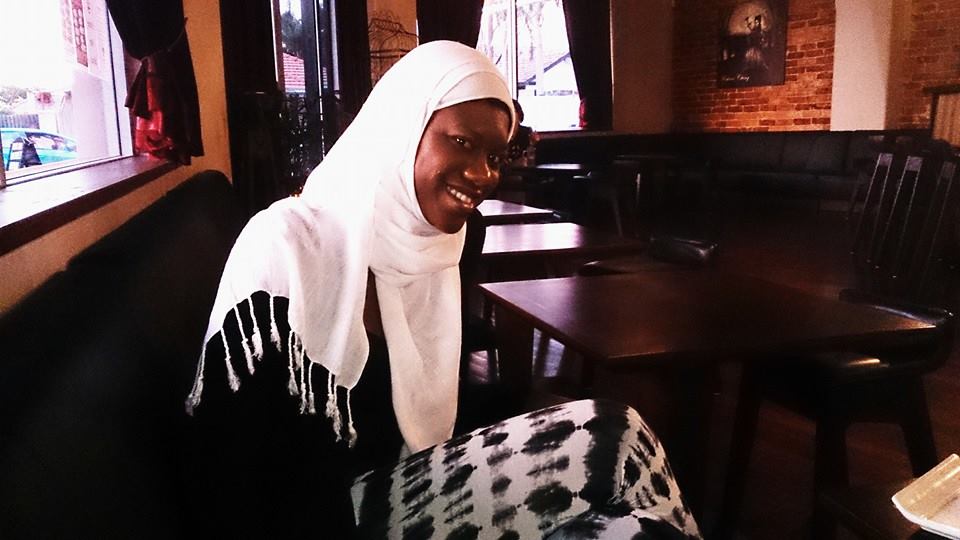
Christelle Collet
She admits it was nerve-racking to get out of house on the first day. “I was very scared because of what happened to a lot of people wearing the hijab,” she confesses. “When I was walking to the bus stop I kept looking at people, expecting they would react somehow.” At the bus stop, Christelle encountered a white man and she immediately thought he could be a potential racist. Her fears turned into stereotypes and she expected people to behave in a certain way. “I had to be aware of my own prejudices and reshape my way of thinking during the experiments,” she says.
During the second day of experiement, Christelle went shopping in Perth and, surprisingly, instead of the usual “hello” and smiles she normally gets, no one made eye contact with her. “I usually make eye contact with anyone and eventually get a smile back but with the hijab people definitely avoided my eyes,” she says.
While on the train back from Perth, Christelle reflected about her fear of wearing the hijab in the city. “How come society successfully got me scared of wearing a specific piece of clothing over my head? Have all the anti-Islam comments by bloggers and trolls on social media lately gotten in my head?,” she wonders.
On day 4 of the experimental week she commented on an article about Ferguson, where she expressed her opinion about the way media tries to shape our judgment of events.
“Take the scarf off your head and we’ll actually consider your rights. Islam can shut the f*** up,” replied one of the users to Christelle’s comment. Other user also said “I think you need to know your ideology is shared with Hamas and ISIS, Al-Qaeda and Boko Horam…or didn’t you know that?” Facebook users looked at Christelle’s profile picture and associated her with terrorism, instead of seeing her as a human being.
“I asked myself how is it for people living for years wearing the hijab? How many of these random remarks do women wearing the hijab get?,” she asks. The experience made her realise she was getting more negative reactions online than in the real world. “Do people feel safer behind their screen to express their hatred and fears?,” she says.
“I have been told by a Muslim lady previously how people referred to her as a terrorist,” she says.”Before it was someone else telling me what they experienced but now I lived it.” Christelle sees this experience as an “eye opener” and encourages people to become culturally educated about the issue.
The experience taught Christelle about what Muslim women go through when hearing the hijab. It made her understand how people see and treat these women differently. However, Christelle also learnt about herself. “The hijab made me see my face differently,” she says. “I discovered the shape of my eyes, my nose and I got to love my face.”
Christelle is not done yet and in the future she wants to try wearing the burka. “I just need to prepare myself psychologically for this one…,” she confesses.
About the Author





