
The 2014 General Elections in India have found themselves deserving of a bold, underlined and highlighted place in the political history of India. The result has been that the Indian National Congress (INC) did not lose; yet the Bharatiya Janata Party (BJP) did not win.
It was Narendra Modi who won India.
Considering the ‘Modi’fication of voters during run up to the elections this year, it now remains only incidental that Modi happens to be from the BJP.
In a country where the din of corruption was almost deafening and its people were writhing in pain under rising prices and inflation, change was the first priority for the people.
Modi promised change and much more and the country voted him to power. Much to his relief, ever since he came to power the economy has held stable; the numbers in his favour. And considering his stance as a Prime Minister and appeal as a leader, his popularity seems to be holding strong with the public – at least, as far as the several State Assembly Elections in India under his regime can indicate.
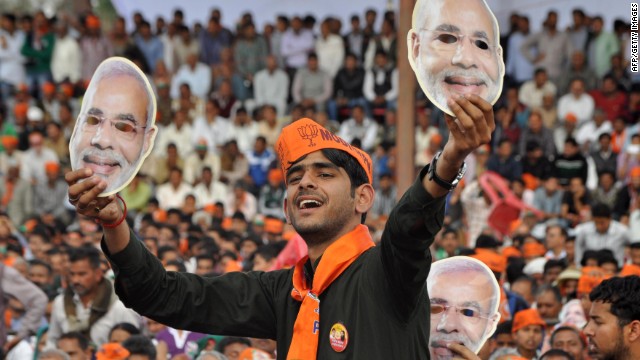
An Indian supporter of Narendra Modi at an election rally. Image Source: CNN http://edition.cnn.com/2014/04/06/opinion/bergen-india-elections-11-things/
This is not about the initial euphoria of the honeymoon period. The people of India know that they live in the world’s largest democracy. They also know that a country with such a huge population cannot afford to have a long honeymoon. Thanks to the critical Indian media, the Government can work or face exposure.
On this issue, many would choose to differ, and to bring in the ‘but-Modi-is-a-Hindu-radical’ angle, projecting the future of India as a country full of prospering Hindus and oppressed Muslims. Many also fear that Hindu radicalism will reach new heights under Modi.
But these critics forget that to in order to win the elections, Modi did not promise temples, freebies to Hindus, or any other religiously motivated incentive. Even after winning the election, he did not launch a Being Hindu campaign. He instead chose to launch the Swacch Bharat (Clean India) campaign and the Make in India campaign, among others.
History suggests that the BJP in the past have enjoyed successes while promoting Hindu Rashtra (Hindu nation) sentiments and promising a Temple in Ayodhya, much to the chagrin of Indian Muslims. Times have now changed, and as noted earlier, it was not the BJP that won India, but Modi; promising not temples but toilets.
India is a country of aware and opinionated citizens. People understand that a temple would not feed a family and a Hindu Rashtra would not mean more jobs. After being out of power for long, the BJP seems to very well understand the national mood. Narendra Modi knows that he is relevant only until the so-called ‘Modi-wave’ in India translates into votes. He also knows what the nation wants and is doing just that: more jobs in a cleaner India, where the cost of living is less and the opportunity to thrive immense. The way in which he is leaving a mark on each of his foreign visits is nothing but a global ratification of his stature.
The apprehensions of Modi ruining the tender secular social fabric of India can only be ignored, as long as all the critics have to raise against him is the violence under his regime in Gujarat in 2002. What happened was sad and should not have happened, yet for a moment, let us think from the critics’ point of view and term him a Muslim-hater devil.
The practical and rational mind reminds us of the fact that every saint has a past and every devil has a future.
And before dismissing him, it must first be remembered that he has been chosen democratically; in other words, the majority view has been respected. We should respect the public sentiment, and not strike him out until he fails India.
About the Author





[…] from younger voters, the classic troubles of corruption and poverty and potentially aggressive religious divisions between Hindus and Muslims that could cause tensions. In a country that has so much potential, Modi has a lot of issues to […]