
The global community stands with bated breath: the Brazil, Russia, India, China and South Africa (BRICS) summit has just commenced here in Durban, South Africa. An important outcome of summit is position of the BRICS on Syria. In a recent interview on Russia Today, the Russian deputy foreign minister, Sergey Ryabkov, spoke of the need for “impartiality” when dealing with Syria and that there is no alternative other than “impartiality” else more tragedy. There will definitely be more dialogue on Syria at the conference with views being expressed by all the BRICS leaders. Further, Russia and China have no plans to displace the United States and NATO from leading positions. The relationship between China and Russia was described as being “synergistic” and that they were still developing relations over time.
Decisions will be made on the “BRICS Bank“ front where the ideas and thoughts of a BRICS bank to rival the financial regulators of the IMF and World Bank will be discussed further. “We want to ensure that this bank plays a good role in pouring capital, constructing loans, establishing credit facilities for, first and foremost, infrastructure projects in the BRICS countries themselves” This quote by Sergey Ryabhov is very powerful and leads us to believe that more concrete decisions will be taken in Durban.
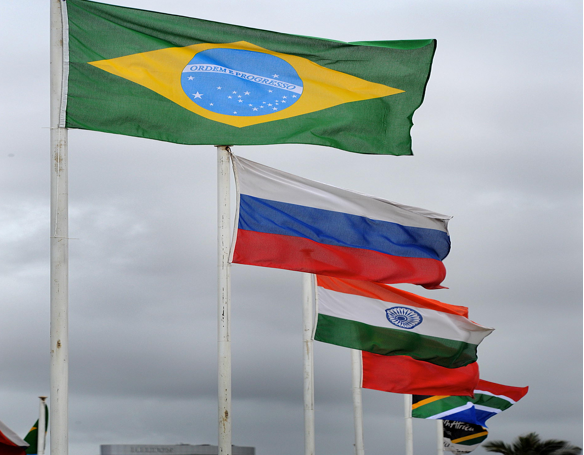
Flags of the BRICS nations outside the Albert Luthuli International Convention Centre in Durban, South Africa (adapted from the official BRICS5 website).
The importance of a BRICS bank cannot be understated: the shift away from western powers would mean a shift in the political and economic landscape drastically. China and India being the manufacturing hubs of the world, Brazil and Russia providing the “fuel” (being rich in energies), and South Africa being the last piece of the puzzle: the gateway to Africa and her resources: the BRICS do seem like a force to be reckoned with.
The summit itself has often been criticized in the past for not being transparent enough however this summit does allow for leaders within bilateral meetings to assess the focal points of issues in a more concise and blunt manner without other parties affecting decision making. The 5th BRICS summit also entails an investigation into how Africa may integrate within the BRICS. The possibility of the BRICS bank could also lead to more competitive finance as compared to the World Bank for Africa and lead to more economic growth in the developing world. The mobilization of this fund and exactly how the BRICS bank will work will be established in Durban.
The possibility of any new issues surfacing at the Summit is an interesting thought: From the expectations of summit and future plans of increased development and economic growth, it is hard to ignore what effects these outcomes will have on the environment. Increased emissions and climate change with carbon taxes are issues that need to be evaluated by the BRICS. It is quite possible that we may see a “Green” BRICS in the future more out of need rather than want. The bilateral meetings have started so the next few hours and tomorrow will depict the outcomes of the summit and whether any concrete decisions are taken by the BRICS.
More coverage on the BRICS Summit here.
About the Author






What a coup for China to still be thought of as an emerging economy.
[…] In Britain, as in other countries across the world, former forces for internationalisation have begun to question this path. The Blue Labour current, which Ed Miliband does not completely disregard in his leadership of the Labour Party (UK), responds to the 2010 general election defeat by being harsher on immigration and international institutions, while focusing more on local communities. Recently, we have heard news of how the EU is facing an unprecedented crisis of confidence, with trust in EU institutions across several major countries being at its lowest. Likewise, the egotism of the West in avoiding voting power reforms in the IMF and the World Bank are leading to efforts by the emerging world economies to form alternative international credit & development institutions. […]