
A month ago, the smog or haze from burning peats in Indonesia blanketed the region, raising alarms over health concerns of the young and elderly. There were increased reports of respiratory problems and eye infections. This year the Pollutant Standards Index (PSI) hit 400 which according to the National Environmental Agency is classified as “very hazardous”.
Schools had to be shut and people were advised to not remain outdoors for long periods of time. Despite the high levels of pollutants in the air, Singapore and Malaysia government did not issue an official “stop work” order and many construction workers, many of whom are from Bangladesh, China and India, had to continue toiling away under harsh conditions.
Demands for N95 face masks soared and over a million masks were distributed in six hours. However as supplies decreased and demands remained high, retailers began to market them at higher prices.
Both Malaysia and Singapore have endured years of haze caused by slash and burn tactics used by palm tree plantations in Sumatra. In the Riau province of eastern Sumatra, thousands of Indonesians were evacuated where the smog and ash from the burning forests are the worst. The haze has been threatening the welfare and health of over 70 million south-east Asians, causing diplomatic rows among the members of ASEAN (Association of South East Asian Nations).
The Economics of Palm Oil
The palm oil industry is worth US$44 billion. Indonesia is the largest producer of palm oil in the world with palm oil exports being worth US$18 billion. The industry alone supports over 5 million people in Indonesia. Apart from Indonesia, Malaysia and Nigeria also produce and export palm oil.
Palm oil is a common form of cooking oil made from the pulp of the fruit of the palm tree. It has a reddish appearance and is popular in African and South-East Asian cuisine. The rise in consumption of palm oil in recent years is due to the replacement of trans-fats with palm oil, which is also considerably low in cost because of the high oil yield of these plants. It can be found in most products from soap to biodiesel to even instant noodles.
Overall global consumption of palm oil in the last twenty years has quintupled. Companies such as Cargill (largest private company in the US), Unilever, Proctor & Gamble, Nestlé, Kraft Foods and Kellogg all use palm oil in their products.
There have been efforts by organisations such Green Peace to change the rules to require the labelling of products that contain palm oil. Since palm oil is high in saturated fats and has nearly nil health benefits, consumers have the right to know if the products they are consuming contain palm oil.
Environmental Impact
There are several reports by the UN that the palm oil industry is been linked to massive deforestation and habitat destruction in South East Asia. The rapid growth in the palm oil business as a result of high demand for the product has led to devastating environmental consequences in Indonesia, the largest producer of palm oil in the world. There has been large scale deforestation resulting in acreage loss of the natural habitat of the Sumatran Orangutan, a species listed as “critically endangered”. Floods and landslides have also increased because of deforestation.
In 2004, the Roundtable on Sustainable Palm Oil (RSPO) was formed to promote production and use of sustainable palm oil. The objective of RSPO is to address any environmental concerns within the palm oil industry. However, only 35% of their members are accredited and they consistently fail to uphold regulations within the industry.
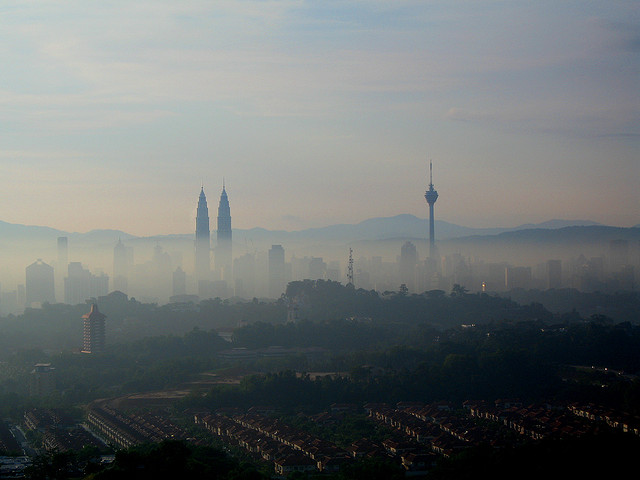
Kuala Lumpar, the capital city of Malaysia, shrouded in haze. Image Credit: Malek.
Human rights abuse
However, the human cost of palm oil has been overlooked. The industry is riddled with reports of human rights abuse and child labour. Investigations by various human rights groups revealed widespread abuse of workers in Indonesia where child workers are common and traffickers prey on poor families in rural areas. Many of these workers are underpaid and forced to work long hours in unsafe environments. They are not even provided with the basic necessities such as adequate water, food and shelter.
According to RSPO secretary General Darrel Webber, “the body has never suspended a member for violations of labour standards.” In April, the RSPO expanded its standards to include a ban on “all forms of forced or trafficked labour.”
There has also been several cases where workers were made to spray crops with the herbicide Paraquat (a chemical that has been linked to kidney and liver damage and has been banned in over 30 countries) without protective gear.
ASEAN & the Agreement on Transboundary Haze Pollution
The Malaysian and Singaporean government are now pushing the Indonesian government to take action against palm oil firms and plantations to curb the problem. ASEAN officials have sat together at ASEAN summits and meetings to discuss of a possible solution but the haze keeps returning. Indonesia despite having signed the ASEAN Agreement on Transboundary Haze Pollution in 2002 has repeatedly refused to ratify it.
In 2002, ASEAN finalised the Agreement on Transboundary Haze Pollution and called upon its members to cooperate in developing and implementing measures to prevent, monitor and mitigate haze pollution by controlling forest fires; placing early warning systems and providing assistance when the problem reaches critical levels as well as exchanging information and technology. The agreement also states that financial aid and help will be provided when dealing with the haze problem. Only Indonesia, the offender has yet to ratify the agreement, all nine other members have done so.
At the recent 22nd ASEAN Summit in Brunei last April, ASEAN foreign minsters discussed the haze menace in detail and to pledge an effective monitoring and fighting system. Malaysian and Singaporean authorities stressed that these meetings are pointless if the haze agreement is not implemented in full.
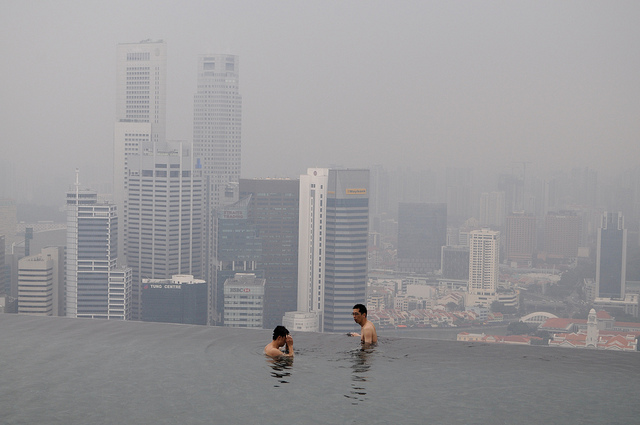
Singapore skyline marred by smog from forest fires. Image Credit: Gui Qi.
Dr Balthasar Kambuya, the Indonesian environment minister has pledged to ratify the agreement. In a statement, he said “We hope it will be completed this year. It is important for us to ratify it as a nation that’s affected (by haze) and concerned with the well-being of others.” There is concern that the pact will infringe on their country’s sovereignty and there also has been backlash from several ministers that the companies from both these nations are also responsible for the haze and they too should take action.
Indonesian politics is rife with corruption and has infiltrated the plywood and palm oil industry. The Indonesian government was forced to act following pressure from Singapore and Malaysia. Although several farmers have been arrested, none have been prosecuted. The governor of Riau, Rusli Zainal was also arrested. However, the real culprits are the conglomerates who employ the cheap slash and burn method in order to maximise profits as well as the corrupt officials who are bribed to “look the other way.”
Singaporean authorities have taken action by investigating any Singapore owned company that owns plantations in Sumatra. If they are found to be involved, then they will be heavily fined or even blacklisted.
Indonesia president Susilo Bambang Yudhoyono apologised for the first time to its neighbours. In a press release, he said, “For what is happening as the president, I apologise to our brothers in Singapore and Malaysia.” He also asked for their understanding and sent 3000 soldiers to fight the forest fires in Sumatra.
However, Indonesian Coordinating Minister for People’s Welfare, Agung Laksono retaliated by criticising Singapore officials stating, “Singapore should not act like children, making all that noise.”
The Future
The two biggest consumers of palm oil are India and China so unless they are brought into the debate, there is little that can be done. With little or no pressure, palm oil companies which are largely unregulated will continue with their bad and destructive habits. Many are unaware of the issue and failure to address it will only lead to further devastating consequences and diplomatic tension. Indonesia’s stubbornness to ratify the ASEAN haze agreement in the long run will cost her more than just a loss of profits.
The people of Singapore and Malaysia believe nothing will change and the haze will return next year. 2 days ago, the haze returned to Singapore and Malaysia after hotspots were detected in Sumatra. Indonesia yesterday declared that it will ratify the haze agreement by early 2014 but there is no guarantee that the Indonesians will keep their promise.
The burning question is; how much longer will South East Asians have to put up with the haze problem and at what cost?
This article was originally published on World Outline
About the Author






[…] Related: The Palm Oil Industry & its Choke Hold on South East Asia […]