
Backlash against LGBT discrimination in Russia is gathering strength, with calls for boycott against the 2014 Winter Olympics. But what do Russian LGBT activists have to say on the matter?
We have seen that violence against the LGBT community in Russia has escalated in the last few months, with the enactment of the law prohibiting ‘propaganda of nontraditional sexual relations around minors’ as well as public discussion of gay rights and relationships anywhere that children may hear it. As activists point out, this will render counselling for LGBT teenagers illegal as well as any attempt to impress upon children that there is nothing wrong with LGBT identity or relations.
Related: 2014 Olympics & Anti-Gay Sentiment In Russia
Whilst calls to boycott the 2014 Sochi Olympics have gained some support, this proposition has had conflicting reactions; some activists claim that the action would be counter-productive, with arguments that denying athletes the chance to compete would be unfair and instead focus should be placed on pressuring Russia’s government.
Anastasia Smirnova, a contributor for Gay Star News and general project manager for the Russian LGBT Network, argued that attending the event and taking a stance against discrimination would be a more effective protest than boycott, citing historical examples in which this proved to be the case such as the Mexico City Olympics in 1968, when two competitors made a stand for human rights:
‘What is remembered … is neither the number nor the names of those who boycotted the games, but the “human rights salute” by Tommie Smith and John Carlos who rose black-gloved fists and bowed their heads on the victory stand as a sign of resistance to racial injustice and solidarity with everyone who fought for equality and human rights.’
Smirnova goes on to say that they will ‘contribute the work of the LGBT Network to the promotion of proactive participation in the games instead of a boycott’, asserting that participation in the games would not in itself endorse discrimination, and silence would have a counter-productive effect.
Openly-gay New Zealand speed skater Blake Skjellerup is one particular activist who intends to make such a stand; planning to wear his official Pride pin from the Vancouver Olympics in 2012 as he marches in the opening ceremony. Skjellerup is also emphatically opposed to a boycott, having told reporters: ‘I think it’s much more important for there to be a very large presence in Sochi, and for that presence to make a stand and just be there, support for the human rights movement in Russia. I think it will be a very positive influence having me there.’ Under the new legislation, wearing a pride pin could be considered a criminal offence.
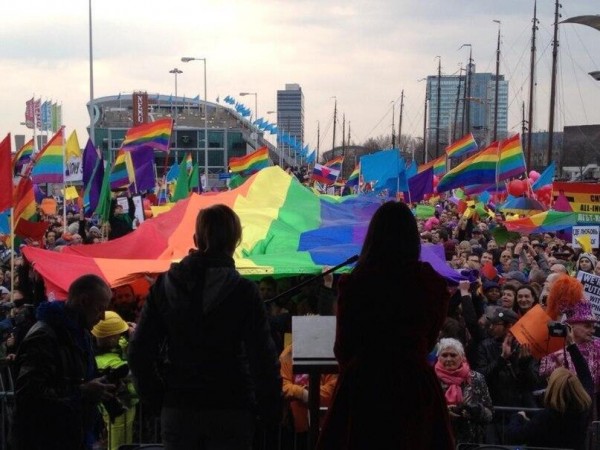
What do you think of the calls to boycott the Olympics? Share your thoughts in the comments below.
This article was originally published on the Urban Times.






This picture is taken at the LGBT protest in Amsterdam last April when president Putin visited the Netherlands for the Russian/Dutch friendship year. The Dutch have said not to boycott the Olympics because they want to keep the dialogue open, whatever that may mean. I’m personally not against a boycott: it’s a way to show Russian leaders how important this issues is to the rest of the world. I’m not sure though whether this would make any difference to the situation in Russia.
[…] Related: LGBT Russians Urge Us Not To Boycott The Sochi Olympics […]