
For the two-thirds of the world that cannot access the Internet, the broadband connectivity arms race between Facebook and Google is providing hope that soon they too may soon be surfing the web. Various reasons prevent people from connecting to the internet where they live – be it censorship, a problem certainly in North Korea and Syria, or a lack of access to the technology necessary to log on, there are still many hindrances preventing worldwide access. But as both tech giants fight for control of the world’s digital spaces, developing countries could see some of these blockades disappear. According to documents released by Facebook, the word’s Internet adoption is growing by less than 9% each year. Both companies agree this is too slow.
Perhaps the most ambitious attempt to conquer the world’s internet deserts, Google’s “Loon Project” plans to connect people via large balloons lofted into the Earth’s stratosphere. But Facebook is not far behind, with plans to deliver internet access via solar powered drone. In hopes of fostering economic development, not to mention billions of new advertising audience members in developing countries, the dream of worldwide net access may soon be delivered.
With teams of world experts in aerospace, engineering, and communications working on either side, you could say Facebook and Google are evenly matched. Google’s efforts, however, have already been tested, and are much further along in the prototype phase than anything yet developed by Zuckerberg.
From its humble beginnings as just another one of Google’s “moonshots”, the Loon project was officially announced in 2013 and initially tested over a swath of remote land in New Zealand. It performed admirably in the first round of tests and was recently launched on another trial run in Brazil.
Each of the balloons are designed to stay up 100 days, or the equivalence of three trips around the globe. Raven Aerostar-designed and manufactured, these specialized Super Pressure Balloons measure about 50 feet wide and 40 feet high. Constantly pressurized both day and night, they soar approximately 12 miles above the ground – far beyond the level at which commercial airliners fly. Each “Loon” has dual automatic air vents, which a pilot at Google Mission Control uses to steer the balloon by controlling its altitude and locating wind currents. According to Google Mission Control the balloons can be made to hover in place as well as successfully guided around the world. Subject to a wide variance in temperatures on it’s journey, the material of the balloon is engineered to be highly durable yet as light as a sandwich wrapper.
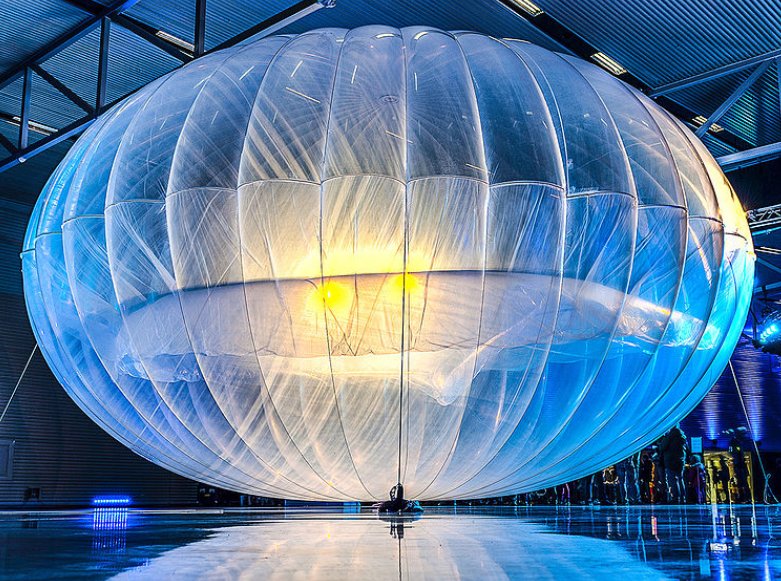
Google Loon. Image Courtesy of Wikimedia.org © 2008
Facebook on the other hand, utilizing it’s new Connectivity Lab to research and test the experimental technology, is looking to drones, lasers and satellites for answers. Their latest initiatives have focused on experimenting with drones that can stay airborne for months at a time, as well as invisible infrared laser beams to make long distance connections speedier. Last year Facebook launched Internet.org, a site devoted to the work of major tech companies as they seek to establish a more egalitarian net-access system. Using more traditional methods, such as making it cheaper and easier to access the Internet on a cell phone, their efforts have already led to 3 million new Internet users.
Google’s balloons and Facebook’s similarly unmanned crafts, inoffensive and unobjectionable though they may seem, are in actuality not much different than their much-maligned drone counterparts. Secrecy is also part of the formula for success here. Google doesn’t share the number of balloons it has launched, and attempts to keep rumors surrounding the Loon Project concealed within the Google X laboratories. With a range of divergent projects currently in development, Google has also reportedly purchased a company specializing in solar-powered drones as well as another firm that makes low-orbit satellites. For these companies a business deal that doubles as an altruistic charitable cause is a smart investment. Not just for their success today, but for their continued presence as a worldwide source of information – and, of course, advertising messages.
However farfetched these ideas might be, they could yield untold good for the third world.
But the social, technological, and economical advancements that could emerge in impoverished communities as a result of Internet access – while still on hold – are not far away. Once established, the Internet could help lay the groundwork for much-needed infrastructure in education and public health, open new marketplaces for businesses, and provide better education for women and the poor. A 2011 study showed that whenever a nation doubles its broadband speed, its economic output increases by .3%. Google and Facebook may have huge financial stakes in their quests to expand into developing countries, but the untold benefits the citizens of these nations stand to gain are worth any price.
About the Author





