
This is the point that those in favour of gun control should keep making. The gun lobby is trying to reframe the debate as a discussion about what causes people to become violent: why do people seem to want to kill people? The answers, we hear from various quarters, range from violent video games, movies or rock songs, inadequate diagnosis and treatment of mental illness, to drugs that induce depression and psychosis as side effects.
Neither side of the debate has covered itself in glory here, with the gun lobby’s disingenuous attempts to blame everything but the guns, and their opponents letting them. You’ll notice in all his interviews with representatives of the pro-gun lobby, available in the links below, Piers Morgan fails to make the point I make above.
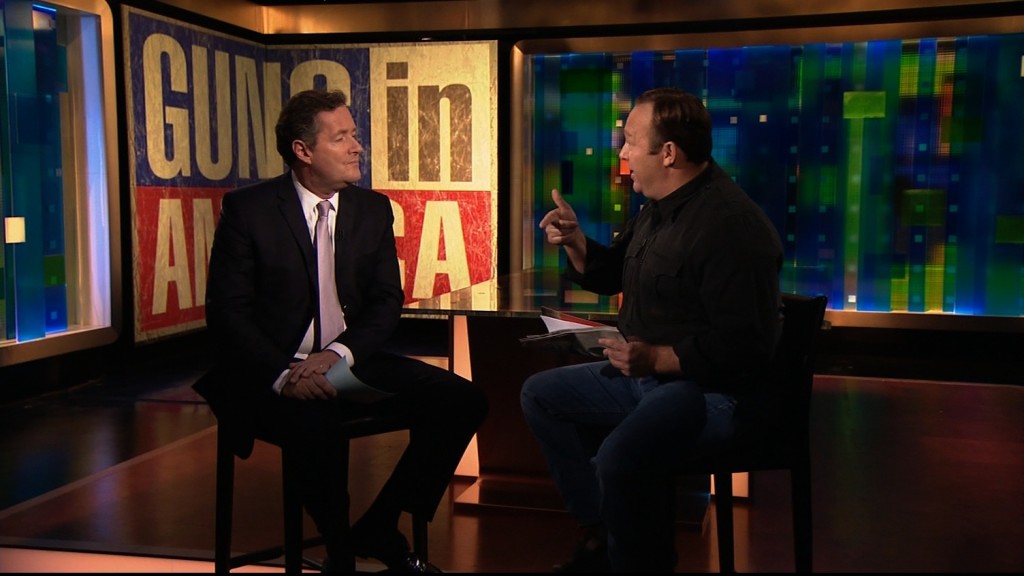
Piers Morgan and Alex Jones debate gun control in the United States
The gun murder rate in the UK is lower than it is in the USA because guns are much harder to obtain. The fact that the UK’s violent crime rate is higher is, if anything, an argument in favour of tighter gun control: if Britain is more violent than America, but its per capita gun murder rate so much lower, then its control laws work.
The gun lobby sometimes says that people can kill other people with knives, too, and that you wouldn’t try to ban them. Actually, some places do: in the UK it is an offence to carry a knife with a three-inch blade in public. More importantly though, knives have a function other than killing: I can cut a steak or butter bread with a knife; I can’t with a gun. Guns are explicitly designed to kill other living things, which is why they are so good at doing so: they do it at range, and automatic weapons with large magazines do it very quickly. None of these things is true of knives, nor of video games, nor music, nor drugs.
Regardless of whether or not these scapegoats make people more violent – and the evidence that they do is limited at best – you wouldn’t pick any of them over a gun if you were contemplating the best tool for killing as many people as possible.
Please let’s stop denying the simple fact: if you want fewer gun murders, gun control works. A person may make the choice to kill others, but if he or she can’t buy an assault rifle from a supermarket, he or she will find it much, much harder.
Postscript: a small cross-section of the gun control debate in the last few months can be seen in the following YouTube videos, which have prompted me to make some of my points above: NRA Chief Executive Wayne LaPierre’s speech in response to the Sandy Hook massacre, Piers Morgan and activist Jesse Ventura on gun control after the Colorado cinema shooting, Morgan’s interview with Larry Pratt, Executive Director of Gun Owners of America, which prompted a petition to deport him by radio host Alex Jones, who Morgan also later interviewed.
About the Author






[…] is mocking the somewhat bizarre attempts to blame the 1999 massacre in Columbine High School on other things, such as violent video games and provocative artists like Marilyn Manson, rather than gun legislation. Since the killers Eric […]