
The world as we know it today is experiencing its peak when it comes to the rights of LGBTQ+ people. With improvements such as constitutional protection, better representation in the media, more coverage of hate crimes and protests (ranging from Pride to suicide), acceptance is becoming a trend.
Just last month, the United States Supreme Court ruled in favor of legalizing same-sex marriage in all fifty states. The announcement was met with worldwide celebration, and the #LoveWins hashtag rapidly spread across social media.
However, not everyone identifying as LGBTQ+ gets airtime, especially not if their lives are in imminent danger. Within Arab populations of North Africa and the Middle East, queer people tend to either be repressed or unheard of, erasing any identity other than heterosexual and cisgender. This erasure pushes many of them to hide in plain sight, confined to a life of secrecy and self-denial.
But now the Arab media has begun to open up to what many consider a deviancy or a Western invention. Famed Lebanese alternative rock band Mashrou’ Leila frontman Hamed Sinno is openly gay, having penned and crooned the song “Shim el Yasmin” (“Smell The Jasmine”), in which he explicitly states his love for another man. My.Kali, Jordan’s first LGBT magazine, published its first issue in 2008. In 2013, Egyptian activists launched a social media campaign to eradicate prejudices on the International Day Against Homophobia, Biphobia and Transphobia (IDAHOT), celebrated worldwide every 17th of May.
![Jordan’s first LGBT magazine [Credit: MY.KALI MAG]](http://archive.the-ipf.com/wp-content/uploads/2015/07/QueerArabs2.jpg)
Jordan’s first LGBT magazine [Credit: MY.KALI MAG]
Though these examples bear some positivity, an overwhelming portion of queer Arabs, notably youths, remain in a state of fear. Since statistics on LGBTQ+ Arabs are practically non-existent due to their invisibility, this article will be relying on the varying experiences of four young queer Arabs who have decided to break their silence: Hawa is a 19-year-old queer Libyan woman, Nuwas is a 22-year-old bisexual Omani man, Kareem is a 17-year-old genderfluid bisexual Palestinian, and Nadia is a 20-year-old lesbian Saudi woman. All four have been at home and abroad, and their names have been changed to protect their identity.
Hawa, 19, has lived in Libya for a large portion of her life and recently moved to North America to begin her university education. She feels that being queer and Arab makes for a huge identity crisis.
“It creates a lot of inner conflict. It’s really traumatic if you don’t have anyone to voice your opinions to. How are you supposed to make those two parts of your identity reconcile? Your emotional and mental wellbeing really suffer, and you find it really hard to assimilate yourself to your culture.”
In Libya, homosexuality generally isn’t accepted. While laws after the 2011 revolution are quite unclear due to the country’s chaotic state, the presence of Islamic extremists and militias has turned homophobic sentiments into murderous rampages. This year, members of the Islamic State in the Libyan city of Derna executed three men accused of homosexuality on the grounds of a local mosque.
After a period of confusion in Libya, Hawa eventually came to terms with her sexuality while living abroad. When she came back for numerous visits to her homeland, her identity became a burden.
“It was never an option to be queer in Libya. I did my best to blend in and act in a way that wouldn’t cause me too much problems because being queer and being in Libya can’t intersect.”
Nuwas, 22, has lived his entire life in Oman, before coming to Europe for university. He states:
“As a child who knew he was not straight, I was homophobic. Growing up Arab, not straight and Muslim, I’ve had to deal with the self-loathing that comes with the race and the sexuality. It has taken close to nine or ten years to sort of fully accept myself.”
According to him, Oman has more of a rule of thumb approach on its queer population.
“It’s frowned upon in public, but if you’re not open with it, people won’t seek you out unless it’s out of revenge, like ‘Oh, I know how to bring this person down’.”
![Graffiti in Ramallah reads “Queers passed through here". [Credit: AL-QAWS]](http://archive.the-ipf.com/wp-content/uploads/2015/07/QueerArabs6.jpg)
Graffiti in Ramallah reads “Queers passed through here”. [Credit: AL-QAWS]
Homosexual activity in Oman, including marriage, is mostly underground due to its illegality. Though the population is well aware of non-straight people’s existence, homophobia runs deep nonetheless. A necessity to conform pushes queer Omanis into self-denial. Nuwas said:
“You’ll have many men who will be involved with other men but consider themselves straight. Funnily enough, there are more non-straight people I know than would like to admit to themselves.”
Kareem, 17, resides in North America. He was assigned the female gender when born to Orthodox Christian Palestinian immigrants. Visits to his country of origin and mingling with Christian Palestinian communities in the West has left him facing difficulties with belonging:
“If you look at me personally, I’m a minority within a minority within a minority within a minority… within a minority. And if you’re a minority complaining about a common enemy oppressing you, why would you do the same to your own people? It’s really hypocritical.”
The common enemy in this case is the state of Israel, where homosexuality and transgenderism are legal. A monument dedicated to gay victims of the Holocaust has been erected in Tel Aviv just last year. The Zionist state has, however, been accused of “pinkwashing”, which is the act of displaying a liberal, gay-friendly image all the while upholding a brutal occupation of Palestinian territories. Kareem confirms this by saying:
“On paper, they’ll say that they are queer friendly, but they’re trying to divert from the fact that they’re committing an ethnic genocide of Palestinians and occupying their land.”
Nadia, 20, currently studying in Europe, has previously lived in Saudi Arabia for ten years. Though her home country is universally known for its government-approved human rights violations, she says the conservative laws somehow aided queer Saudi youth towards self-discovery:
“I think the gender segregation in Saudi makes it so much easier for guys and girls to sort of experiment with each other. A lot of the people I know went through a phase where they had an experience with a person of the same sex, mainly because at a certain age you need to let out this energy, and we had no outlet outside of our girlfriends.”
According to Nadia, finding fellow lesbians in Saudi was easier than in her current Western surroundings.
On the topic of her homeland’s strict laws, she shrugged:
“I think in the eyes of the law, gay people are supposed to be stoned to death or something. You don’t really see anyone do that, cause it’s kind of hard to prove that anyone’s gay.”
![LGBT MENA group contingent getting ready to march in SF Pride Parade 2012. [Credit: LGBT ARAB FACEBOOK PAGE]](http://archive.the-ipf.com/wp-content/uploads/2015/07/529626_417215794983741_2015539894_n.jpg)
LGBT MENA group contingent getting ready to march in SF Pride Parade 2012. [Credit: LGBT ARAB FACEBOOK PAGE]
Though homosexuality grants some degree of invisibility that transgenderism doesn’t, Saudi’s religious police have still managed to arrest people and raid parties based on mere suspicions over the years. However, the country’s strict environment didn’t seem to have much of an effect on Nadia, who never once questioned her lesbianism.
Though being queer isn’t heterogeneous to being Arab, both identities still manage to conflict on many levels. If one were to look past homophobic and/or transphobic laws, the first (and quite obvious) circle of intolerance is the social. Norms and unspoken rules in Arab societies vary by country.
However, the attitudes towards LGBTQ+ people are generally the same. Hawa believes the root of the problem begins with “socially enforced gender roles”:
“A heterosexual Arab man will see a gay man as an insult to the masculinity he’s been brainwashed into. There’s so much work to be done. You have to deconstruct gender roles, you have to dissolve the dominant masculinity in Arab countries.”
Nuwas has noticed a similar issue with Arab hypermasculinity:
“Some guys have this pride which I think is just illogical. Because of their misogyny, anything that is effeminate is of lesser value.”
Another example of gender-based drawbacks in the Arab World is the virtually non-existent recognition for transgender people.
Kareem said:
“I’ve never heard of any advocacy for trans people in my community because for one, there’s no advocacy for gay people to begin with. So if you’re going to get into the more complex things involving gender and sexual orientation, it’s just completely in the dark. Nobody knows about it, let alone advocate for it. It just doesn’t exist. If you bring it up, they’re not going to have it.”
This proves to be a huge problem for Kareem, whose identity is being vehemently erased as his family still refer to him using female pronouns, contrary to his wishes. Family is an additional hurdle for queer Arab youth. Nuwas and Nadia have come out to their immediate family members, who have come to accept their sexuality.
However, Hawa and Kareem are still very reluctant to open up due to their families’ blatant homophobia. Hawa confessed that it wouldn’t be easy for her or her family if they found out about her sexuality:
“If this news makes it to my family, my life will just fall apart. They’re liberal, but still comfortably, openly, loudly homophobic.”
Coming out isn’t on the map for Kareem:
“I’m never, ever planning on doing it. I’d get disowned, and I’d have nowhere to go. They are so violent in their attitudes towards gay people. They’re always talking about how they shouldn’t get rights, they should be castrated, they shouldn’t be allowed to live, they’re not actual human beings… It’s so horrible.”
Hawa was subjected to similar comments from the women she looks up to in her family: her mother and grandmother.
“Hearing them talk like that was awful. Worst feeling in the world.”
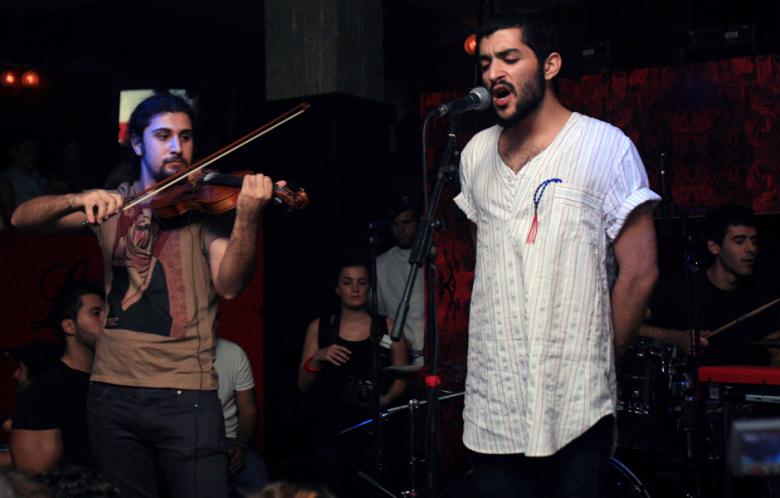
Band Mashrou’ Leila, whose frontman Hamed Sinno is openly gay. [CREDIT: BILAL JAWISH)
Arabs identifying as LGBTQ+ are also faced with a linguistic problem, as the Arabic language generally fails to accommodate the spectrums that are gender and sexuality. Nuwas pointed out that the words “gender” and “sex” are fused into one, which shows a pre-existing lack of nuances. The few words that make distinctions between the different facets of gender and sexuality are usually present in dialects, rendering them unofficial, and also tend to be slurs.
Nevertheless, Hawa notes:
“Linguistically, Arabs don’t have to know the word ‘queer’ to be it.”
Religion is a very sensitive topic when it comes to LGBTQ+ Arab youth. Nuwas and Kareem both chose to continue following the religion they were brought up in.
Kareem, an Orthodox Christian, said:
“I think I’m pretty devoted. I personally don’t believe in a hateful religion. People are flawed, they carry their personal vendettas using holy scriptures. I know my God accepts me. Who is anyone to tell me otherwise?”
Nuwas, having closely studied the Qur’an, describes his take on religion as “neo-Islam”:
“In Oman, we have bars and clubs where alcohol is sold. Alcohol is explicitly mentioned in the Qur’an. We’re fine with people getting drunk, but being gay is frowned upon.
“My atheist and agnostic friends are like ‘Come on, you’re not really Muslim’ and the Muslims are always preaching. So both sides are pulling me in situations I don’t want to be in. I’m happy where I am.”
It is typically assumed that the Western world is a safe haven for queer folk, as many countries have lawfully and socially come to accept the LGBTQ+ community. Nevertheless, other facets of certain queer people’s identities have proved to marginalize them further, even within movements that supposedly welcome any underdog with open arms.
One particular social disadvantage comes to mind regarding LGBTQ+ Arabs: their ethnicity. When Hawa moved to North America, she has embedded herself to her new home’s prominent gay community. She has also, however, felt alienated due to her background:
“A lot of activities and circles run by white LGBTQ+ folk are filled with privileged people.
“For example, there is so much pressure on coming out in the West. I sometimes get questioned about that, and they make it seem like it’s an obligation when that’s a completely privileged way to look at it.
“It should never be an obligation in any context. When we look at coming out of the closet, one should consider what the person is coming out to.”
![Khaled Jarrar’s rainbow mural “Through the Spectrum” painted on the Israeli separation wall near Qalandiya checkpoint in the occupied West Bank. [Credit: KHALED JARRAR]](http://archive.the-ipf.com/wp-content/uploads/2015/07/through_the_spectrum_2.jpg)
Khaled Jarrar’s rainbow mural “Through the Spectrum” painted on the Israeli separation wall near Qalandiya checkpoint in the occupied West Bank. [Credit: KHALED JARRAR]
Nadia has also had a similar issue when it came to a Western girl she was seeing:
“She didn’t want to be with me because I’m Arab. She thought I wouldn’t come out to my parents and that there wasn’t any future to it because of my background.”
In addition to that, many of the subjects have listed issues with representation. According to Kareem, racism will transfer onto predominantly white queer movements:
“There’s a general struggle from queer people. It’s way worse for some of us. There’s an erasure of power dynamics. Obviously white gay people get way more exposure.”
However, Nuwas believes the lack of Arab representation also comes from the danger queer Arabs will face should they decide to step into the spotlight:
“There’s two facets to that. There’s me saying ‘There isn’t enough representation of people of color in the LGBTQ+ community’, but then again the responsibility of being that representation makes me think ‘Well, I socially can’t play that role’.
“So I don’t place the blame on anyone, but I still think it’s wrong that there isn’t someone I can look to in those sort of situations.”
Kareem also went on to condemn the “superiority complex” upheld by Western countries over their Middle Eastern counterparts when it comes to the LGBTQ+ struggle:
“The moment you guys get your act together, the moment that transgender people don’t have a shorter life span, the moment that almost half of trans people don’t try to kill themselves, and the moment that gay people aren’t persecuted and don’t get attacked in North America… When that moment comes, come and talk to me about the Middle East, because it’s really hypocritical.
“Fix your damn self, then come talk to me.”
Furthermore, both Nuwas and Kareem have noted issues within LGBTQ+ movements when it comes to accepting bisexuality. Nuwas pointed out:
“I’ve had people ask ‘How many guys have you dated, and how many girls have you dated?’ and try to extrapolate what I am from that.
“Sexuality in general is a spectrum. It’s not black, white or grey. It varies so much. There are some bisexual people who are more into guys or more into girls. And their history doesn’t define where they are on the spectrum.”
Kareem goes on to add:
“Bisexuality is seen as ‘Hey, you’re half gay, half straight’, not as its own sexual orientation. It’s as if you liked the color grey, and people were to say ‘Oh, so you like half black, half white.’ No, it’s its own color.
“There’s hatred within the queer community towards bisexuals because they’re seen as doing it for attention, like ‘You’re not fully gay, you can’t be part of the movement’, ‘You’re just pretending to be gay’. I heard that a lot.”
Nuwas observes:
“There are so many factors that go into the making of someone’s history. You grow up, and you learn and you understand and you remove people from your life and you have new ones. And none of that defines the innate human condition.”
So what does the future hold for the Arab World’s queer youth?
Despite significant negative experiences, the young subjects do not exhibit strong pessimism vis-à-vis their circumstances. As their futures are laced with uncertainty, Hawa, Nuwas, Kareem and Nadia choose to simply live in the moment and refuse to be defined by the limitations imposed on them.
An important question persists: When will their time come? When will the Arab World accept its own people?
Hawa’s response to these questions were:
“Before queer Arabs can be saved, they need to have a voice.
“They need to be given a platform and be united. Activism produces pressure on social institutions and authority figures.”
LGBTQ+ Arabs may be invisible now, but if globalisation as we know it today helped orchestrate uprisings such as the Arab Spring, they may not remain silent forever. The Middle East and North Africa are known to harbour a youth of notorious unrest. With today’s world wrapping its head around the spectrums that are gender and sexuality, the idea of queer Arabs breaking out of the closet and into their homeland’s open arms may not seem entirely utopian after all.






I am so impressed with the comments of all the participants of this article; their political awareness and critical approach to analysis their identities as well as questioning the popular and much tried narrative of west serving as ‘safe heaven’ for queer folks is just amazing.