
Guided by a security guard, we entered a room with a glass partition dividing the observers from the courtroom filled with red robed judges and black robed lawyers. The defense advisors of the Republic of Srpska’s former president, Radovan Karadžić, turned to watch us enter. To my surprise, our close proximity meant that not only was there just a glass wall to separate us, but also the accused could see us clearly. I made eye contact with Karadžić for a moment, an unnerving feeling passed in knowing I was looking at a man indicted by the International Criminal Tribunal for the Former Yugoslavia with ten charges of genocide.
Originally we were supposed to attend the trial of Ratko Mladic, the Commander of the Bosnian Serb Army, but it had been cancelled due to his illness. From from what I had heard about Mladic, I was lucky to only get a glance from Karadžić during this trial. I had heard stories that during the cases, Mladic would often make obscene gestures at the people watching, including miming slitting their throats.
Update: (12th April): While we were informed during the briefing at the ICTY that Mladic was unable to attend court due to illness, I recently discovered that we were misinformed. According to several articles released April 10, 2013, during the trial in question, Mladic was thrown out of court while forcefully objecting to the testimony of a survivor. Quotes such as “lies…and f**ck your mothers were heard while he was removed from court.
Fortunately for our group, Karadžić, who was representing himself, spoke softly to one of his defense advisors before going back to questioning the witness, the current President of the Serb region in Bosnia, Milorad Dodik. Karadžić’s defense strategy was immediately apparent, as Dodik illustrated that the first attacks in the 1992-95 Bosnian war came about as a defense against a rising Islamic state based on Sharia law and an “alliance of the Muslims”.
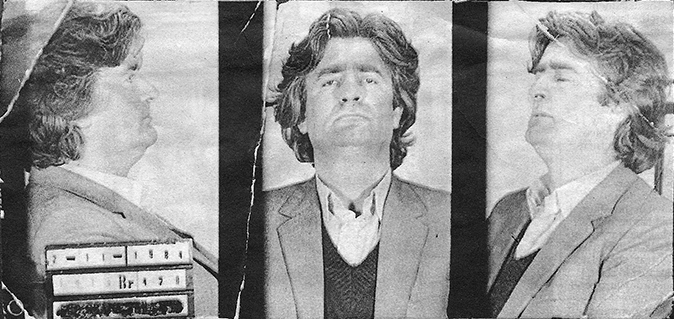
File picture from Bosnian police records show Radovan Karadzic when he was arrested for industrial crimes in November 1984. This photo was recovered in 1992 from a Sarajevo trash bin by Metro photographer Rikard Larma.
Accused due to his involvement with the displacement and genocide of Bosnian Muslims and Bosnian Croats, Karadžić highlighted the tensions between the ethnic groups that continue to this day, and he began asking the witness whether the state of Bosnia-Herzegovina was still in a fragmented condition. However, the prosecution objected the relevance of the question, as the defense tried to highlight that what the people wanted in 1992 was to keep Yugoslavia intact. Throughout the trial, the defense continued attempting to illustrate a Christian majority, with an extremist rising Muslim minority gaining control of the region.
Yet during a briefing with a member of the Outreach program of the ICTY, with 161 people accused and 68 persons convicted, it seems unlikely that Karadžić will find himself amongst free men. Karadžić himself was indicted under charges of genocide, extermination, murder, inhumane acts, and participating in the joint criminal enterprise to eliminate the Bosnian Muslims in Srebrenica by killing the men and boys while forcibly removing the women and children, among other charges. During the trial, the widows and mothers of those men were in attendance. They scoffed at his claims of a rising Muslim minority against the government. At one point I watched as one woman hung her head down in despair. According to an interview I observed them conducting with the Associated Press, one woman said that “Dodik was the extended hand” of Karadžić, and that Dodik’s participation in his defense was not a surprise due to Dodik’s denial of the genocide.
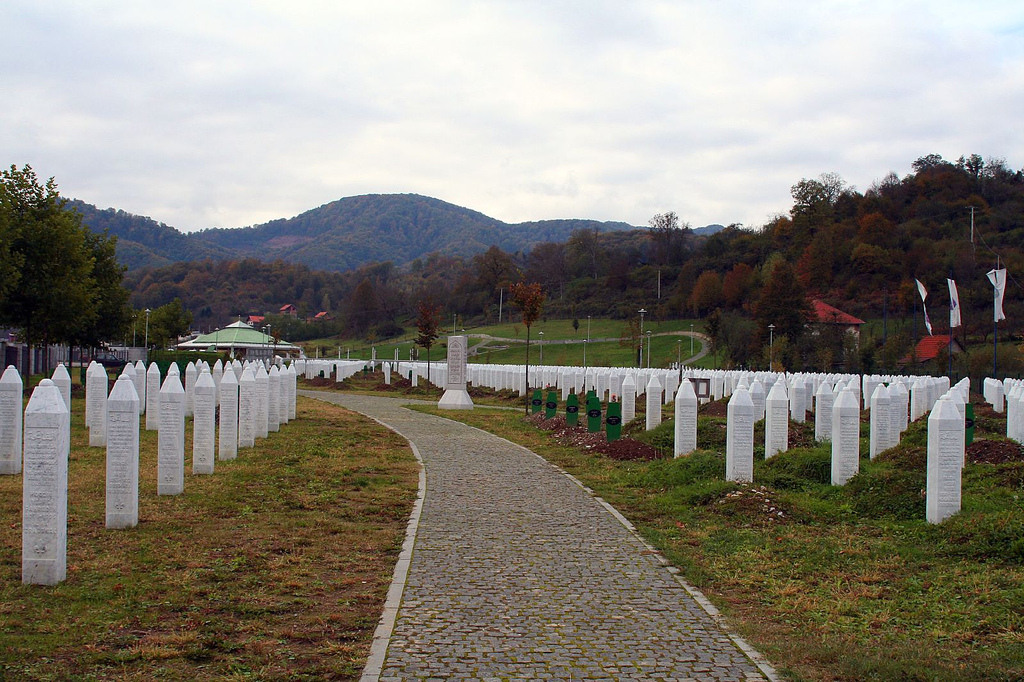
A tribute to the victims of the Srebrenica Massacre. In 2010, Dodik stated during a speech at a military cemetery near this spot that: “If a genocide happened then it was committed against Serb people of this region where women, children and the elderly were killed en masse”. Image Credit: Kathleen Franklin/Flickr
A member of the ICTY Outreach program noted, acknowledging the atrocities by all sides during the Bosnian war is even more important today. As time passes and knowledge of the events are lost, it is easier for the generations born after the war to see themselves as the sole victims. Unfortunately, in purposefully forgetting the atrocities (such as those in Srebrenica) in an attempt to rewrite history, it is damaging the progress made by programs such as ICTY’s Outreach. Outreach which tries to reach out to the youth in the former Yugoslavia as well as give a voice to the victims can only work as long as the trials within the ICTY go on. But as the graying widows of Srebrenica grow older, and as Serb, Bosnian and Croat children are raised with biased second-hand knowledge of the war, will old tensions rise again?
You may also be interested in reading Serbia: Made in Yugoslavia, a first hand account of the struggles of life in Serbia today.
About the Author






You are wrong on one account. Karadzic is going to walk free. He has been in control of this event since the beginning. Neither the court nor the prosecution realize at this point how it is going to turn out. And only after months are they going to realize how brilliant his every move has been. It is only a few months until the verdict is made. The prosecution has been denied their entire strategy for the past few months and they are now left ‘scrambling to collect themselves’ in order to still try and make a case of their key arguments. Meanwhile Karadzic is mocking the court by filing motions that are only meant to humiliate them. He is saying “when you have convicted me, are you going to sentence me right away or in a different hearing?” And they are like “yeah buddy, we will pass sentence over you immediately, you hear us!!” And he is just laughing in his fist. The fools. It is like saying to a child “and when you have achieved your request in not wanting to go to school anymore, are you going to sleep late every day or will you help with the dishes?” And the child seriously responds to this question, all the while the parent is laughing about its naivety. The parent knows this outcome is never going to be realized.
And so does mister Radovan Karadžić.