
The second round of Presidential elections in Afghanistan has brought a lot of issues to the forefront as Election Day, 14 June, approached. This election marked the first time for Afghans to witness a democratic change of power, even as they faced a proactive resurgence of Taliban violence against voters, election and government headquarters.
Violence, perpetuated by the Taliban, has not swayed many voters to reject the transitional change of state power or not cast their vote. It is reported that over 50%, roughly 7 million Afghans voted in the first cycle, though it was marked inconclusive as no candidate could secure 50% of the democratic vote. It appears that even in the face of violence, voters would risk their personal security in revolt against the Taliban. As the day drew near, Afghan voters and people around the world expected a surge in violence and violence-related news in respect to the election.
These are crucial times in Afghanistan’s unstable transition as a democratic nation. As US troops have pulled out over the year, the Taliban are more eager to thwart the idea of a democratic Afghanistan, but have failed to do so up to this point. Their consistent attacks on citizens and government buildings only seems to encourage Afghans to risk their lives to ensure the future of a safe and terror-free state. The lengths some have gone to, and again went to on Saturday for a second time, marks the perseverance of hope in a transitioning democracy.
Although voters must still worry over the government corruption and election fraud that has plagued the transition, including the issue of polling stations not being open at all and the almost 3,000 individuals who were fired for misconduct or fraud related charges. This is a major issue of the election, as corruption affects so much of the public and private sphere, making it an arduous task to undertake by the upcoming President elect. The two primary candidates, out of an original 16 are Abdullah Abdullah and Ashraf Ghani, formerly foreign and finance ministers, respectfully. Abdullah has been generally viewed as the frontrunner, making the massive issue of corruption a primary concern to tackle, should he win the Presidency.
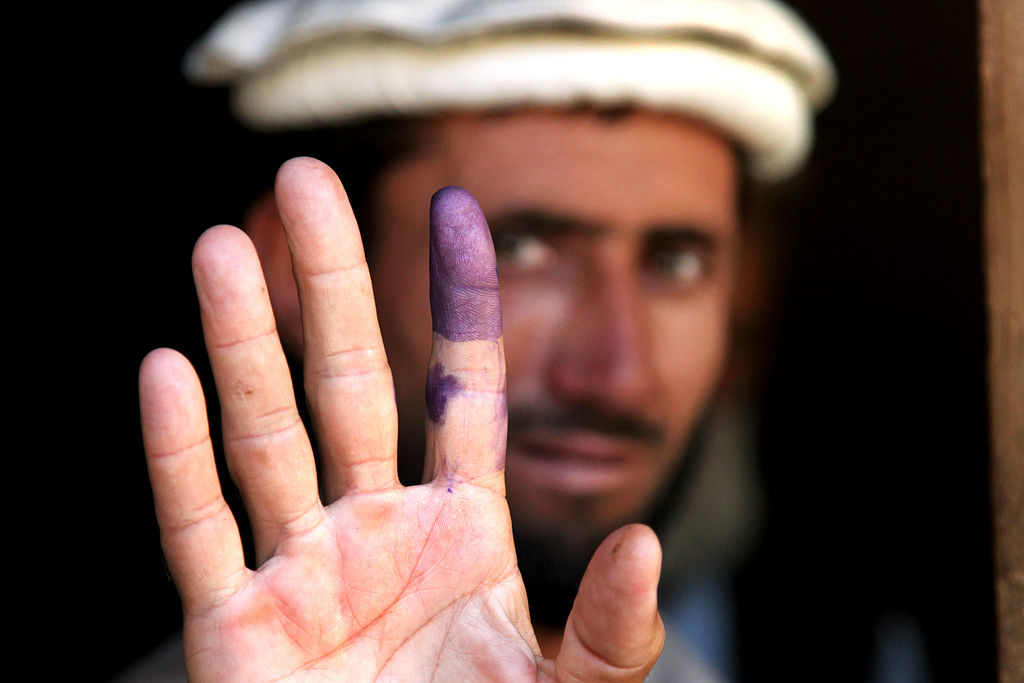
An Afghan man showing his inked finger, which was part of the procedure to prevent people from voting twice. Image credit: U.S. federal government
Both candidates appear willing to establish a conducive relationship with the US and the rest of the international community in an attempt to diminish security concerns with the Taliban and the weed-like problem of corruption. Current President Karzai, is at center of many of these issues that has tarnished the transition to democracy and has not cared for a continuing relationship with the US. Although the US has provided much assistance during his term as President, including a hefty bailout during an economic scandal that vividly showed the lengths of corruption.
The significance of both candidates willing to sign bilateral agreements with the US, shows the continuing importance of the US’s role in a transitioning Afghanistan. Both candidates seem to agree that as US involvement diminishes the result will most likely lead to a Taliban wave of insecurity. President Karzai has begun peace talks with the Taliban, which seems to be more of an appearance formality than for anything substantial to come out of it, which both Abdullah or Ghani will continue in an effort to secure control.
Regardless of the results, the President elect will have many issues that require extensive attention, particularly with regards to finance and security. The transition is a very unsteady one towards democracy and this second run-off election will hopefully resolve the issues surrounding the voter fraud and misconduct of the first cycle. While citizens risk everything, they are showing the government and the international community they are willing to place a vast amount of faith in this election, in which progress is possible.






[…] East, elections have had to deal with much more issues than other democratised elections this year. Afghanistan was just one of the countries that ran into issues trying to hold its first democratic election. […]