
When you think of what you need to survive, what comes to mind? Food? Air? Water? Facebook? As renowned survivalist Bear Grylls stated in an interview with GQ magazine last year, the key is in the rule of three. Without food a human can survive for about three weeks, without water around three days, without air around three minutes and without Facebook…well, obviously there is life after Facebook. Though I know many who would contend that notion.
If I were to ask you what percentage of the human body was water, you’d likely be able to give me the correct answer with ease. One of the first things you learn in biology class at school (besides the fact that the life-sized anatomical human skeleton model is not a toy) is that water is the main constituent of the body making up around two-thirds (60-70%) of our body weight. It is the bloodline of the planet. From it springs forth life and sustenance for every living organism on Earth, and without it we’d be little more than a withered husk. So with March 22nd being World Water Day, it seemed only natural to take time to pay homage to this indispensable resource.
Running copiously from our taps, it can be all too easy to take water for granted. However, as the population grows and industry continues to expand, the planet’s freshwater reserves are being dangerously stretched with a clear disparity in water consumption between affluent and less-developed countries.
With water being a requirement not only for human life and dignity but for agriculture and irrigation, community welfare and economic development, and ecological preservation, it is vital that there is a buck in the widespread trend of water commodisation, mismanagement and exploitation – particularly prone in developing countries.
Environmental activist and anti-globalization author, Vandana Shiva, has written with fervour and accuracy on the area of water privatisation. In her book “Water Wars”, a crucial piece of work which manages to grasp the global manipulation of water, she said:
“We cannot survive as a species if greed is privileged and protected and the economics of the greedy set the rules for how we live and die.”
Poignant and painfully precise words. Ms Shiva also goes on to state how, in 1998, 28 countries experienced water stress or scarcity, with this number expected to rise to 56 by 2025. According to the UNDESA’s (United Nations Department of Economic and Social Affairs) Water For Life information, around 700 million people in 43 countries suffer today from water scarcity. Worryingly, though, is the fact that whilst this can be attributed to natural phenomenon, it is also largely a human-made problem.
As Joel Cohen of Rockefeller University pointed out in his article in the New York Times in October 2011, we have more than enough food, water and other essentials to keep every one of the 7 billion — and far more — fit and healthy. The crux of the issue lies in the distribution of such resources and as UNDESA points out, water is “distributed unevenly” with “too much of it is wasted, polluted and unsustainably managed.”
“Everyone has the right to clean and accessible water, adequate for the health and well-being of the individual and family, and no one shall be deprived of such access or quality of water due to individual economic circumstance.”
This is an excerpt taken from “Article 31: The Right to Clean and Accessible Water”. Steven Starr, producer of Flow: For the Love Of Water, a film on stopping water privatisation in the developing world, is gathering a proposal for the addition of Article 31 into the Universal Declaration of Human Rights in order to address the global water problems. The video below shows him presenting the petition to add an Article 31, The Right To Water, on the 60th Anniversary of the Universal Declaration of Human Rights.
The task of tackling the issue of water management and scarcity is on-going, incorporating issues such as contamination, the provision of clean water supply (which has seen technological advances such as water producing billboards), the the role of women in effective and sustainable water management, and the understanding of the impact of such gender relations in developing countries.
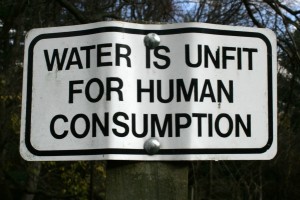
Source: Flickr/woodlywonderworks
With 2013 designated as International Year of Water Cooperation by the United Nations, we can all make sure we do our part and ensure our cooperation in order to strike a balance between the different needs and priorities of those around the world and to share this precious resource equitably. Then, perhaps, we can see the slogan created by Indian contest winner, Megha Kumar, become a reality, ”Water, water everywhere, only if we share”.
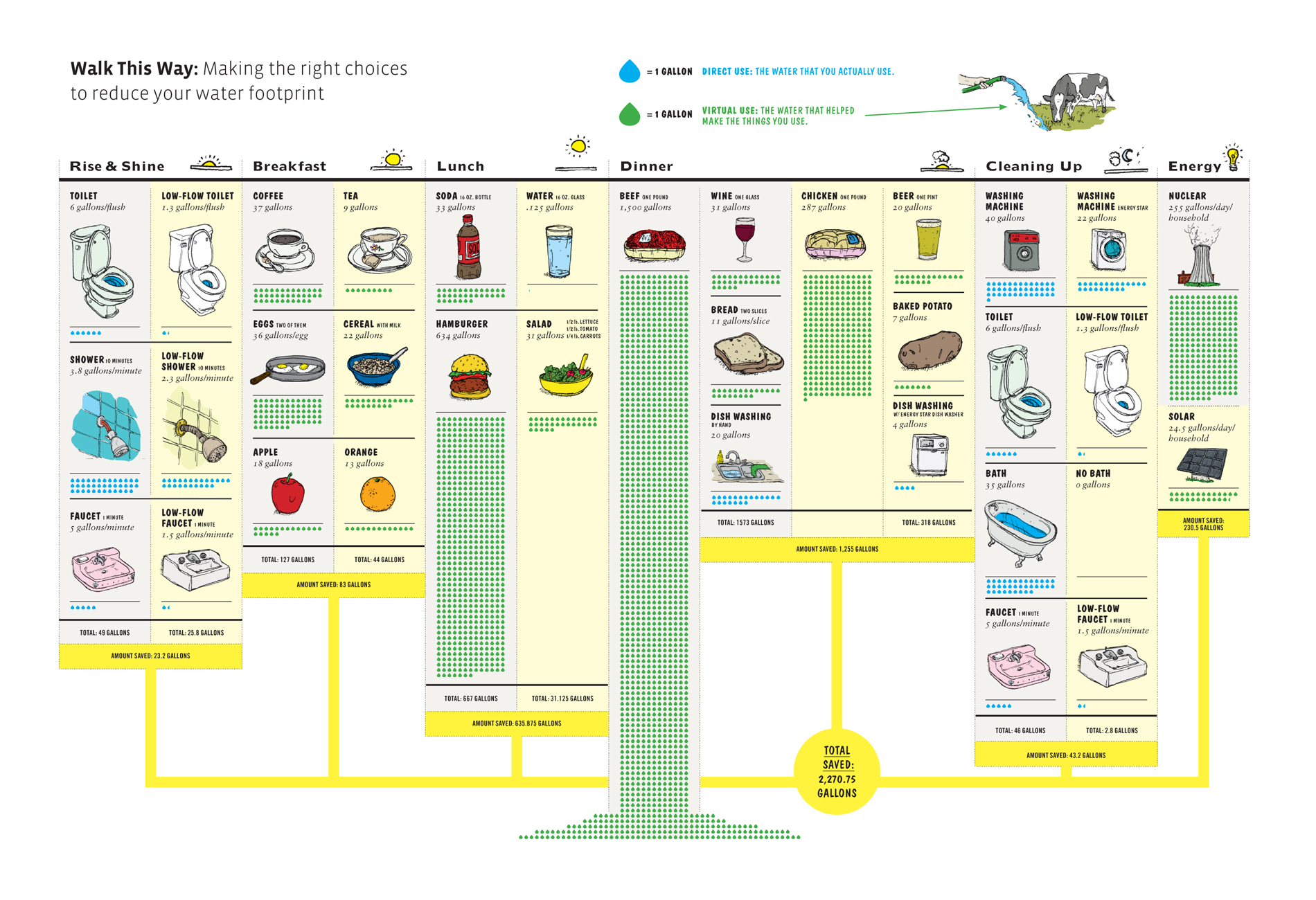
The infographic below, designed by Good Transparency, shows the water footprint of daily life and simple changes we can make to reduce our water consumption.
This article was written by Angela Yussuff and originally appeared on the Urban Times.
About the Author






[…] The UN General Assembly officially recognized the human right to water and sanitation only in 2010. Before and after, there have been a slew of organisations, programmes, cooperative frameworks and global forums, many of which are guided by the UN in their aims to spread awareness, promote education and research, encourage cooperation and legal agreements. The International Hydrological Programme, including the From Potential Conflict to Cooperation Potential, The World Water Council, the Global Water Forum, and UN-Water are just a few examples. The UN-Water declared 2013 to be the International Year of Water Cooperation, an initiative aimed at raising awareness through a series of events throughout the year under the slogan “Water, water everywhere only if we share”. […]