
As an article on IPF outlined a few weeks ago, things seem to be moving in Catalonia, a region in north-eastern Spain. After almost four decades as an autonomous community, more and more people have taken to the streets to demand full independence. Support for this option among the Catalan population is at an all-time high, and the leaders of Convergence and Union (CiU), currently in government, have made plans for an independence referendum to take place in 2014. After a quick succession of unpredictable changes in recent months, it would seem that the impossible may soon become inevitable – independence, for the first time in decades, appears to be a real option now. However, a closer look at the situation suggests that the proposed referendum is unlikely to take place at all. Here are the 4 reasons why:
1: The European Union’s reaction to the possibility of a referendum has been lukewarm at best. In fact, more recent statements by EU officials suggest that a newly-independent Catalonia would be ejected from the institution, and forced to re-apply for membership. This greatly damages the position of the pro-independence movement, for two reasons: firstly, the parties that are currently pushing for a referendum are also enthusiastic supporters of the European Union, and have made it clear that they want an independent Catalonia to be a leading member of this body. Being rejected by an institution which they respect so deeply would be a tough blow. Secondly, the economic situation of a Catalonia outside of both Spain and the EU would be dramatic. Not only would the region have high levels of unemployment and public debt, but it would also have to decide whether to keep using the Euro or to set up a new currency of little international value.
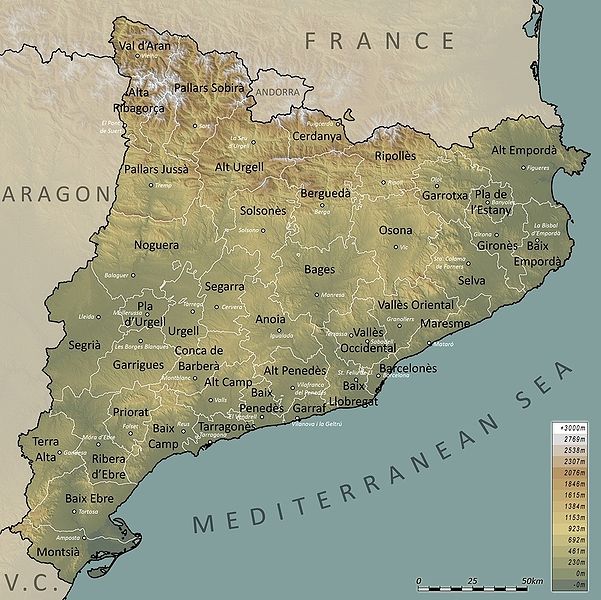
Regional map of Catalonia. Image credit: Hansen
2: Catalonia is in the midst of a social earthquake, and this is having a profound effect on its political environment. The largest party, currently in government -CiU- has traditionally been a consensus-seeking force, not openly pro-independence but never rejecting that option either. As such, it has two main sources of votes: those who are in favour of independence and want a referendum as soon as possible, and those who are Catalan nationalists, but do not want to break apart from Spain. The second largest party – Republican Left of Catalonia (ERC) – has always been explicitly in favour of independence, and as such attracts the more assertive, rebellious nationalists.
The problem is that CiU, which usually had no problems dealing with the central government in Madrid and reaching a consensus over most issues, is now the force calling for a unilateral referendum. This is so unlike CiU’s nature that many Catalans have become sceptical. What we are seeing now, according to most polls, is that those voters who are in favour of a referendum are increasingly supporting ERC, whereas CiU is left with more moderate nationalists as its main support base. Soon enough, the CiU leadership may realise that most of its supporters are not pro-independence at all, and have to re-think its strategy. Therefore, it seems that the main driving force behind the independence referendum is standing on ideological quicksand.
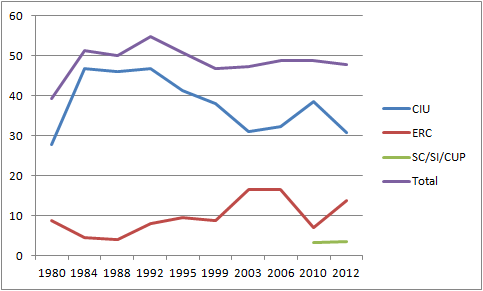
Votes won by ERC roughly equal votes lost by CiU. Credit: Politikon
3: Catalonia is simply too important to be let go. If we look at current events in the United Kingdom, we can see that the central government is not overly worried about the Scottish referendum. In terms of population and economy, Scotland is not hugely important to Britain today. The British Conservative Party might be particularly tempted to allow independence because of its dreadful election results in Scotland. With Catalonia, however, the situation is very different. This region is one of the economic powerhouses of Spain. For better or worse, Catalans are known to be excellent entrepreneurs, and that is just what Spain needs to get out of the economic crisis. Furthermore, the People’s Party (PP) – currently in government in Spain – bases much of its philosophy on the protection of Spanish unity. For them to allow a potential independence referendum on Spanish soil would be like a Green Party embracing fossil fuels: a political suicide. Thus, while there may be reasons for London to let go of Scotland, Madrid has every incentive not to allow Catalonia to leave.
4: The current Spanish government has discovered the power of doing nothing. When faced with the deepest crisis Spain has seen since the 1950s, the government has done little to alter the country’s economic structures. When faced with a never-ending flow of corruption cases, the government has done nothing to encourage openness. Now that it is faced with a strong challenge from Catalonia, it has also failed to respond. Unfortunately for the Catalans, this seems like a winning strategy. The Spanish Constitution forbids unilateral referenda, the economic situation in Spain is likely to improve within the next year – thus decreasing unrest in Catalonia – and the push for a referendum may soon start to lose momentum. In this case, time is on the side of the Spanish government: they may well be able to ignore the problem for long enough for it to stop being a pressing concern.
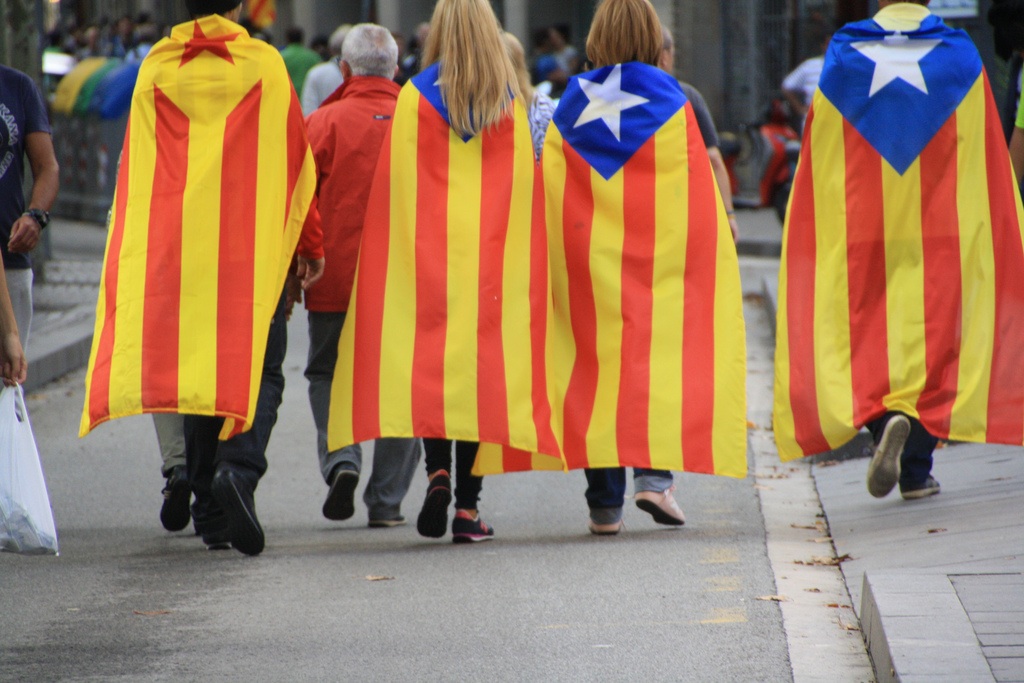
Independence Day. Barcelona, 11th September 2013.
It is hard to deny the importance of the independence topic in Catalonia today. Civil society has awakened and made the referendum debate an unavoidable part of Spanish politics – this is in itself an impressive achievement. The probability of there being a referendum, however, is slim. Catalan parties stand on unstable ground, Spanish law supports the current government’s do-nothing approach, and the European Union seems unwilling to openly support the referendum process. Because of this, and despite calls for a popular vote sometime in 2014, you should expect no such thing. Like most other problems in modern-day Spain, the issue of Catalan independence is likely to be swept under the carpet.
About the Author






Mr. Cabanillas, I understand the opinion expressed in your article, but then, you are spanish. Catalonians think differently, ther will be a call to vote on the 9th of november 2014.
Actually, I come from a Catalan-speaking region that many consider to be part of Catalonia. And I would be delighted to see an independence referendum in November, but I just can’t see it happening unfortunately.
Earlier this week the issue was debated at the Spanish Parliament. It once again became clear that the current government intends to see this one out, and ignore the problem until it is forgotten. Since it is the central government that has the final say in these issues, they are likely to win the battle.
This article is a nonsense. Catalonia canot continue forming part of Spain. There is no way and we will not permit to them to give their opinion for us. The spanish goverment had benn promoting the xenophobia during more than a century andf it is time to end this situation. Anglea Merkel is also colaborating with the spanish fasccism.