
On Saturday 12th another car bomb exploded in the Iraqi city of Samarra killing at least 14. Civilians, and more recently school children, have been deliberately targeted in attacks. The fact that the car bomb exploded in a shopping street underscores the scrupulousness and blind violence of the militants. Some 6,000 civilian deaths have already been counted for this year, with the trend pointing upwards. But what are the reasons for this new spike in violence and murder? Are the problems house-made political mistakes, spillover from the Syrian conflict or irreconcilable ethnic divisions?
Let us look at these possible explanations in reverse order. First, there is the possibility that the divide between Sunni and Shia Muslims has grown so wide that it is impossible to bridge. Under Saddam Hussein’s rule Sunnis formed a big part of the ruling elite. But after the removal of all Saddam supporters from civil service (known as ‘de-Baathification’) Sunnis now find themselves in a position where they have to share power with Shia Muslims, secularists and Kurds. Most importantly, Shia Muslims have taken over the army and security forces. This gives some Sunnis a reason to take up arms and fight back violently.
But, bomb attacks and civilian targeting are methods of minority militant groups and do not represent the whole of the Sunni population. There is no evidence for the assumption that civilians are targeting other civilians. The biggest part of the population remains peaceful, despite daily bombings and suicide attacks. In fact what we see in Iraq is a fight between security forces and extremist militants, mostly Sunni organisations like Al-Qaeda or Al-Nusra splinter groups. It is not a situation about to escalate into a civil war if the government refrains from using the security forces to fight Sunnis.
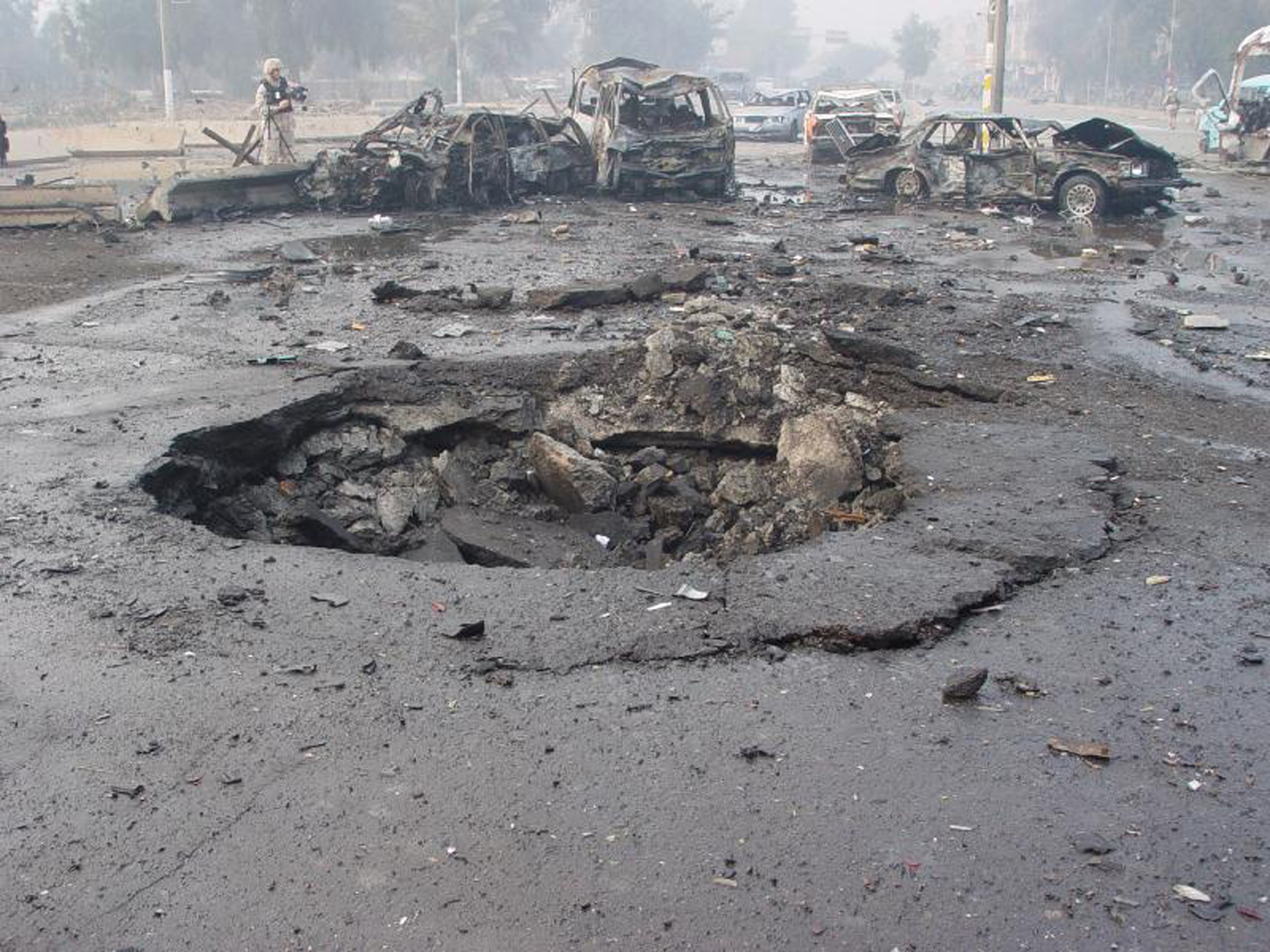
Car bombing, Baghdad. Image credit: Jim Gordon
Second, the Iraqi government explains the recent intensification of attacks by pointing to the next-door conflict in Syria. Rebels in Syria are mostly Sunnis fighting a combination of Alawites and Shia Muslims loyal to Assad’s regime. Some Iraqis have gone to support the rebels’ cause in Syria. So, Sunni militants feel encouraged by the Syrian rebels’ continuing resistance against an overwhelming military force. If they can do it, why shouldn’t Iraqi Sunnis?
http://www.youtube.com/watch?v=O26ZEp_fZCw
While this certainly is the case (and provides yet another reason to find a resolution to the Syria conflict), this does not illuminate the origins of attacks in Iraq. It does explain why attacks have become more numerous and lethal since the civil war in Syria broke out. It does not, however, explore the underlying problems which have led to dissatisfaction in the first place.
.jpg)
To find the root causes for discontent one has to look at internal factors, such as political mistakes and confrontational rather than conciliatory politics.
After months of deadlock following inconclusive elections in 2010, Nouri al-Maliki, a Shiite, was sworn in as Prime Minister. Since the very start his national unity government, composed of Shia, Sunnis, secularists and Kurds, has been marked by fragility and distrust. Government posts were handed out according to ethnic origin rather than democratic mandate or merit. It was a matter of time before this shaky coalition would break apart. It happened when al-Maliki issued an arrest warrant for his Deputy Prime Minister, Tariq al-Hashemi, a leading Sunni politician, on the grounds that he maintained death squads, which plan attacks on civilians. While Al-Hashemi fled, condemning the warrant as politically motivated, al-Maliki was centralising power in his office to crack down on Sunni militant cells.
In this counter-offensive the security forces have become more violent themselves. In the past week, 42 militants were sentenced to death and hanged. The government fears that if a Sunni leadership takes over in Syria, it will sponsor Sunni militants in Iraq. This is one of the main rationales for their attempt to eradicate the insurgency. But such state-sanctioned violence will only increase the militants’ motivation to fight back and most probably it will help them recruit new members. How is it possible to fight violence with violence?
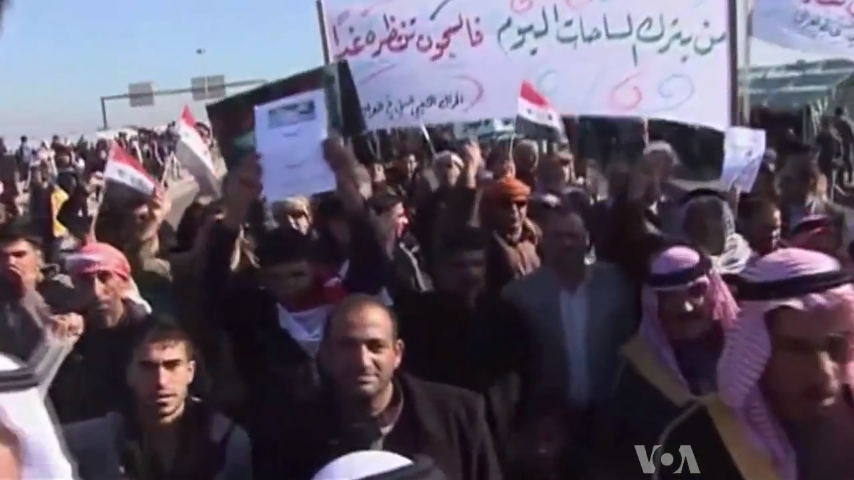
Iraqi Sunni demonstrators protesting against the Maliki led government. Image credit: Voice of America News: Selah Hennessy reporting from London, UK.
It is time to fight back against the insurgents with other means. Development is one major antidote to sectarian confrontations. It will lower unemployment, which will give young men (and hopefully women) a chance to lead a dignified life rather than joining militant cells out of lack of prospects. Iraq should also create a body modeled on the South African Truth and Reconciliation Commission to lay bare sectarian violence and provide a talking forum for all parties. Over ten years after the U.S.-led invasion, Iraq is still struggling to restore peace and become the democracy it aspires to be according to its Constitution. The means to achieve these ends will, most definitely, not be more violence.
But is al-Maliki the man to trust in this decisive period? Earlier this year, he faced down protests calling for his resignation by using the security forces. In January, the military opened fire on protesters, killing 4 and wounding over 40. This episode and the increased use of the death penalty are examples that may raise questions about al-Maliki’s violent strategy, when in fact, he should be promoting peaceful measures.
About the Author





