
The Middle East has always been home to vibrant Jewish communities, whose history in the region dates back more than 3,000 years. Despite occasional bouts of tension, Jews were generally permitted to practice their religion peacefully alongside the Muslim majorities and formed a vital part of the social fabric of the countries in which they lived. The creation of the state of Israel in 1948, however, dramatically changed this picture. The perpetual state of warfare between Israel and its Arab neighbours from 1948 onwards caused many Arab governments to view their Jewish citizens with suspicion at best and outright hostility at worst. Suddenly made to feel like strangers in their own homes, thousands of Middle Eastern Jews left their native countries for Israel, some in search of a better life in the new Jewish state, others forcibly expelled by their governments. From a population of over one million spread across Morocco, Algeria, Tunisia, Egypt, Iraq, Yemen and other places, today the historic Jewish communities in these countries have all but disappeared.
The one striking exception to this trend is Iran. While many Iranian Jews have emigrated to Israel over the years, a substantial number have opted to stay in their homeland. Estimates place the size of the Jewish community in Iran around 25,000, making it the largest Jewish community in the Middle East outside of Israel.
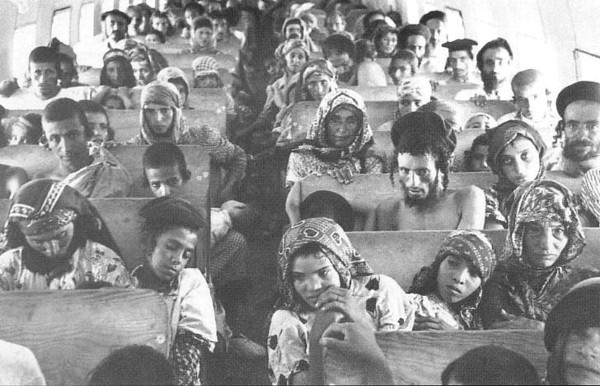
In the course of the operation “Magic Carpet” (1949-1950), the entire community of Yemenite Jews (called Teimanim, about 49,000) immigrated to Israel. Most of them had never seen an airplane before, but they believed in the Biblical prophecy: according to the Book of Isaiah (40:31), God promised to return children of Israel to Zion “on wings of eagles”. Image credit: Humus sapiens
On the one hand, the existence of this community is not surprising since Israel’s military confrontations have been primarily with the Arab states, of which Iran is not one. On the other hand, ever since the Islamic Revolution of 1979 Iran has been one of the most vocal critics of Israel in the region. Former President Mahmoud Ahmadinejad was known for his inflammatory diatribes against Israel, as well as for denying the Holocaust. Given the Islamic Republic’s clear stance against Israel and Zionism, it would not be unreasonable to expect this rhetoric to spill over into discrimination against Iran’s Jewish citizens.
But instead, the Iranian government has been careful to draw a distinction between Zionism and Judaism. Shortly after the 1979 Revolution, Ayatollah Khomeini declared that Jews would be a protected minority in the Islamic Republic. The Iranian constitution officially recognises the Jewish religion and guarantees its adherents a seat in parliament. Tehran is home to many synagogues, Hebrew schools, and even a Jewish hospital, and Iranian Jews are permitted to travel to Israel to visit their families. This is not to say that their situation is perfect; Jews are excluded from high posts in the military and judiciary and are not permitted to close their schools on the Sabbath. Yet, astoundingly, they have resisted some very strong inducements to move to Israel. A few years ago, a fund established by wealthy expatriate Jews offered Iranians cash incentives of up to £30,000 per family to encourage their emigration to Israel, but the offer was met with overwhelming rejection. On the whole, Jews seem to be proud Iranians who are comfortable practising their religion in their home country.
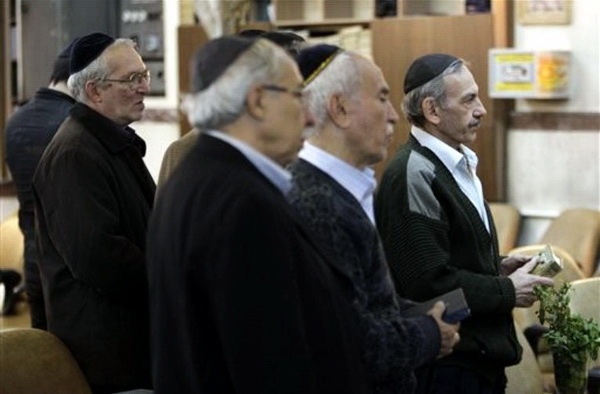
Iranian Jewish men attend Hanukkah celebrations at the Yousefabad Synagogue, in Tehran, Iran, Monday, Dec. 26, 2011. Iran’s population of 75 millions includes about 20,000 Jews, the largest community in the Middle East outside Israel, and they face no restriction on their religious practice, though they must follow Islamic dress codes such as head scarves for women. They have one Jewish representative in the parliament under the constitution. Image credit: AP Vahid Salemi
In the West, Iran is not exactly known for its religious freedom. Given the antagonistic relationship between Iran and the US over the former’s nuclear programme, media coverage of Iranian politics is usually overwhelmingly negative. A 2013 report by the US Commission on International Religious Freedom designated Iran a “Country of Particular Concern,” and media reports like this one often castigate Iran for its poor human rights record when it comes to religious freedom. Hardliners in Washington and Tel Aviv are keen to portray Iran as an anti-Semitic, oppressive dictatorship on par with Nazi Germany, determined to annihilate Israel and bring down peace and stability in the Middle East. Evidence of Iran’s internal persecution of religious minorities adds fuel to this interpretation and helps to justify pre-emptive military action against Iran.
To be sure, Iran does not have a clean record when it comes to religious freedom. State protection like that afforded to the Jews only extends to officially recognised religions. Meanwhile, Iran’s Baha’i community, considered heretical by the Shi’a religious establishment, has been subjected to a long and bloody history of harassment, imprisonment and marginalisation. Even the officially recognised religions are only protected within certain limits, and Christians are frequently arrested on charges of evangelism, apostasy, or for threatening national security. But to call Iran anti-Semitic is surely taking it too far. The existence of such a large and comfortable Jewish community in the country, unique in the Middle East, gives lie to this interpretation. Despite his fervent criticism of Israel, Ahmadinejad never actually called for the destruction of the Jews or even of the state of Israel itself: his comments calling for Israel to be “wiped off the map” were famously mistranslated and his policy stance towards Israel could be more accurately described as regime change.
What is more, the recent election of President Hassan Rouhani brings hope for genuine reform in the country, not least in the domain of religious freedom. In a significant departure from the policies of his predecessor, Rouhani has officially recognised the Holocaust, calling it a “reprehensible and condemnable [crime].” In another unexpected move, his official Twitter account tweeted Rosh Hashanah greetings to Iranian Jews last month, a move that was duplicated by foreign minister Javad Zarif. Rouhani also chose Iran’s only Jewish member of parliament to accompany him to the UN General Assembly in New York, and in the run-up to the assembly he released scores of political prisoners including two Christian converts from Islam accused of apostasy. Some commentators have emphasised that real action to improve the situation of Iran’s disadvantaged religious minorities, especially the Baha’i, will be the true test of Rouhani’s commitment to reform. But if relations between Iran and the West are to be given a fresh start, both sides must be willing to compromise. US policymakers must stop viewing Iran as the incarnation of all that is evil, and cease with the misguided comparisons to Nazi Germany. Portraying Iran as anti-Semitic is not only inaccurate, but deeply damaging to the higher goal of Middle East peace which should be a priority for both governments.
About the Author






A breath of fresh air and encouragement for more of us to turn to face the light. Peace on Earth is inevitable.
Really good article, on a topic that is, unfortunatly, rarely touched on.
Firstly however, despite Ahmadinejad’s words being mistranslated, the concept that “the regime occupying Jerusalem must vanish from the page of time” is pretty similar to the idea of wiping IsSrael from the map. It is purely, in my opinion, a matter of sematics.
Also, the assumption that Rouhani is a breath of fresh air, who is a positive figure in terms of the Jewish population, and indeed as a figure who can curb the tensions between Iran and the wider world, are sadly false. Rouhani was the head of the Iranian Supreme National Security Council in the 1980s and 1990s and under his reign, Iranians murdered 85 people at the Jewish Community Center in Buenos Aires.
Even more so, in terms of Iranian nuclear capabilty, in his book about his time as Iran’s chief nuclear negotiator he stated that “While we were talking to the Europeans in Tehran, we were installing equipment in Isfahan” (the facility where uranium ore called yellowcake is converted into an enrichable form) and he claimed that “by creating a calm environment, we were able to complete the work in Isfahan.”
With Rouhani at the helm, I hate to say, I don’t think peace on earth is attainble.
I’m an Iranian Jew. I think the author of this article is a little naive. Firstly about 90% of Iranian Jews have left for Israel and some Los Angeles. The Jews remaining in Iran are an older generation that will surely die out soon. I personally don’t have any relatives that still live in Iran. Secondly, statements by Jews in Iran are worthless because the country does not have free speech. To what I hear the few Jews left in Iran are afraid for their safety and many of them keep their Jewish identity a secret.
Thank you all for your comments. First, on the issue of Ahmadinejad’s words being mistranslated, I disagree that this is merely a matter of semantics. I think it is important not to conflate criticism of the occupation with a military threat to Israel’s existence or to equate the latter with anti-Semitism. Ahmadinejad has never threatened war on Israel and he has clarified in more recent interviews his view that a referendum should be held to determine type of government in the Palestinian territories.
I do however agree that we must be cautious about singing Rouhani’s praises too early on in his presidency. While he has made some promising moves and expectations are high, I think we really have to wait for his rhetoric to translate into concrete actions before drawing conclusions, not least when it comes to issues of religious freedom and civil and political rights in Iran more generally.
Mike, you are absolutely correct that the majority of Iran’s Jews have indeed left for Israel over the years. However, the fact that such a large number remain is still remarkable when compared to the rest of the Middle East, where in many countries the Jewish community has become all but extinct. There is very little reported about Iran’s Jewish community in the international media, but from my research the general picture that I get is one of relative tolerance, albeit in a country with serious restrictions on civil and political rights. I think there is a pressing need for more critical research into the lives of Jewish Iranians – as well as other religious minorities – and I hoped that this article would help initiate that discussion.
This article is correct in the sense that if you don’t make trouble and are not politically active or undermine the system or the Iranian government, no gives a damn what you follow or believe in inside Iran. The same goes for Bahai’s or jews or Assyrians or the 90% of the regular shia’s. There is no discrimination unless you come up the ranks or try to be politically active. Iran is no different to any other country.