
The 23rd Commonwealth Heads of Government Meeting (CHOGM) is being held in the capital city of Colombo, Sri Lanka, from the 15th – 17th of November 2013. The last CHOGM was held in 2011 in Perth, Australia and the first ever CHOGM was held in 1971 in Singapore.
The Commonwealth is an organisation consisting of former colonies of the British Empire with the Queen as the head. The CHOGM is the biennial summit meeting of the heads of government from all Commonwealth nations. It is held every two years in different member states.
One of the objectives of this summit is to bring investment and trade to Sri Lanka. The Commonwealth Business Forum (CBF) benefits the host country. The last CBF during the Commonwealth summit in Australia brought some $10 billion worth of investments to the country.
In order to rebuild a nation devastated by a 26 year civil war and to maintain such a large army, the Sri Lankan government is in need of investors and funds. With its ever growing debt to the International Monetary Fund (IMF), the country is falling deeper and deeper into debt.
The controversy surrounding the Commonwealth Summit in Sri Lanka kicked off on Sunday when news of the Indian Prime Minister Dr Manmohan Singh announcing that he will not be attending the summit. He will instead be represented by his foreign minister, Salman Khurshid.
Despite many calling this a boycott; the Sri Lankan government claim the decision was down to “internal political reasons.” It seems like the Indian Prime Minister has bowed to pressure from political groups in the Southern state of Tamil Nadu to boycott the event. The state of Tamil Nadu in India has always been outspoken in its support of the Tamils in Sri Lanka. With the Indian general elections coming up in May 2014, Mr Singh probably does not wish to upset the Tamil voters who make up about 4 crores (40 million).
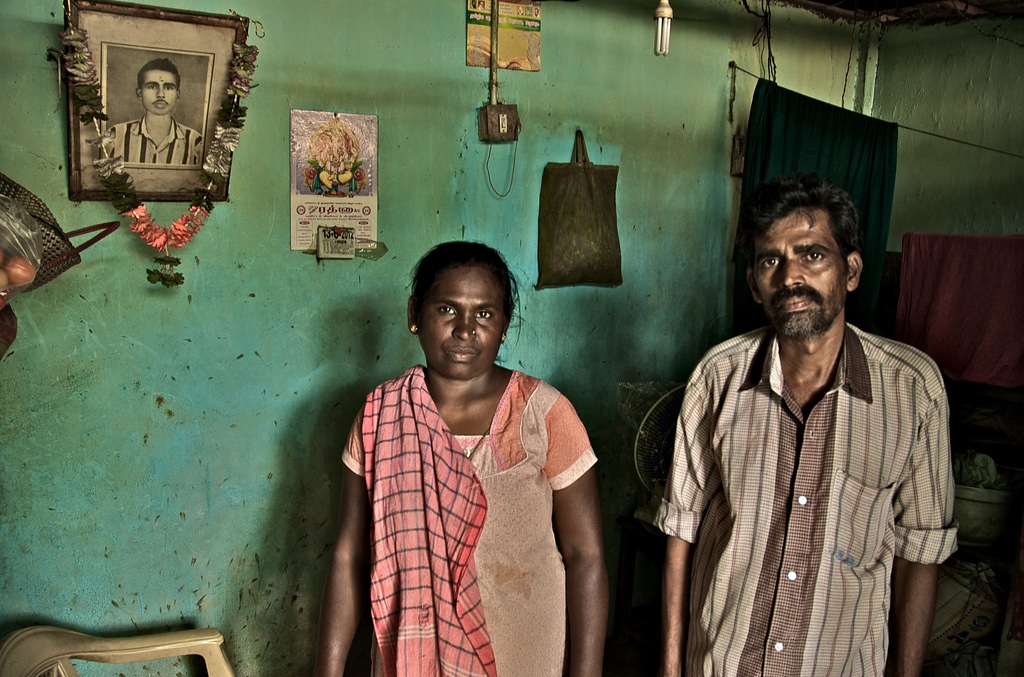
Sri Lankan refugees in India. Image credit: European Commission DG ECHO
Canadian Prime Minister Stephan Harper has also declined to attend the meeting. He cited a lack of accountability for human rights abuses “during and after the civil war is unacceptable.” The largest expatriate Sri Lankan Tamil community resides in Canada.
Many argue that David Cameron should boycott the summit. As a representative of a nation where the preservation of democracy and human rights adhere above everything, Mr Cameron would be standing up for “commonwealth values”.
Opposition Labour foreign affairs spokesman Douglas Alexander has urged the Prime Minister strongly to reconsider his decision to attend the summit. However, Foreign Secretary William Hague said that not attending the summit would only damage the Commonwealth.
Allegations of torture & war crimes
These alleged war crimes which began in the final months of the war in 2009 have continued into the present where former members and supporters of the Tamil Tigers are being detained and tortured under the ruse of rehabilitation.
There have also been numerous stories of torture and sexual assault streaming out of Sri Lanka’s prisons and detention centres. Sri Lankan President Mahinda Rajapaksa has been urged to investigate these allegations of war crimes and torture.
In response, he set up the Lessons Learnt and Reconciliation Commission which was a farce and a blatant attempt by the government to silence the international community’s accusations of war crimes. Even then the Sri Lankan government has failed to implement the recommendations by its own reconciliation commission.
The Sri Lankan government has also banned all protests in Colombo. News reports state that protests, marches and display of banners have been banned in locations where the delegates are visiting. Once again these actions discredit “commonwealth values” including freedom of expression.
Following a visit this year by the UN High Commissioner for Human Rights, Navi Pillay, released a statement that Sri Lanka was “heading in an increasingly authoritarian direction.” Human Rights Watch also called the record of Rajapaska’s government on this “abysmal“, and says an investigation is long overdue.
Reform or become irrelevant
The Commonwealth in general has a poor track record when challenging member nations and many commonwealth nations have outlawed homosexuality.
Suspension from the Commonwealth is the most severe form of punishment dealt out by the Commonwealth. Four countries have been suspended in the past including Pakistan, Nigeria (now lifted), Fiji and Zimbabwe which has ceased to be a member now. Fiji is currently on suspension for the second time after refusing to hold elections.
The Commonwealth Ministerial Action Group (CMAG) was established to suspend members. There is no mechanism in place to expel members unless they choose to leave the commonwealth.
Without retribution or reprisal, the commonwealth is indirectly saying that the Sri Lankan government is free to carry on with its illegal and immoral conduct. According to British Prime Minister David Cameron, the Commonwealth has been “shamefully silent” on the matter.
So why has there been no reprimand by the commonwealth in the case of Sri Lanka? Is this a blatant example of double standards. Is it possible that the Commonwealth is in danger of becoming obsolete and is failing in its duty to uphold “core values.” If the Commonwealth does not reform, it is in danger of becoming irrelevant.
Despite that, it is still not too late and the British government and the Commonwealth can still exert considerable influence over the Sri Lankan government. This is a golden opportunity for the Commonwealth to make it crystal clear that it will not tolerate such conduct from its members.
About the Author






[…] This article was originally published on International Political Forum. […]