
In December 1996, November 21st was declared “World Television Day” by the United Nations General Assembly. The resolution was adopted with flying colors, but not without 11 abstentions from the vote. One of these abstentions came from the German delegation, where Germany’s representative to the UN, Gerhard Henze, expresses the country’s opposition to the resolution:
I do think Mr. Henze makes several valid points. The first is that if the UN is trying to celebrate the power and influence of mass media, then these three days do cover it. Second, there is credibility to the statement that radio has much more importance to information media than television and other forms of communications, especially since radio is more ubiquitous and more associated with grassroots movements and usurping state-controlled media. Third, even in 2013, television is still a luxury and a rich man’s communication tool. Those are several reasons why World Television Day is a stupid idea and that today should be a totally different day. It’s also National Adoption Day in the United States, which is a way better concept to celebrate instead. But, here are several more reasons why television doesn’t deserve it’s own international day of remembrance.
More People Have Access to a Cell Phone than Access to a Television
Of the world’s 7 billion people, a whopping 6 billion of them (or 85% of the globe’s population) has access to a mobile phone. Only 4.5 billion in the world have access to television. However, we don’t have a World Cell Phone Day, or World Telephone Day, or World Mobile Phone Day. The closest is World Telecommunications Day or maybe World Internet Day (October 29). This is also surprising when you consider that more people have cell phones than a toilet, showcasing the power and the ubiquity of the mobile device.
Television Still Has a Gender Bias
If there’s one industry that still has gender bias, it’s television, and this is both in jobs and in programming. In a 2012 study from USC Annenberg and the Geena Davis Institute on Gender in Media, the research team analyzed 11,927 speaking roles on prime-time television programs aired in spring 2012, children’s TV shows aired in 2011, and family films (rated G, PG, or PG-13) released between 2006 and 2011. The team looked at female characters’ occupations, attire, body size and whether they spoke or not, and came to the following five conclusions:
- female characters are sidelined – only 28.3 percent of characters in family films, 30.8 percent in children’s shows, and 38.9 percent on prime time television were speaking female characters
- women are stereotyped and sexualized
- a clear employment imbalance exists
- women on TV come up against a glass ceiling
- there are not enough female characters working in STEM (science, technology, engineering, mathematics) fields
Those are startling facts about the representation of women on television, but part of the problem is that women aren’t well-represented in the positions that create and star in these television shows. The infographic below illustrates shows the the media doesn’t match the demographics of the U.S population:
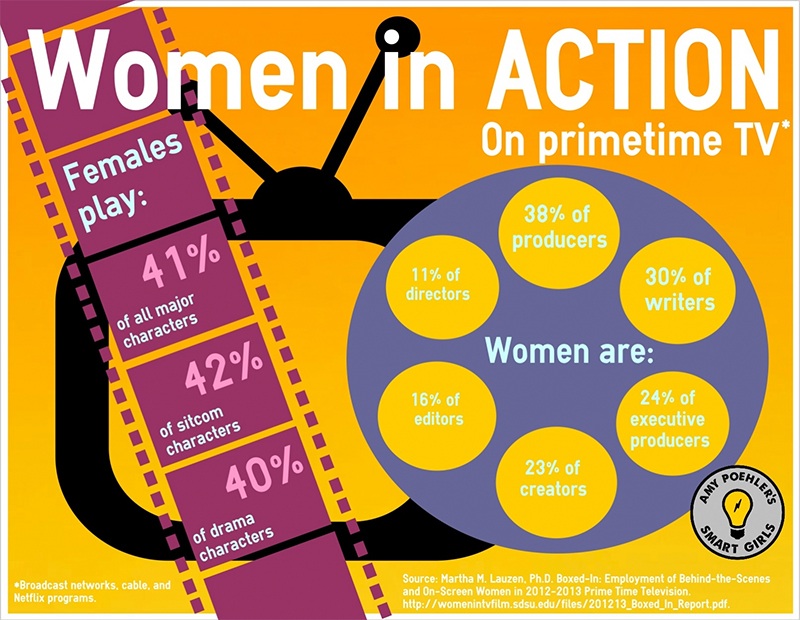
With statistics like these, World Television Day is arguably a euphemism for “World This is Still a Man’s World Day.”
In Many Ways, Television Isn’t Good for You
One of my biggest pet peeves is when people don’t realize that what’s on television isn’t a reflection of real life or how real life works. It’s the main reason I hate crime dramas, because people actually think that crimes are solved in a hour because shows like CSI and SVU get it done in 60 minutes, not realizing that the plot in the show takes place over the course of a few days, let alone an hour. It’s not just the fact that people don’t think of television as fiction, but also that some of the ideas this fiction portrays isn’t necessarily the best for people to have.
There have been many studies that show television isn’t all that good for you i.e. your not exercising, it hinders development in children (pediatricians recommend that those under 2 don’t watch any TV, while those older than 2 should watch no more than two hours per day), it can set a bad example as a representation of society etc. Research from the University of Queensland, Australia found in 2011 that you lose 22 minutes of your life every hour of television you watch. Americans, on average, watch five hours of television a day, and watching this much television increases your risks of heart disease and type II diabetes.
Why do we have a day honoring something that isn’t necessarily good for us? After all, many would agree that there are better things to do than to watch television.
It’s Really Not Just One Medium Anymore
Television is no longer specific programming that you consume through one device. Netflix is television, in a sense, but I don’t even need a TV set to watch anything streamed on the media service. There are also products such as Google TV and Apple TV, both of which stream TV shows but also provide access to movies, YouTube, music, the Internet, and Netflix. These are devices that are separate from at TV set, but would work with your cable news package, if you have one. TV has become much more than iconic newsmen and catchy jingles for laundry detergent.
Also consider that, at least in the United States, the number of people that own a television is trending downward. The most recent survey from Nielsen found that 96.7 of U.S households owned a television, down from 98.9 the previous year. Nielsen thinks that there are two reasons for this trend: poor people were unable to transition to digital, so they opted to get rid of their TV instead of replacing it or purchasing a signal box, and younger Americans, like myself, choosing to go without television once they have their own jobs and homes and to rely on the Internet instead. This trend also means that the world may have to reconsider the meaning of “access to television.” I, for example, own a television set but I am unable to watch cable or the local news broadcast. It works, but all I can do is play video games on it. I don’t pay for cable and I don’t own a signal box to watch the local news broadcast. However, I do have a Netflix subscription and I do watch my favorite TV shows online the day after they air. By all accounts, I have access to television and I certainly do own a television set. But, I don’t watch TV or use my TV set in a traditional sense.
In light of these trends and changes, it’s really hard to pin down what we are celebrating when we have World Television Day. If it’s reminiscent of what TV was in 1996, then those days are over and were really celebrating nostalgia. If it’s to celebrate the triumph of mass media and mass communication, then the Internet and the mobile phone really win in that regard, as television doesn’t have that power like it used to. At best, World Television Day is outdated. At worst, it’s a hallmark to gender bias, health hazards, and a luxury for the few.
About the Author






[…] did just write an article about the stupidity of World Television Day, but that’s not why I don’t have television. I don’t have television because my […]