
Commentary on the situation in Syria generally revolves around a handful of well worn subjects; the regime’s use of chemical weapons, how the West finds the regime abhorrent, the fact that Russia and China are supporting such a regime, or that there is no viable or clear cut plan to move out of this quagmire. This article puts all such arguments aside and claims that there is an underlying and agreed upon current that places almost everybody involved on the same page with regards the desired outcome in Syria. This desired outcome, (regardless of any rhetoric,) is that Assad does not lose. Simply put, Assad will not lose in Syria because there are very few countries that want him to, although let us be clear that ‘not losing’ is very distinct from actually ‘winning’.
The options for how the conflict can play out are as follows.
1. An Assad loss and probable coalescence of a fanatical Sunni government.
2. An Assad victory.
3. Assad not losing.
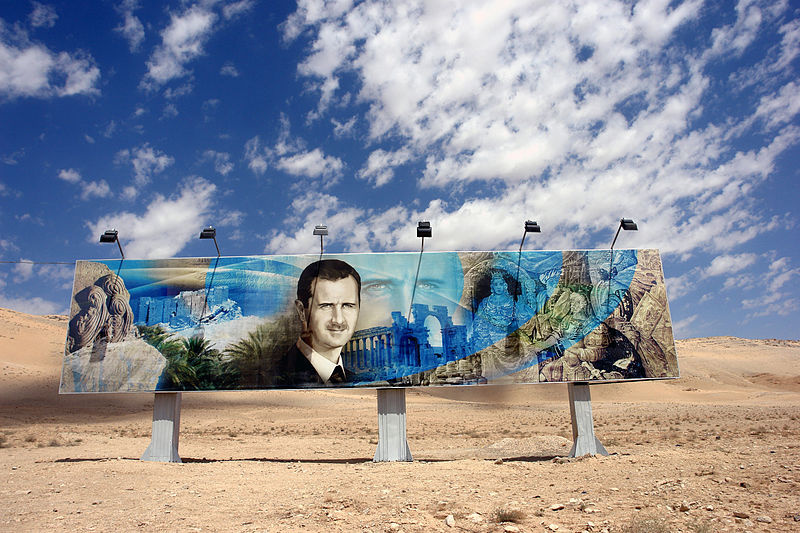
Assad will not lose so long as the international community refuses to take a stand against him. Roadside mural of Bashar al Assad along the Demascus-Aleppo highway.
Most of the world views outcome No.1 as being more unstable and dangerous than the two other outcomes. Therefore Assad will not lose because most governments of the world will do all that they can to make sure that outcome No. 2 or No. 3 results. The USA, Russia, Iran, Europe, Saudi Arabia and Israel all fear a coalescence of a Sunni extremist government in Syria, and all know that geopolitically a continuation of the Assad government is the best possible outcome.
A victorious, war weary and broken Assad regime is the ideal option for two reasons. First, the victorious regime will be extremely weak, docile and compliant on the international stage in its relations with any country that lets flow the reconstruction money. Second, the victorious regime will have unprecedented strength internally; if the regime wins it means that it has defeated its internal enemies, making it the proverbial last man standing. In this scenario the regime can and will squash with extreme prejudice and brutality any leftover fanatical Sunni sentiment.
After an Assad victory, the second best option is Assad not losing. Assad not losing means ongoing factional civil war in which chaos reigns supreme. Chaos and anarchy would likely keep the Muslim Brotherhood and fanatical Sunni movements from gaining control of the Syrian government.
Although geopolitically an Assad victory is the best and most favorable outcome, most countries will not admit to this fact and will not actively work towards an Assad victory. The USA, Europe and the West have a history of playing up the part of Obama’s “exceptionalism”, pretending to stand for human rights, freedom, democracy and the rule of international law.
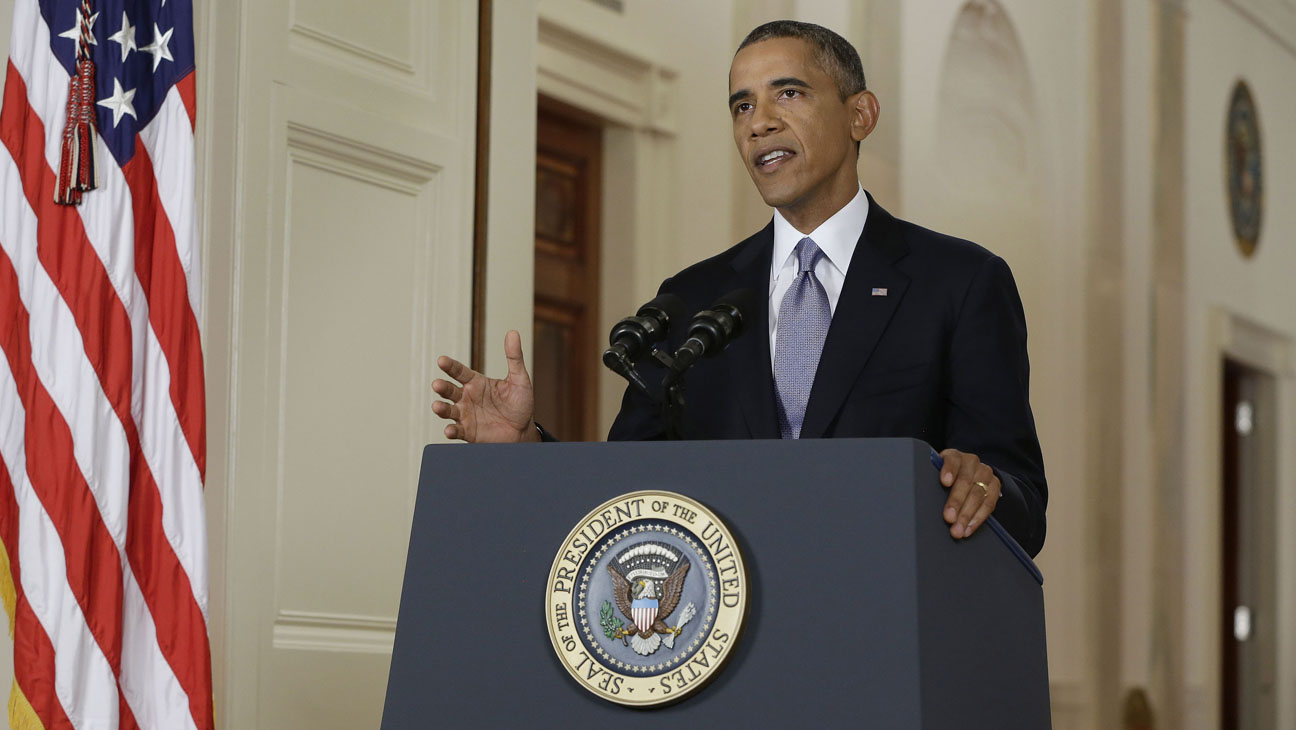
Can we believe Obama’s humanitarian rhetoric on Syria? WASHINGTON, DC – SEPTEMBER 10: U.S. President Barack Obama addresses the nation in a live televised speech from the East Room of the White House on September 10, 2013 in Washington, DC. President Obama blended the threat of military action with the hope of a diplomatic solution as he works to strip Syria of its chemical weapons. (Photo by Evan Vucci-Pool/Getty Images)
It is this farce that is used to create an air of moral superiority that has played an important role in the way that they justify foreign policy that is, under the surface, just as pragmatic and self serving as that of Russia and Iran. To damage this air of moral superiority in supporting the Assad regime is a non-starter, which is why the USA, Europe and the West will not admit to an Assad victory being the most favorable outcome. Instead, they will keep emphasising their moral superiority and claiming that the Assad regime must go. They will support the rebels just enough to keep them in the fight, while at the same time acting against the Assad regime just enough to highlight and stoke their “exceptionalism”, but never enough to truly damage the regime. Assad will not lose because very few countries honestly want him to, and very few countries will act sincerely work towards an Assad loss. Thus, we can expect a long, drawn out civil war in Syria.
Thinking further, we can also reasonably expect that in the long run the chances of Assad winning are very good. Assad losing is the outcome that everyone is trying to avoid and some (Russia & Iran) are actively working towards an Assad victory.
Keeping Assad from losing entails the maintenance of a long, drawn out, chaotic civil war. And, this is something that can only be kept going for a finite period of time. This makes time Assad’s ally, and time is one of the fiercest allies one can have.
We can expect the war will end when the population becomes so war weary that it will accept a “political” solution that the international community will make sure keeps at the minimum the structure of the Assad regime in place. Assad may be replaced, but the replacement will know that he is expected to use his internal strength to quash and root out the Muslim Brotherhood and any related sentiment. It is a stunningly cunning strategy on the part of the USA and the West as a whole, but that the world needs to recognise it for what it is. Countries invested in Syria must start being honest about their intentions.
About the Author






[…] (Source / 14.11.2013) […]
[…] (Source / 14.11.2013) […]
Thanks Michael, this is the best political analysis for the vague in Syria, I will be frank the first glance on the article I got confused how this criminal man will never lose, but then after I understood why, well done.
Comparing to those extremist ignorant fanatics who are in majority came from foreign countries to fight in Syria not for democracy but for theocracy Assad is a Saint. That is the general filling that now emerges to the general population and that in part explains also the recent gains of the Syrian Arab Army.
Interesting article.
However, I am not so sure that the West would be happy to see Bashar al-Assad win the war. It would probably be the least-bad option, but that doesn’t make it a good option. After all, Assad was already a pain in the ass for Western powers (as well as a de-stabilising influence in the region) before the uprising. A victorious Assad, no matter how weakened or crippled, would go back to the policies of the past at the earliest opportunity.
The more I read about the topic, the more it seems that the West – and particularly the USA – just wants the war to go on for as long as possible. A trouble-making country like Syria is crippled, and Iran and Saudi Arabia throw tonnes of money and equipment at the conflict, becoming poorer and weaker. The eventual outcome? Not a big deal. But may it take as long as possible for the war to reach such an outcome.