
Colombia has long been known for its drug cartels; and many an article has been scribed in response to this not-so-secret trade that has been (and is still) sweeping the country.
What Colombia is not known for is its testigo trade; the buying, selling, and financial manipulation of witnesses in court, who may or may not have seen what they claim to have seen, and whose false interpretations of a particular criminal acts are sending an incalculable amount of people to jail. This new found way of making money and escaping punishment is while perhaps not as glamorous as the ritzy lifestyle of the narcotraficantes, is certainly just as dangerous. Any break down of judicial power leaves a country in a position of vulnerability, and days after the news broke that Colombians (along with Peruvians and nationals of the UAE) could soon qualify for visa-less travel to the EU, this is bad news indeed for the state now classed by various MEPs as ‘recovered’.
Although false testimonies in Colombia are nothing new, they are becoming more and more commonplace in courtrooms across the country. Top Prosecutor General Eduardo Montealegre warned last year of “the appearance of false witnesses deceiving justice” but suggested that these cases were more often than not concentrated on politics, usually involving the clash between politicians and narcotraficantes.
However, the soap-opera case of student Luis Colmenares, allegedly murdered in October 2010, has proven that nowadays it isn’t only the infamous that can benefit from an inaccurate source. If you’ve a few pennies in your pocket you may well be able to buy your freedom (or incarcerate your enemies).
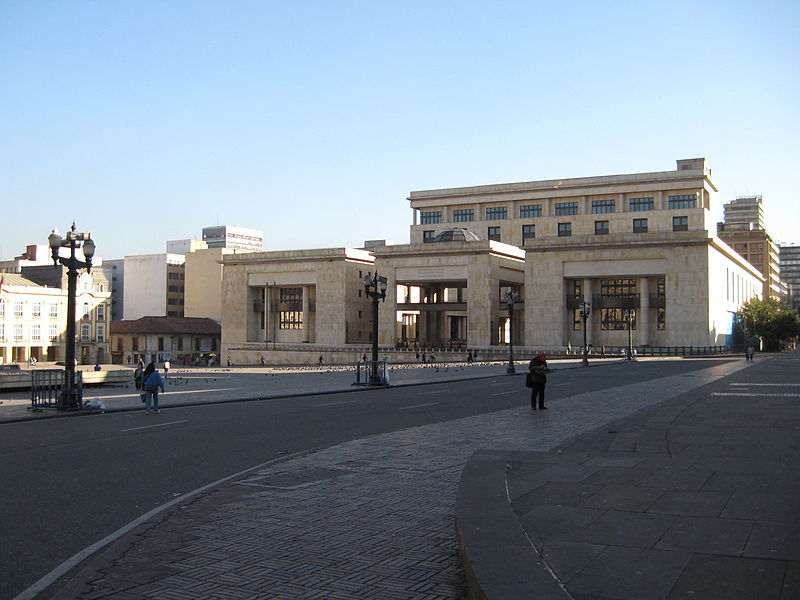
Colombia’s Palace of Justice. Image credit: Robledo59
Since his death on Halloween 2010, Luis Colmenares’ family have been tirelessly pushing for answers, their quest somewhat complicated by strange testimonies. The primary witness, Ayola, was found guilty of fabricating evidence when it was discovered he had signed into work at 6pm, and out again at 6am the following morning (Colmenares was allegedly murdered at around 3.15am). Later, Ayola claimed he did in fact escape his workplace and end up exactly where Colmenares was last seen alive. On the 24th October 2013, he admits to having stayed put in his place of work, and that his lies were swayed somewhat by a financial contribution from the family of Colmenares. Now speculation lies in whether or not Ayola has been paid by the defendant’s family. Then there’s the second witness…
Prior to this case, the most widely known example of false testimony was that of Segifredo López, a former state deputy and FARC hostage, who was arrested after four false-witnesses claimed he had orchestrated his own kidnapping. Given the high-profile nature of Lopez’s work, the average Colombian was not overly concerned about the existence of a Witness Cartel: it seemed to only affect the government, politicians, and drug-smugglers. “False victims’ cartels” that were allegedly “bleeding the nation” did not attract much interest from the general population, given that in “98.5% of cases in which the Colombian Army had extra-judicially executed civilians, nobody had been brought to justice”. A shocking statistic which renders understandable the general apathy of the population when informed of false witnesses acting against the state.
Now, the media coverage of the Colmenares ‘show’ has changed all that. The one silver lining of this case, according to Journalist Daniel Mendoza, is that “it has highlighted the existence of a witness cartel in Colombia”; a cartel which can affect not just those in the limelight, not just the state, but the ordinary citizen.
Yet despite the international calling for a formal investigation into the use of false witnesses in Colombian courts, the authorities are still unable to neither confirm nor deny the existence of a formal, cartel-style, trading system. As with the drug cartels, it is very probable that the actors behind-the-scenes are willing to go a long way to protect their interests. For now, at least, the High Courts have promised to “employ stronger and more thorough checks when dealing with witnesses, to ensure credibility”. We can only hope that the growing media coverage into this worrying trend helps to tackle and not exacerbate the problem.





