The Middle East and North Africa (MENA) region and democracy are having a hard time making sense with one another. The West has found itself in a sort of existential crisis; the chaos that has erupted in MENA in the search for democracy has the West teetering at the sheer instability that has befallen the region. Meanwhile, the West recognises that any protestation in this context will look hypocritical and unaligned with its deep-rooted belief in democracy. Democracy, of course, is something we in the West don’t want to give up, but it does create a collision of thinking, and has in the Arab world, proven to spark chaos and instability.
In this sense, although our crisis in the West is of a different nature than that being experienced in the MENA region; our crisis has been birthed precisely due to the current events in this post revolutionary context. We have intervened during the revolutions in the search of democracy, and again we are plagued with questions of intervention, but this time, in the face of democracy.
When the Egyptian military demanded Morsi leave office in July, the United Nations urged Morsi to stand ground, and warned that the move – despite the thousands crowded in Tahrir square inciting the initial request – would signify an overt diminishing of the democratic system, rooted in dialogue.
How do we navigate democracy in the largely destabilised MENA region, while maintaining a deep-rooted belief in democratic systems at home and abroad? Western leadership has been clear about the importance of stability in the region to Western interests. We’d all love to believe that sane as well as non-fundamentalist leadership exists in the region (yes, those two characteristics account for the recently fallen – I triple-checked). We’d also all like to believe that if given the chance, the Arab public would vote for them.
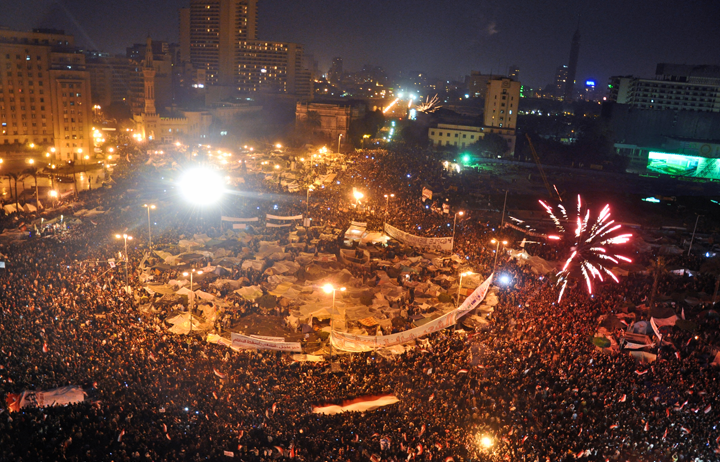
Celebrations in Tahrir Square after Omar Soliman’s statement that concerns Mubarak’s resignation. February 11, 2011. Image credit: Jonathan Rashad
So was it, perhaps, a hard pill to swallow for the US when Morsi was recalled from his position by protests of his countrymen? MENA protests were had turned Frankenstien – the exciting breakthrough we once marveled at turned-monster, it meant that even though no two countries in the region seemed to cooperate on any issue in the modern era, that they were so interconnected that any process in one point in the region acted as a pressure point for something else within another.
Take Syria for instance. Once the presidential chair in Egypt was void again, pro-regime propaganda in Syria thrived, happily pointing to Egypt’s democratically elected leader (even if he was a wanna-be dictator), ousted by the people who voted for him as if to say ‘look what democracy can look like’. This pro-regime propaganda spread throughout Syria, in an effort to reinforce any doubts of a successful transition of power the protestors may have, or for whatever other reasons pro-regime propaganda is used in civil war. Apart from learning that overthrowing a horrid dictator is in fact the easy part (hello, Libya), the lesson to be learned here is that democracy is chaotic.
Hundreds of miles away from Egypt, in Turkey, when the “most stable country in the Middle East” became internationally synonymous with policy brutality and other reputation destroyers like tear gas and water tanks, the country’s parliamentary speaker stated, “that if there are expectations and demands, we should express them within the framework of law”. What are we talking about here? Is it democratic to voice opinions in peaceful public protests and pressure governments to decisions without tolerating excessive use of force? Or is it democracy to expect that all citizen concerns will be addressed in a ballot box, even those that come forth between elections? In the context of the post Arab Spring MENA region, attempting to understand democracy is fascinating undoubtedly fascinating and confusing at its peak.
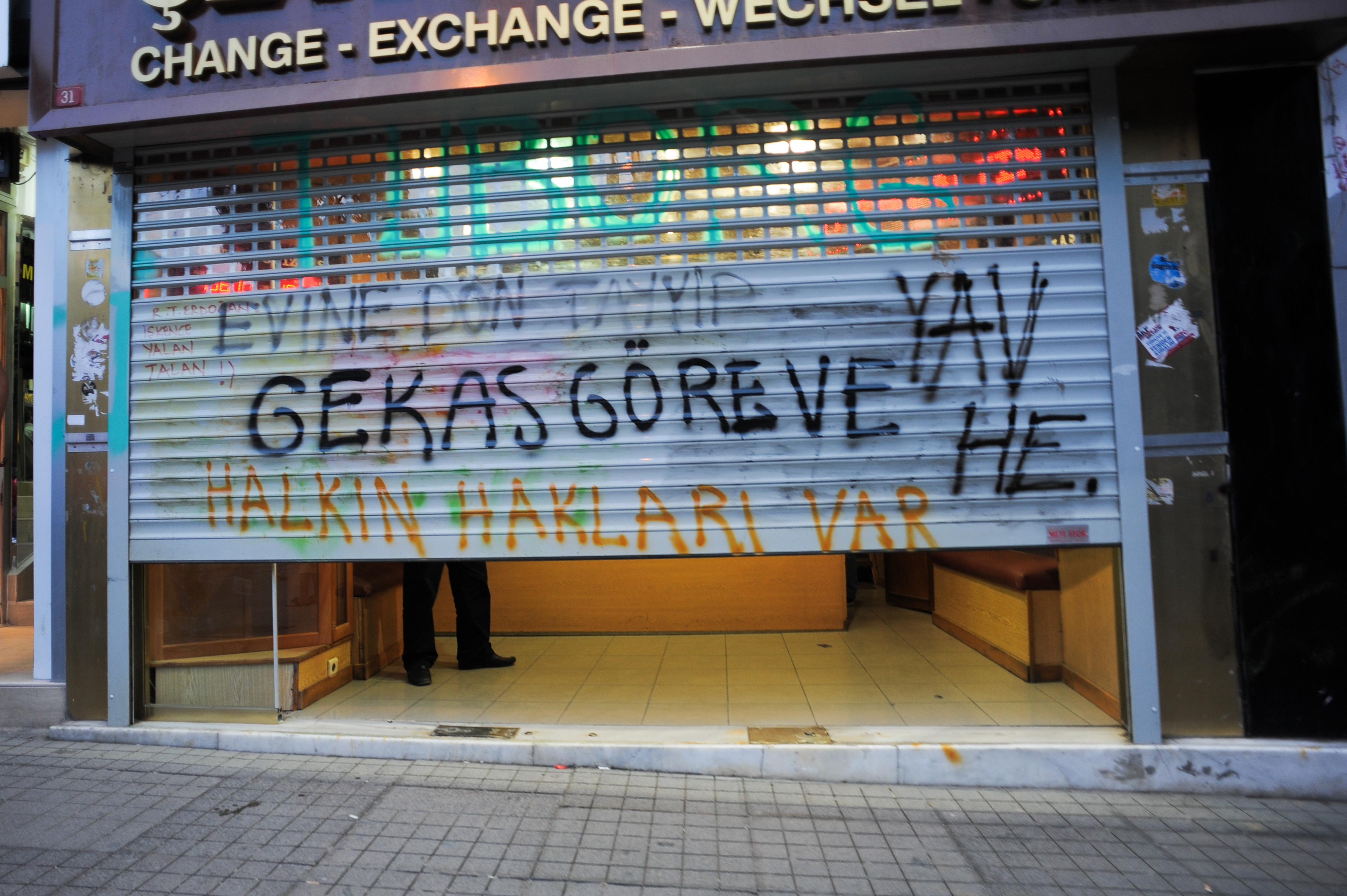
Street graffiti stating: “People have rights”. 2013 protests in Turkey. Image credit: Mstyslav Chernov
The Turkish protests presented the West with an unhappy public who were ready to criticize their majority elected governing party – and this was a leader Western governments actually liked. But before Turkey’s Justice and Development ruling party could be pressured by the international community to display effective management of insurgency, or to practice a counter-insurgency that is aligned with standards of international law, or at least live up to its reputation as a democracy and not a dictatorship, attention in the region turned to Syria. Even Turkey was swathed with hundreds of thousands of Syrian refugees and burdened with a humanitarian crisis that immediately destabilised the country after the startup of the Syrian unrest.
The situation is becoming untenable. In Egypt, people are expressing their demand for the Army to come back, and in Syria, people are looking for compromise within the administration. Granted, there are no easy or quick solutions to all this, and within the realm of discussion surrounding the Arab Spring, the subject of stability within the region comes to the forefront. Particularly, it must be realised that mainstream understandings of ‘stability’ is neither straightforward nor universal. Discussion of said ‘stability’ in post-Arab Spring countries, for the sake of understanding ourselves as democratic, must then be taken with a grain of salt.
We have to, for the sake of gaining a holistic understanding of the West’s current existential crisis, explore the case of democracy in post-Arab Spring MENA while avoiding the mainstream view of the western origin of democracy originated in the West and viewing foreign intervention in the region as an export of democracy into MENA. One point in favor of shedding this perspective is reminding oneself that Qatar was highly involved in the democratisation during the Arab Spring. It becomes unclear to us in the West, the direction and success of injections of democracy in the MENA region when an authoritarian state has a hand in orchestrating them. But then again, Qatar’s role in the mix of it all may be nothing more than the biggest irony within the situation.
Finally, although dictators are just not the business today, if it was inherent to leadership to consistently do the right thing, perhaps dictatorship would be the government to beat. Is it too early to say, “it isn’t, and it’s not.”? I’ll let you decide.
Furthermore, it is not that the US is staunchly against undemocratic regimes – no. It would be ahistorical to say that the West hasn’t forged ties of cooperation with regimes like the Saudi Arabian monarchy as far back as the thirties. Not to mention the US and Britain’s roles in the overthrowing democratically elected Mossadegh of Iran in 1953. But despite the current turmoil in the MENA region, and the crisis the West is facing understanding its championed democracy, one thing is clear: we cannot give up on democracy in the Middle East.
In fact, we are at a transitive place that we can interrupt this before it tumbles into what it surely will – an uninterrupted record of failure. Within the Arab world now, there is strong consensus about developing alternatives to the current government, but the world can provide strong incentives to mobilize these alternative scenarios involving like formal responsibilities for the international community in the provision of security and services or any other idea that might move away from of humanitarian crisis, failed states, and not to mention – a protraction of the West’s existential crisis.
About the Author