
In the waning days of World War II, British Prime Minister Winston Churchill ordered his strategists to develop a plan for a surprise attack against USSR forces in occupied Germany. Appropriately named “Operation Unthinkable”, the plan was designed to push the Soviets out of Europe before the United States could abandon Europe and focus on the invasion of Japan. With the US gone and the rest of Europe in ruins, nothing was standing in the way of Russia reoccupying all of the lands which had just been liberated from Nazi control. And even when Japan surrendered pre-invasion, there were fears of the US returning to their inter-war isolationist policies and leaving a broken Europe to a red-tinted fate.
In this uncertain atmosphere, NATO was born. Soon after it was created, Lord Ismay, the first secretary general of NATO, would be recorded saying that NATO’s mission was to “ keep the Russians out, the Americans in, and the Germans down.”Accomplishing this mission in a Post WWII landscape might have seemed daunting initially, but NATO managed to achieve it. Now, with the Cold War over and with no immediate state-based threats to Europe, NATO’s main mission is seemingly complete. Without an antagonist super-power and clear goals, what purpose does NATO serve and why should it continue to exist? And perhaps more importantly, is there any benefit to keeping NATO around?
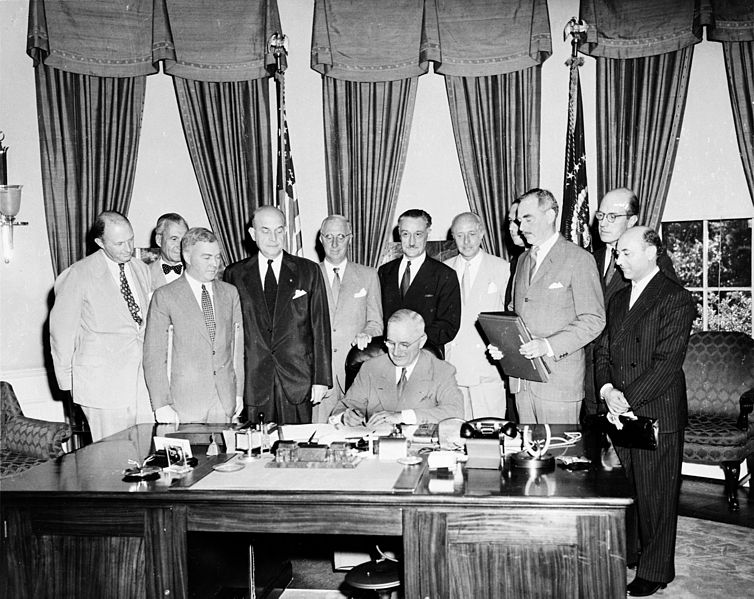
Photograph of President Truman signing the document implementing the North Atlantic Treaty at his desk in the Oval Office, as a number of dignitaries look on. Image credit: Abbie Rowe, 1905-1967, Photographer
In the modern day, NATO’s original goals have become mostly irrelevant or outdated. The US is not a presence truly needed or wanted in European affairs, and hasn’t been since the end of the Cold War. Besides the historic special relationship between the US and UK, many European nations seem more interested in participating with the European Union as a means to compete against American economics and global influence. This could become even more poignant if the EU eventually expands to include single European military. Even without such an expansion, what good is a standing military power in an age without large, hostile states? From an EU perspective, the US can only provide economic competition and unnecessarily militaristic policies in an age where the corporation reigns supreme. For Europe, standing next to the proverbial “bull in a china shop” is a good way to get hurt.
The need to “keep Germany down” has been abandoned to some extent. Germany has one of the best equipped militaries in the world, and is ninth in total military spending. Germany has also grown into an economic powerhouse thanks to the free market structure of the EU and SEA agreement in particular. Some would argue that the German control over the economic and political future of Europe, through the EU, is expanding into an empire in its own right. While nobody will admit to Germany being so powerful once again, except perhaps the Greeks or Spanish, Germany once again has the fate of Europe in its hands.
Keeping Russia out of Europe isn’t really necessary, or even wanted. After the fall of communism and the threat of a Soviet invasion ceased, there were more economic opportunities to be had in Russia than fear of the recently failed state. Now, Russia has returned to being a strong military power but arguably poses no real threat to Europe’s security. In such a globalized, economic world, any act of aggression against Europe would be equivalent to financial suicide for Russia. Similarly, Russia has elected to remove itself from the EU and has formed its own Commonwealth of Independent States. While this organization does not reach the supranational scope of the EU, it does tie the former USSR states closer together economically, separating them from the EU and mainland Europe.
NATO has remained constant as an organization while the times have changed around it, as its original goals have clearly outlived their usefulness as international policy. Europe is considered to be a ‘producer’ rather than a ‘consumer’ of security and may want to cut most ties with the US. Germany has become and economic superpower, and despite the current austerity crises in the EU, leads the EU by the nose in fiscal and economic policies. Russia is accelerating its military modernization, potentially returning to the power within the former USSR. However, it seems content to bask within its Eurasian affairs, emerging only to humiliate American presidents and block Security Council actions. In that manner, NATO is obsolescent. And this has shown in recent history.
But if NATO could evolve in its goals, the organization could see a renewed importance on the world stage in comparison with other supranational organizations such as the UN or EU. Perhaps Tomas Valasek of the Centre for European Reform laid out the new NATO goals when he said:
“The [new] purpose of NATO is to maintain the habit of close security and military co-operation between the U.S. and its European allies, to defend the member-states’ territory and populations, and to build a more secure Europe by deterring aggressors, facilitating transition of authoritarian societies to democracy, and intervening against the worst violators of human rights.”
Based on these goals, NATO provides a suitable discussion and planning organization for the world’s strongest and most global militaries. Being able to coordinate military actions from many countries to achieve success on a mission was one of NATO’s primary tasks during the Cold War, and this could translate well to modern peacekeeping and intervention efforts in the modern day. This idea has been exercised in recent history with the War in Afghanistan, the Libya intervention, which was headlined by NATO airstrikes, and the raids on Somali pirates in the Gulf of Aden. All of these operations were reliant on various nation’s forces and NATO based logistics to succeed. Article 4. Similarly, it could be argued that instead of focusing on territorial defense, NATO has become focused on the defense of European and American interests abroad. In this way NATO plays a key role in the ongoing economic and political stability of Western nations and their allies abroad.
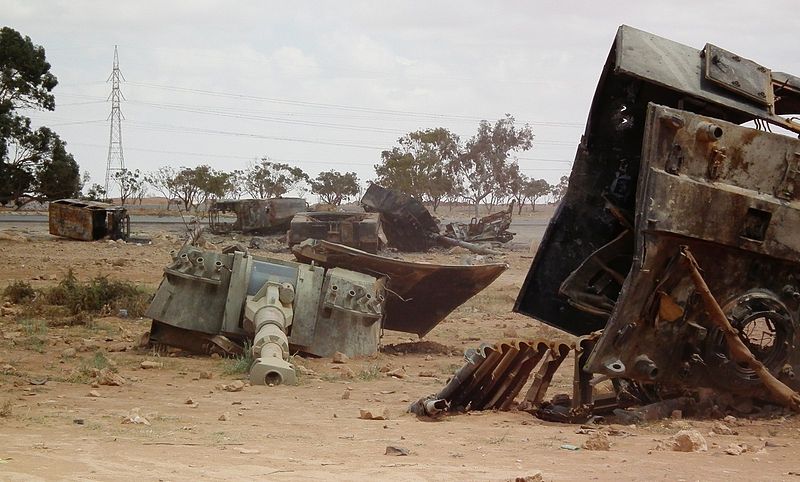
Part of a group of six (italian built) Palmaria heavy howitzers of the Gaddafi forces, destroyed by French airplanes at the west-southern outskirts of Benghazi, Libya, in Opération Harmattan on March 19, 2011. In the background other destroyed vehicles along the street that leads from Benghazi to Ajdabija. Image credit: Bernd.Brincken
NATO also provides a suitable forum for discussing potential humanitarian interventions. As NATO is comprised of the world’s strongest and most human rights oriented countries, not only could issues be discussed and potential actions be considered, but actual interventions could become reality. NATO stepped in during the Bosnia-Herzegovina conflict to provide air support to outmatched UN troops and later performed airstrikes in the Kosovo War to stop Slobodan Milosevic. In these interventions, NATO was extremely successful, illustrating just how potent and useful such an organization could be for preventing further human atrocities. The UN peacekeepers may be mandated to prevent atrocities in a warzone, but NATO troops actually have the training and equipment to make such lofty goals successful.
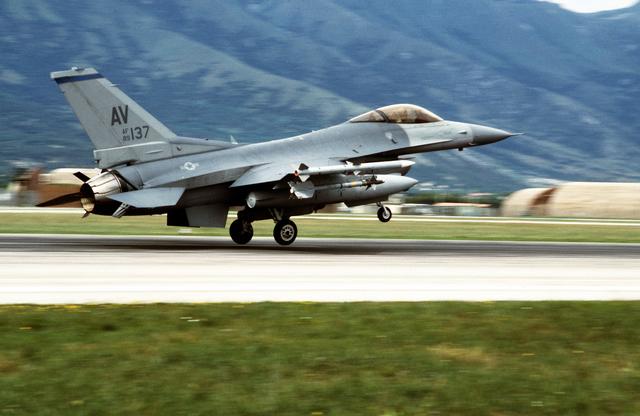
NATO planes engaged in aerial bombardments during Operation Deliberate Force after the Srebrenica massacre. Image credit: US Army
Finally, a NATO alliance would help maintain the strong connections between Europe and America. Although tensions between the two continents are running high in the wake of the Snowden scandal, Harvard’s definition of NATO’s role, “drawing members together, encouraging them to resolve disputes peacefully, causing them to plan and work with rather than against one another, and fostering respect for democratic values and institutions,“ has never been more poignant. Through NATO, a tradition of pan-Atlantic cooperation has lasted for almost a century of turmoil and could continue into the foreseeable future. NATO is a symbol of that cooperation, and a reminder of the strength that can be found when Europe and America act together. Similarly, NATO provides yet another arena for relations between Europe and America to be conducted. Being able to maintain strong military, and civilian relations between western countries is in the greater interest of every western state.
The recent NATO led interventions in Libya and Somalia show that NATO has begun to shed its Cold War era goals, and become a coordinating presence for Western military powers. Yes, the need for a territorial mutual defense pact may be irrelevant in the modern day. And yes, there are extreme fiscal challenges to NATO members sustaining sizable military expenditures in the modern austerity climate, despite the troubling fact that Asia has begun to overtake Europe in military expenditure. If NATO evolves into something more than it was and pushes through the challenges, NATO can fulfill a global role unlike the Euro-centric EU or the underfunded and impotent UN. NATO can become a force for good, an international organization with the power to enforce policies anywhere around the globe, at any time. The world needs a stabilizing force like NATO as the US becomes less and less able to perform the “world’s policeman” role alone. NATO is far from obsolescent. With some faith in its processes and time to evolve its goals, perhaps NATO has never been so expedient.
About the Author





