
In an attempt to overcome the so-called ‘war on drugs’, Uruguay has decided to legalize marijuana. This makes the liberal South-American country, the first nation in the world to legalize the production, sale and consumption of marijuana. Although the selling of and consumption of marijuana has already been legalized and/or tolerated in countries such as Canada, Israel and my native country the Netherlands, the production chain has always remained mysteriously illegal. In the Netherlands, selling and consumption of marijuana is not penalized, however large-scale growth of marijuana is a criminal offense. So, where does it come from? Good question.
Keep floating
Being a liberal young woman, I see no moral objection towards allowing people to smoke weed. I’m not even saying that out of personal interest, I’m done with youthful experimenting. Cannabis is one of the most popular stimulants in the world. It’s a natural resource. It has been around for ages and is not likely to lose its clientele any time soon. The law doesn’t seem to have much influence. Legal or not, people will smoke. Marijuana will be sold. Hemp will be produced.
The Dutch hypocrisy of the closed backdoor
Nevertheless, I’m not a fan of the current drug policy in my country, The Netherlands. Usage and the selling of marijuana is ‘tolerated’, but large-scale growing of hemp is a criminal offense. Basically, the front door is open whilst the backdoor remains shut. Marijuana factories are being uncovered non-stop, only to re-emerge shortly after. The police are fighting a losing battle. To avoid being prosecuted, hemp growers are driven into operating in a shady, secretive business in order to meet the coffeeshop’s demand. With the production chain of hemp remaining criminalized, the Dutch “allow-it-to-control-it”-policy relies on a defective, incomplete mechanism.
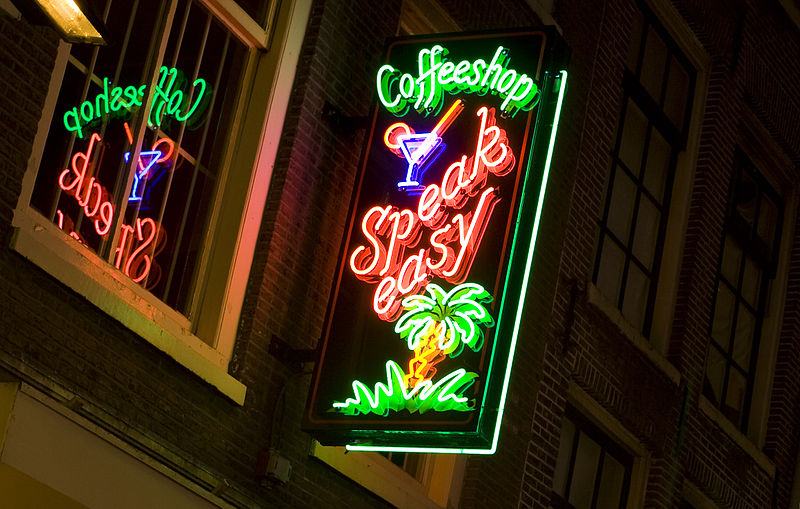
A view of a neon sign of a cannabis coffee shop in Amsterdam, The Netherlands. Image credit: Massimo Catarinella
The reluctance of lawmakers to regulate the production of hemp is counterproductive. The demand for marijuana has encouraged crime by generating a massive illegal market where organised crime is in charge. Dutch citizens are paying the price for this malfunctioning system; The government misses out on about one million in tax money a year; energy companies are deprived of a big source of income; high judiciary and police costs go hand in hand with increased crime rates; and above all hemp profits go straight into the hands of ‘criminals’!
I find it hard to understand how a government can allow this incomplete system to develop, turning a blind eye to the obvious illegal production of hemp. The main objective of decriminalizing marijuana was to protect soft drugs users from exposure to hard drugs. Although this might have been effective at the consumers-end, the highly desired separation of the soft- and hard drugs markets as a whole has failed. Suppliers of marijuana are in many cases suppliers of XTC, heroin, cocaine and any other profitable illegal substances. If coffee shops allow the safe consumption of cannabis, then how come illegal hemp growers are still not considered as farmers only?

Uruguay: Social Experiment
With the legalization of marijuana, Uruguay will become a significant social experiment, from which many counties can learn. The legalization of the whole chain, including the production will create a ‘new’ agricultural industry; the hemp growing industry. Will the regulation of this market, and therefore taxation of the market, benefit the country’s economy? Will the use of soft-drugs increase and lead to an increased use of hard-drugs, as the critics say ? Will crime-rates drop? Will drug trafficking vanish because the black market becomes a legal market? All these questions will be answered in the years to come. Even though Uruguay operates in a completely different environment than the Netherlands, I’m expecting that the regulation of the whole marijuana chain will be effective. I’m hoping that Uruguay will manage to introduce a full-functioning system that will lead as an example to the rest of the world. To be continued…
About the Author






[…] published on the International Political Forum and Urban […]