Mandela, as the eulogies which were sent from all corners of the globe showed, was a man revered by almost everybody. At his funeral Obama mixed with Raul Castro, Robert Mugabe and Oprah Winfrey. As we lose the last of the great twentieth century icons, the question arises, who comes next?
Where are the next generation of Mandela’s, Ghandi’s and Martin Luther King’s going to come from? Or is the era of global icons over?
In fact the story of Mandela is more complex than a good man being recognised, for he was not always so universally acclaimed. As has been recently pointed out, if he was so loved and his ideals so supported then the apartheid regime in South Africa would have ceased far sooner. The truth is that for many years lots of groups in the West – especially on the right – were hostile to Mandela and thought him a threat especially in the Cold War period. The British Conservative party for instance insisted for many years that Mandela was a terrorist and should remain on Robben Island.
The reason that in the end figures like Mandela or Ghandi came to be considered by many to be global icons is because they fought on despite the struggles, criticism and opposition to their ideas and their very being. So what problems does the next potential ‘Mandela’ face when become a global, ideological icon promoting and furthering the fight against oppression?
Firstly, Mandela was fighting the legal oppression and segregation that characterised the apartheid system, Ghandi was fighting for legal independence while Martin Luther King was fighting to end the legalised segregation between black and white American’s. Particularly in the west, the struggles against discrimination today are increasingly not against laws or legal barriers but instead against structural, economic or social barriers to equality. Therefore, while these inspiring men were fighting against clear legal inequalities with clear ends in sight, today’s oppression is far more likely to be in the shape of structural or social differences or weightings which are more likely to be long drawn out struggles where ‘victory’ is hard to define. The reason that these individuals are revered is because they won. Not only did they fight but they succeeded in achieving their aims of overturning legal oppression, this is why we may never again have such clear, ‘simple’, global heroes in the future. In South Africa, since the end of legalised segregation in the form of the apartheid, the other factors that entrench segregation and racial inequalities continue to exist and are hard to overcome simply by a campaign from an inspired figure. This is despite the acknowledgment and desire by the national government and majority of voters within it (as seen by the continued re-election of the African National Congress) to further the cause and promote racial equality.
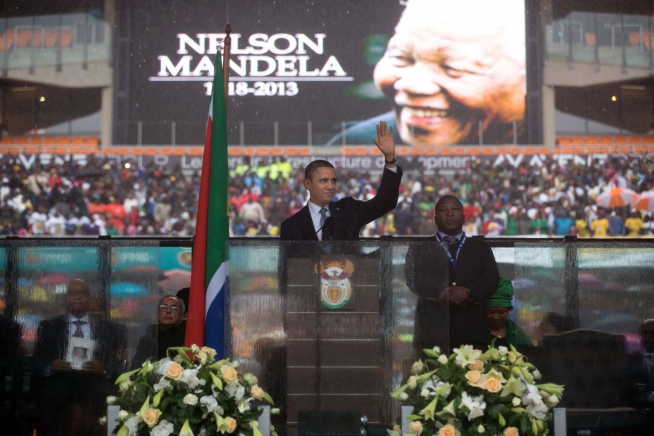
United States President Barack Obama speaks at the memorial service for Nelson Mandela in Soccer Stadium, Soweto, South Africa on 10 December 2013. Image credit: White House/Chuck Kennedy
Secondly, knowledge about the world and key political activists, is far greater today than it was throughout the 21st century. Far more is known about these individuals and it is harder for someone to keep under the radar before launching themselves onto the international stage. In this way, while some may argue that Aung San Suu Kyi of Myanmar is the natural heir to the throne, the media and government outlets have been able to find ‘dirt’ on her which they have used, largely unsuccessfully, to try to discredit her or at least chip away at any emerging halo.
Yet not only does transparency, 24 hour media and sound bite focus make it harder to be held up as a perfect hero, but it is not clear we want our heroes to be perfect any more. The emergence and desire of mainstream media determined to show us the ‘darker side’ can be seen from the recreation of fictional ‘hero’ Batman as a having a darkside to discussions concerning Ghandi’s sexual preferences.
Thirdly, and linked with the previous point, they must have a brand or a story that can be sold, understood and appreciated. In the case of Mandela, he overcame obstacles to achieve his aim. Here though there are instances of an almost neo-imperialist and orientalist focus on these men. So, for example, much was made of Mandela’s childhood in a village to play into the rags to riches rhetoric despite the truth being slightly different.
So our potential new iconic figure faces a number of problems to become the next Mandela. Firstly, what to fight against. Secondly, to be cleaner than clean to ensure the image of them is not tarnished. Thirdly, to be personable and have great branding. Finally, they must win or at least have some impact deemed positive by the global community. While longing and hoping for another Mandela or Ghandi to fight for equality in the face of often oppressive opposition, we must remember that each and every individual has the power to assist in the replication of oppressive norms, and thus the potential to play a role in overturning and changing such unequal structures, norms and values. Rather than waiting or relying on one man or woman to change the world, if responsibility is shared then changes towards a better world will come quicker.
About the Author