
On November 19th, the European Parliament voted in favour of Erasmus+—the new EU funding programme for education, training, work and sport abroad proposed by the European Commission. From January 2014, more than 4 million people are expected to participate in the new scheme, which will allocate an increasing number of opportunities for vocational education and training across Europe.
As it has been announced, Erasmus+ will bring together several existing European and international cooperation programmes, including the most popular Erasmus and Leonardo da Vinci, formerly part of the Lifelong Learning Programme. More importantly, it will secure a budget of €14.7 billion, which represents a 40% increase compared to the current spending levels that the European Union has so far contemplated for similar programmes. Strategic partnerships and increasing funds will guarantee a new range of opportunities for students and young professionals who are willing to acquire new skills and qualifications abroad. In addition, the new agenda will include for the first time bursaries for sports, as well as Master’s Degree and Joint Master Degrees loans, aiming to shape a new generation of European citizens and boost their employability within an increasingly international and competitive job market.
The increasing funds for Erasmus+ represent a great yet not surprising victory for the European Commission. In line with “Europe 2020”, the EU’s most recent growth strategy, the advancement of education and training through transnational mobility is in fact vastly regarded to be key for the economic and social development of Europe. The Group of the European People’s party (EPP), the largest political group in the European Parliament, responded with enthusiasm to the budget increase, stating that “transnational mobility of EU citizens not only contributes to enriching their cultural and professional knowledge, but it is also necessary to enhance labour markets’ efficiency and EU competitiveness”.
Along these lines, in 2012, Umberto Eco argued that Erasmus is by far the most successful project promoted by the EU, and that similar initiatives are indeed necessary for the future of Europe. Through the integration of people coming from different countries and backgrounds, “Erasmus has”—in the words of the Italian philosopher—“created the first generation of young Europeans”, in a way that no other institution has. It has done so by facilitating the spread and assimilation of a certain European identity that, due to the cultural, historical and linguistic diversity of the old continent, too often seems hard to conceive.
However, whereas the strategic importance of transnational mobility as a means for economic and cultural development in Europe begins to be widely recognised, alarming trends in this sense have recently suggested that the EU itself is rather decreasing in popularity. As Data shows, the general Eurozone crisis and the disparities between Southern and Northern European countries have in the past two years largely undermined trust in the European Union. On the one hand, people in fragile markets, particularly in Greece, Spain and Italy, have become critical about the austerity measures dictated by the central bank and supported, above all, by a prosperous Germany. On the other hand, the prevailing feeling in more stable countries such as Sweden, the Netherlands and the UK is that they should not pay for the economic irresponsibility and inefficiency of the “lazy Southerners”.
This no win situation has consequently resulted in an ideological rejection of the political and cultural values of the European Union—namely cooperation and solidarity. More important, as analysts believe, is that this popular discontent might have triggered the rise of more profound grievances in Europe. Case studies in Italy, France, Greece and Scandinavian countries have shown that the loss of EU popularity among political parties and civil society is increasingly linked to dangerous far-right ideologies. The belief that economic growth should be driven by national sovereignty, as opposed to European cooperation, is in fact at the core of modern nationalist propaganda.
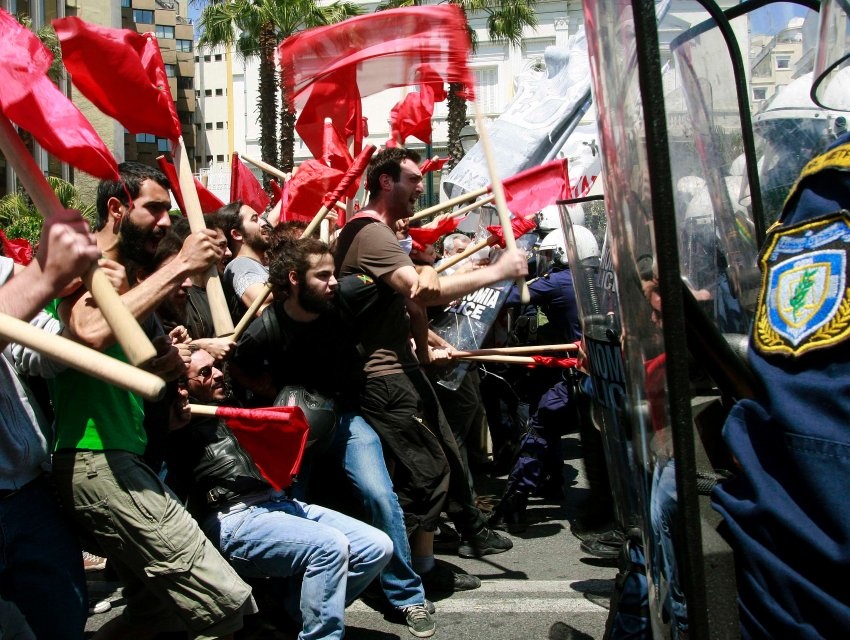
Greeks protest austerity cuts. Image credit: PIAZZA del POPOLO
In light of the new extraordinary budget, the launch of Erasmus+, which admittedly is part of a broader plan aimed at the economic recovery of Europe in the long run, may therefore as well be conceived as a symbolic attempt to counter both “Euroscepticism” and the growing populist nationalism. By bringing together different cultures and people through vocational education and training abroad, programmes of transnational mobility openly advocate values of inclusion, tolerance and cooperation that have been lately disregarded in Europe. Moreover, although no one seems to realise how amazing that is anymore, it is thanks to the spread of these values among people that for so many years enduring peace has been made possible and that extremists have been prevented from gaining institutional power.
Millions of young citizens who have joined the previous Lifelong Learning Programme have already embraced these principles, on which the EU itself is founded, and many more will in the next years have the same opportunity. Although this is by no means a quick-fix to the current economic downturn, it is without a doubt a way to foster the social and cultural cohesion of European states, which after centuries of bloody wars, are now ready for peace and democracy.
About the Author