
How safe are western tourists in India? This is a question which does not have a black and white answer – yet ignoring this question also means ignoring the tourism business, and of course, giving credence to India’s image as one of the most unsafe places for women in the world. Delhi again proved that it was unsafe for women after a 51-year-old Danish woman was gang-raped – not too far from the bustling Delhi railway station. And according to reports, her ordeal lasted for hours.
The recent rise in these cases are a warning for the Indian government – no tourist will come to India if they feel threatened, risk being cheated, and if the idea of visiting India brings anxiety, and with it, an exhaustive list of to-do’s and dont’s. Unsurprisingly, tourists coming to India has reduced by 35 percent due to safety and security reasons.
Incredibly misleading
Last year, the Indian government released a new advertisement for their tourism campaign ‘Incredible India’. This campaign shows a western woman traveling through India all by herself, with no hassles or troubles whatsoever. If she gets stuck, she is instantly helped. Among other things, she finds the Indian ‘head nod’ fascinating, loves the curry, and the chaos. If any western tourist (and especially a girl) was to blindly believe in such a misleading narrative, the outcome could be disastrous. Which is why embassies across the world are offering a reality check for those travelling to India – and if this does not embarrass the Indian government, nothing will.
Recently, I had an opportunity to interact with a web designer from Europe, who happened to have visited India eight years ago. Back then, he said, he had traveled with a group of three – two boys (including him) and one girl. He complained that while he enjoyed travelling (more than 3 months through India), by the end of the journey, the girl who was travelling with was visibly shaken – she was groped, molested, sneered and ogled at. He asked – “Is it the same still? Would Indian’s find one girl travelling with two boys loose?” To this, I said, I have no black and white answer. During our discussion, not surprisingly, he brought up the December 2012 Delhi gang rape incident – “the details were disturbing,” he said. At the end of our discussion, he confided, “I found India interesting, the people are also fine – but I would not want my sister to go to India by herself. That would worry me.”
Another female acquaintance from Europe, who dared to backpack through India recalled that during her stay in a hotel in Goa, some men kept knocking on her door at night and were forcibly trying to enter her room. She sensed something was amiss and did not risk opening the door – “I was shit scared. I left the place immediately the next morning,” she said. What could have happened if she did open the door?
Some more horror stories
I have had the opportunity to travel to the northern part of India in places like Rishikesh and Haridwar. Apparently, these destinations are also very popular among tourists. Both Rishkesh and Haridwar are considered as holy places in India, and one expects that the conduct of men would be mature – at the least for that time and place. Yet, I have witnessed a sight where a group of men cheered among themselves, made objectionable gestures, put a camera on the face of a harmless female foreign tourist who was busy reading! What’s worse – this happened while the families of these very men were taking dips into the holy Ganges.
It would not be surprising to know that there would be tens of thousands of incidences, some more and some less serious in nature- many reported, many unreported, and much more pushed under the carpet -some which involve sexual harassment and others which involve scams or both.
Take for instance this narrative – a tourist from Finland, who identifies himself as Friedrich on a travel forum, and claims he was victim to a gem scam in Goa (see this thread). This is what he has posted on the thread.
I’m from Finland and I have been in Goa (Arambol) and the same thing happened to me two months before. When I found out I was cheated I was furious and went straight back to Goa to demand my money back.
Unfortunately, I had to learn that these f******! people are organized in some mafia-like structure and that even the police is in on all that because they get bribed by them. I would really like to know how this girl got her money back because I faced some serious violent behavior and threatening of the worst kind. I was scared and I wouldn’t recommend going there. Take care if you do.
Going by the various narratives on the thread, more than 25 people were scammed in the past few months for thousands of dollars. Highlighting these scams and their modus operandi are good investigative stories for journalists in India, but these stories hardly make it to the priority list of a news editor – for reasons best known to an editor.
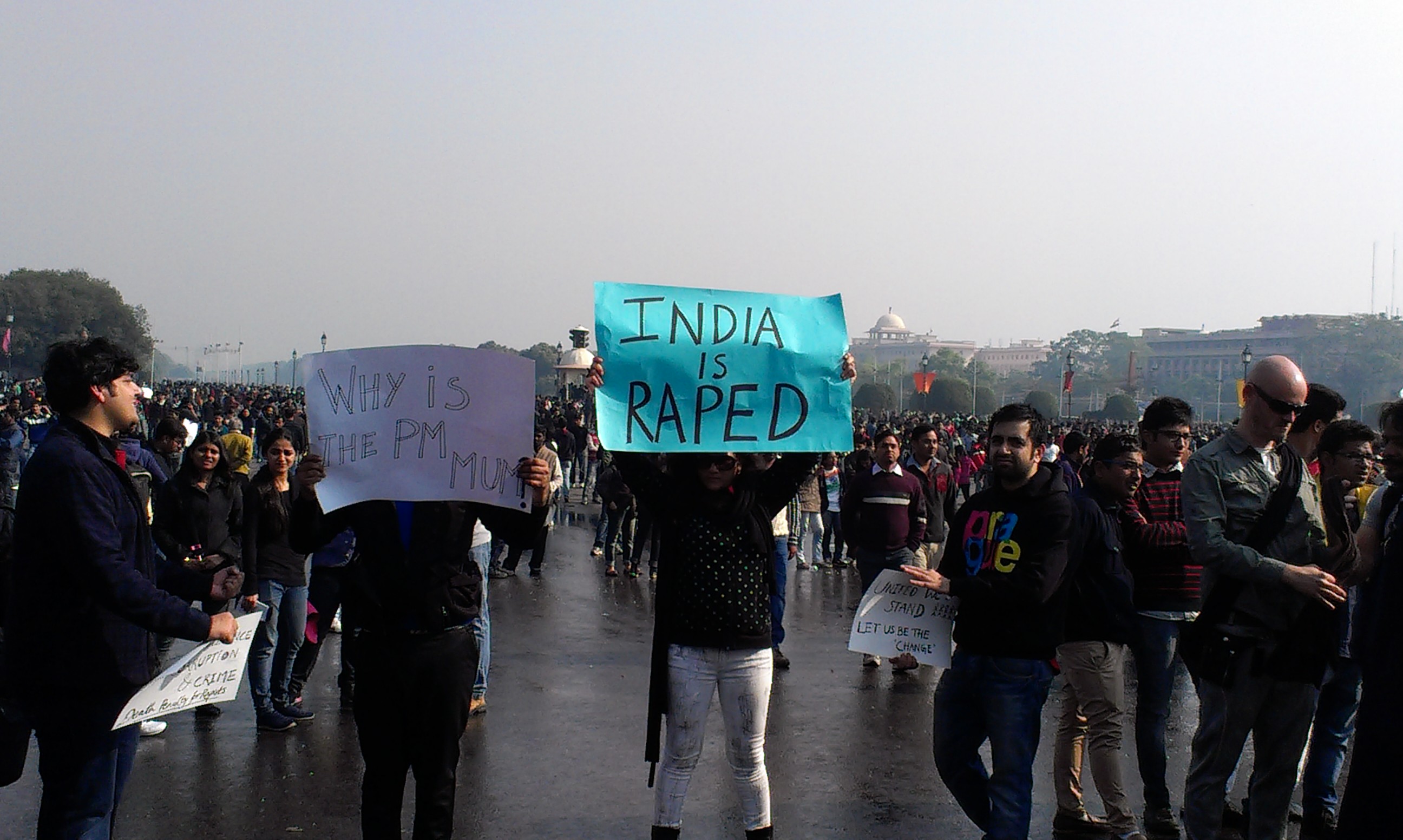
December 22 2012, students protest the rising violence against women, the morning saw as many women as men come out for the spontaneous march. Image credit: Nilroy (Nilanjana Roy)
Corrective measures
There are a few precautionary measures which the Indian government can take to improve the situation.
– Increasing security and information centers for tourists in India, and ensuring that all policemen are courteous and capable of taking a tourist’s complaint in English.
– The government can also provide a compulsory licensed guide (not this, but something less expensive and reasonable?) to all first time visitors for a limited time (this could also help in organizing employment in the tourism sector in India).
– The embassies of the visiting tourists must constantly update their to-do’s and dont’s and hand it to every tourist who enters India. An information guide or portal like this must include information about the crimes which have been reported by previous tourists – this can help a tourist remain alert to existing methodologies of scams or dangerous situations.
– A two or three-fold increase in punishment (imprisonment or fine or both) for crimes against tourists.
– Fast-tracking cases which involve tourists as a considerable amount of time and money is lost due to red-tape (this is a good example of speedy justice and needs to be observed across India)
The above measures may help, to some degree, in helping a western tourist feel safe.
Immediate need for an empirical research on attitudes
In a recent press conference while addressing the issue of the Danish woman who was gang raped, Delhi CM Arvind Kejriwal demanded to know the reason for so many rapes in India and more so in Delhi. This is a very perplexing question, and perhaps best understood by conducting an empirical study on the attitude of Indian men towards Indian women and their attitudes towards white women.
There is a common perception among many Indian men that white women are promiscuous, loose and overly sexual. This perception is fed by a number of mediums – ranging from hollywood films, pornographic films, to other forms of media, including Bollywood, where finding western dancers gyrate to some Bollywood item number is preferred. Many of these songs have nothing to do with creativity or aesthetics, but are meant to satiate mens eyes.
When it comes to Indian women, there also exists a tendency among some Indian men (which exists in both rural or urban India) to judge any Indian women who follows western culture as promiscous or as someone who is “asking for attention”. These perceptional issues can only be corrected by a combination of measures which includes sensitization, education and introducing stricter laws for crimes against women – be it Indian women or women travelers.
Given the diverse social structures in India and the various variables which come into play, to say that men from urban India or cities are more considerate than rural counterparts would be an assertion. Perhaps, only an empirical study can offer a reasonably correct measurement of where Indian men stand when it comes to their attitude towards women and western women, and whether or not coming from urban or rural India makes a difference.
Until the answers to these questions are found, it is in the best interest of tourists to be assertive and alert at all times – sounds alarmist, but better to be safe than sorry.
About the Author






I think Goa should be mentions here as well.
I recently lost my nephew Felix Dahl in there. He was murdered. His case is ongoing like so many before him.
The government of Goa doesn’t do anything to help the relatives of the victims,proper investigation never takes place and no guilty party is never prosecuted. This is widely known by everyone over there and its just the tourists that are unaware of these facts.
Due to the relatively small size of the state of Goa,the numbers of these killings are alarmingly high.
The world wide media is catching on these facts and Goa can not be considered a safe travel destination that it once was.
And with these killings they are killing the tourists industry in Goa.