
The tide may be against the Aam Aadmi Party (AAP), but they are in a position to turn things around in their own favor more than any other political party in India given their Gandhian ways
Mahatma Gandhi’s technique of countering British atrocities was simple – spelling them out to the public. To counter Gandhi’s influence the British often put those expressing dissent behind bars, including Gandhi. This, however could not have a lasting effect – the British had no idea how to deal with Gandhi’s strategy of ‘non-violence’. No matter what they did, they failed.
For a layman, Gandhi has been just an honest and truthful freedom fighter but if we look deeper, what worked in his favor was the ethos, pathos and logos which he put to use. How do you think things would be if Gandhi was the first one to slap? Would he be in a position to effectively represent the ‘victim’ group?
What Gandhi did was not just saintly but also politically astute. He offered another cheek but also propagated the pain which followed. The result? India’s independence. And do not forget, the British still live with the label of human rights violators. What do you think of political parties in India, who ruled for the last 60 years, will go down in history as?
Nearly six decades later, after the British left India, the AAP (Aam Aadmi Party) is representing a new victim group. A group which has survived rampant corruption and misgovernance operating under the guise of ‘worlds largest democracy’ and other such sociological propaganda’s. And this victim group is represented by all classes across India – what’s more, it is spelling out the atrocities, just like Gandhi did. Nearly six decades later, after the British left India, the AAP is representing a new victim group.
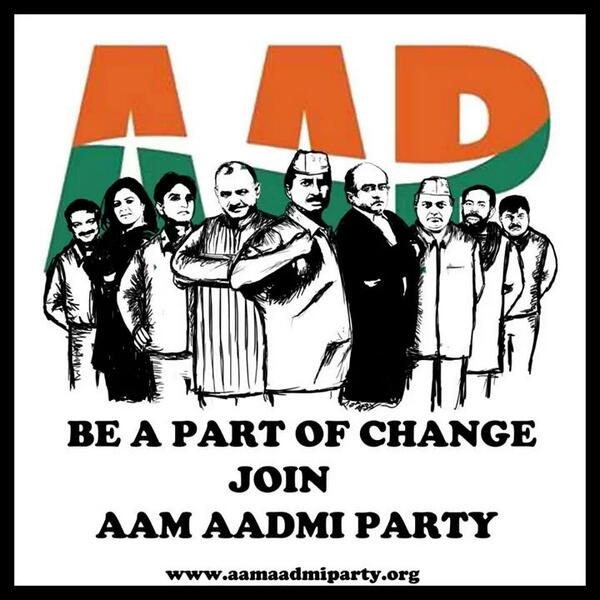
Image credit: Parul Bajaj
The only difference? There are no cheeks to offer, but tweets and mobile camera’s to raise, and live press conferences and campaigns to stream on Youtube. Call it revolution 2.0 – where social media is being put to purposeful use. The massive volunteer base of the AAP, as if, operating as a counter propaganda unit, and cutting the manipulations of the mainstream media in India which supports the dirty corporate-political nexus for its own bread.
Other Gandhian traits
There is another interesting Gandhian trait in the AAP – the decision to knowingly put oneself in high-risk situations. The AAP, for example, has a protocol to not take security. Gandhi too, was known to put himself in high-risk situations. ‘Those who preferred security to freedom had no right to live’, he said. He, too, like Mr. Kejriwal (the AAP convener) maintains now, once said, ‘his life was in the hands of God and that if he had to die no precautions could save him.’
Needless to say, by not taking security, the AAP leaders are walking on a sharp knife. But this decision also has the benefit of attracting and maintaining public attention towards them and the issues they raise. Although a risky bargain, it is, at least making people ‘think’ about why would, after all, Mr. Kejriwal choose to take such a risk? And what does he or his ministers gain from it?
The law and order situation in India is deteriorating. The number of women being raped and abused is rising steadily. The courts are burdened with a massive backlog, which could take decades to clear. Just as I finished writing this article, four men in Hyderabad had set a woman on fire because she resisted their rape attempt. In other news, a student from North East, living in capital city Delhi, was beaten to death. There is nothing ‘Bharat Nirman‘ or ‘India Shining‘ about this.
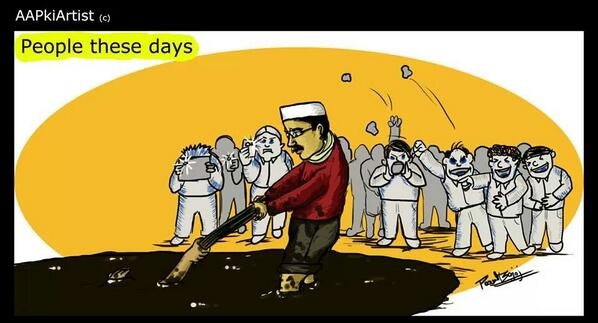
Image credit: Parul Bajaj
Target the image
One of the Aam Aadmi Party’s (AAP) main strength is their clean image which is why there are consistent attempts to malign it. These days it appears that political parties do not have many arguments to be used against the AAP. In the absence of which they try to ‘invent’ arguments – take the Media Sarkar sting operation, for example.
There were essentially two objectives of the Media Sarkar sting – Firstly to create doubt in the public mind about the AAPs clean image, secondly to create a public opinion that ‘AAP is the same as BJP or Congress and therefore voting for either or all makes no difference. The news media, to a great extent, appeared to support these objectives and tone and tenor of their coverage on the issue was disturbingly biased. The timing too of this sting was suspect.
Eventually the Media Sarkar tapes turned out to be edited indiscriminately to project the AAP leaders as ‘compromised’, but the new developments on the story (the details and context in raw footage) was not given air time on news channels – a typical strategy of the AAPs opponents to legitimize only one narrative and keep all other narratives out of the public and media discourse.
What is interesting is compared to the Media Sarkar sting, the Cobra Post sting which came a few days later, was a better piece of investigative journalism and made a shocking revelation about Congress and BJP MPs willingness to lobby for a fake international company in exchange of money. Though a serious case, it received only token mention in the Indian news media.
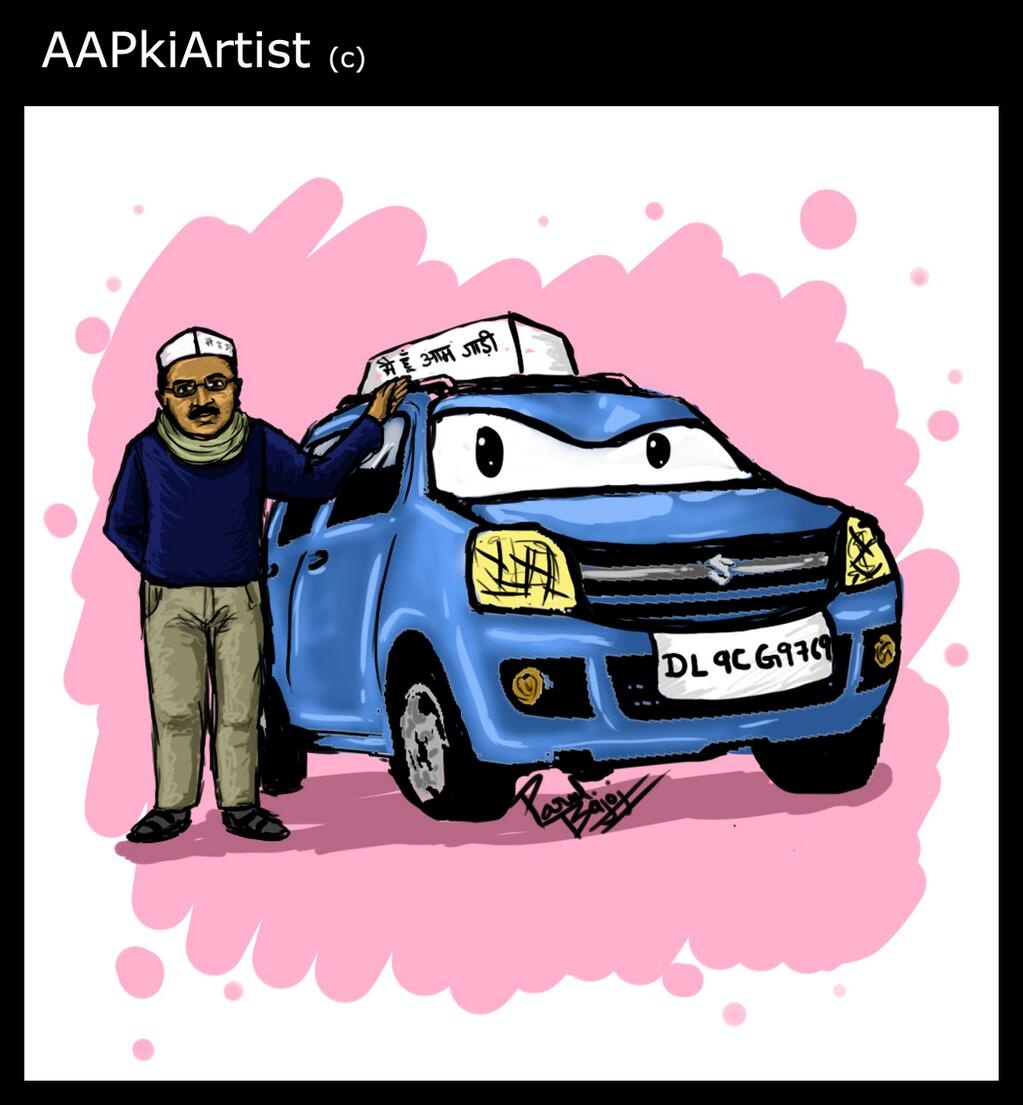
Image credit: Parul Bajaj
Operation dissonance
Unlike, the AAP, the Congress, BJP and others have consistently failed to appeal to the emotions and rationale of many people in India. Last ditch attempts are now being made by these parties to show themselves as accountable. Take for example, a recent interview with Congress’ MP Rahul Gandhi in Times Now – this was the first time in 10 years since he became an MP, that he felt the need to give an interview to a news channel.
It is possible that the BJP and Congress’ inability to appeal to people’s emotions and rationale is the reason for massive spin doctoring in the Indian news media these days. Their leaders, in general, lack both connect and good will. Given this atmosphere, breeding dissonance and setting agenda using trivial issues, name-calling, allegations etc. is the only option left with opposing parties to swing some votes before the 2014 Loksabha Elections. Add to this, extremely poor journalistic acumen where mere responses and counter-responses make ‘breaking news’ of the day.
All said, the AAP has to be prepared for a slew of propaganda waiting to be unleashed against them in the build up to 2014 Lok Sabha Elections (just like it happened before 2013 Delhi Assembly elections). This propaganda could operate under themes like – ‘Showing external threats’ (AAP is unstable, Pakistan may attack), ‘Anti-national sympathizers’ (AAP has sympathies of naxals and maoists), attempts to damage the AAP’s financial resources by running targeted campaigns among the NRI community and create mistrust or stalling tactics like filing arbitrary court cases as PILs, defamation cases etc.
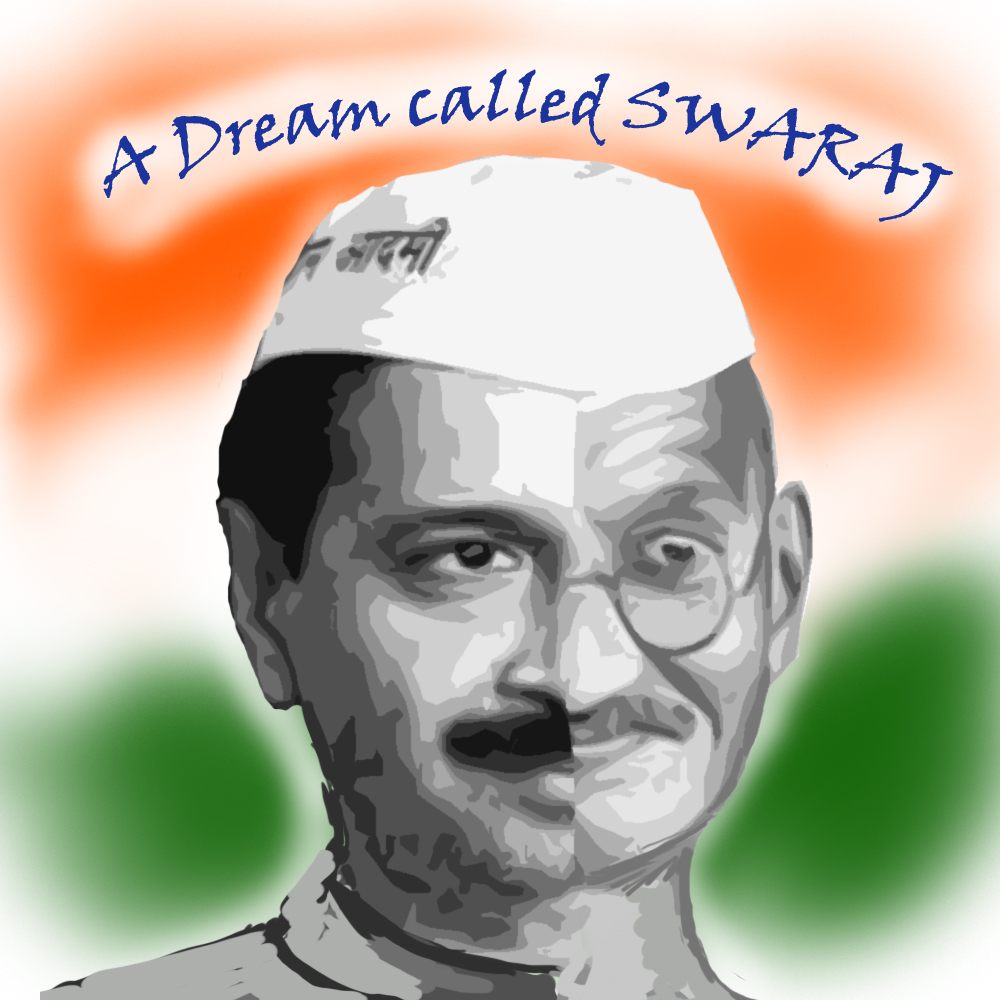
“A dream called Swaraj”. Image credit: Parul Bajaj
Question the media
In the past few days, Indian news media has failed to follow-up on important stories. For example, who wrote the Shanti Bhushan article and provided it to the media? Why did the Indian news media report too critically about Arvind Kejriwal’s Janta Darbar while a foreign correspondent for the BBC had a different story to tell? Why is it that the on ground public opinion and videos on Khirki controversy is different than what is reported in the news media? Why was the Media Sarkar Operation played up, while the Cobra Post operation played down? Why are BJP-Congress supporters projected as dissatisfied Aam Aadmi’s in news media shows? Why are there so many opinion polls on news television appearing to favor one party over the other? Is this to influence public opinion? What is their methodology? Is the channel open for evaluation?
More than ever before, the people of India must be critical of the news media and question their reports. A well-known media scholar Manuel Castells says, “Media is a place, where power is decided – media by itself does not hold any power.” People of India must recognize this and keep a watch on who is setting the news agenda and what could be the motivations behind it. Because “media is a place where power is decided,” many corporates and politicians invest in it. Media is not the be all and end all and people have the right to question or demand facts on a case to case basis.
For academics, perhaps an empirical research on how much time news media devotes to ‘issues’ rather than ‘personalities’ may lead to interesting results. The media too needs introspection – is it in denial that their readers can know better than they do? This political phase in India could damage Indian media’s reputation forever and also the profession of journalism.
Remaining steadfast
The strategies employed by the AAP are a trademark Gandhi, and there are no failures on this path. What is ironical – the opposing parties first started by ignoring the AAP, then laughed at them and have now released a slew of propaganda to fight them. The AAP could achieve the next step – which is, winning – provided it remains steadfast and committed to goals of the people in a non-violent way. And most importantly, the AAP must not worry about mistakes – mistakes will be forgiven if commitment and honesty is evident.
About the Author






lokpal bill is a boon for a common man………
http://youtu.be/Fg1o2dydkJs
MPs should chase voter/constituents to connect with them:-
mpConnect is an app which lists you the member of parliament at Loksabha, ordered by their names or constituencies.
The users can look up the MP from the list and connect with their respective MP, either by calling, texting or by email.
We hope that the MP’s shall contact you with their convenience. If the connections to a particular MP reaches our benchmark number, we shall try to connect with them and request for the responses.
If they cannot do per person, we shall provide them a web interface, where they can give a collective response of all the communications received.
Website URL: http://mpconnect.voter.in/
Email: info@voter.in
Android : https://play.google.com/store/apps/details?id=com.v_empower.connect_mp
IOS: https://itunes.apple.com/us/app/mpconnect/id723718298
Logo & Screenshots: Pull from the Website & Playstores (Android & IOS).