
Without realizing it, you are accustomed to the Eurocentric view of the world map: Europe is in the middle of the atlas and all other continents are gathered around. You don’t even question it, because this is how we were taught in school, this is how we see it on TV, and this is how, well, world looks like, right?
Imagine my surprise when I found in an American bookstore a map where North and South America are right in front of your eyes, Europe to the right, and Asia to the left. It might be merely an act of narcissism or it could be the acknowledgement of the human’s power-seeking nature.
A few days ago I was talking about this with a friend of mine, who happens to be from Egypt, and I had the ill-inspired idea of asking him how do they, in the Middle East, see the world. What do you mean, we, from the Middle East? I am from Egypt. And so it hit me: Why do we call it Middle East and what does it mean?
The Origins of the Term Middle East
The word itself started being used about 100 years ago and it was introduced in the context of colonial officers trying to define their sphere of influences. Both Brits and French had to mark their borders from neighboring colonial territories and to create fixed boundaries. Some people attribute this term to the year 1902, a British colonel being the first person who used the term Middle East. Recent scholars, though, say that it’s older than that, maybe dating back from 1800. In any case, it was not commonly used before the 20th century.
said Sebastian Maisel, Assistant Professor for Arabic and Middle East Studies at Grand Valley State University (GVSU).
The Middle East is not Middle East by virtue.
“Others have called it so, others that weren’t neutral: They were people with an interest of dominating this territory with results that we still see today,” said David Alvarez, Associate Professor at the Department of English Language and Literature at GVSU.
Coeli Fitzpatrick, Associate Professor who teaches Islamic philosophy at GVSU, said that the reason the term was even created was so that the British could talk about the region, meaning not quite China and not North Africa.
Britain and France were the dominant forces about 100 years ago, before the World War I, and they controlled much of the territories that we call the Middle East now.
“There were the Brits, the French, the Italians, and they all tried to carve out pieces from the nominal ruler, the Ottoman Empire, and incorporate it in their territory,” said professor Maisel.
This is how, from the European viewpoint, Orient is divided into far, middle and near, without taking into consideration any of the local naming.
Initially, when the world map was created by British colonial officers, they looked at the countries that are called now “the heart of the Middle East” from Egypt to Iran, including the Arabian Peninsula. At the same time, North Africa, Afghanistan and Pakistan were excluded. Why? Simply because, as you can see, the core Middle East territory was a British colony, while North Africa was under the control of the French.
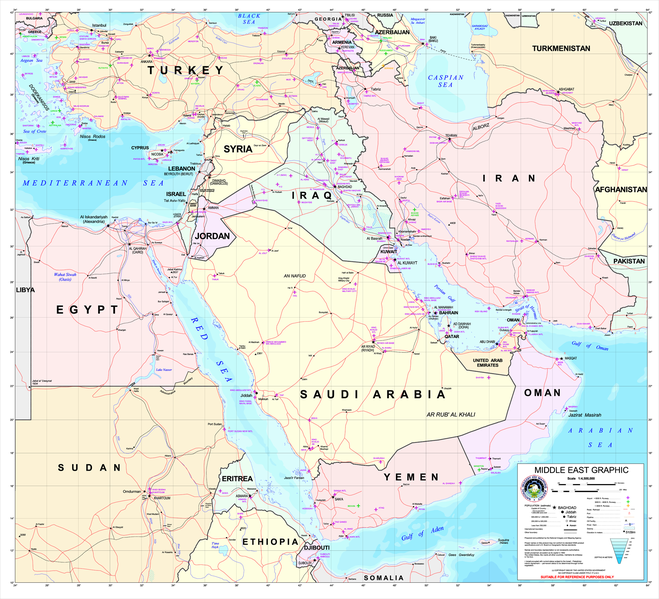
Middle East map. Image credit: US-Government
“It’s simply something carved out, that someone from the outside deemed important to them without considering the traditional borders, cultural borders and historical borders,” said professor Maisel.
After World War II, the world was again polarized and the area itself became more aware of its own togetherness. Considering the common language, religion, history and culture, it became accustomed to incorporate the territories of North Africa in the notion of Middle East because of the similarities with the core land, which was from Egypt to Iran and from Yemen to Turkey.
“You can see this is a gradual process,” said professor Maisel,”what we call Middle East became larger and larger towards the end of the Cold War with the war in Afghanistan.”
That’s when these two countries, Afghanistan and Pakistan, were more and more often incorporated in that notion of Middle East.
By then, those who defined the area as Middle East were no longer just the British and the French – it was the most of what we call the Western world, including United States.
What do Middle Easterners call themselves?
“That’s a good point, ‘cause they don’t call themselves Middle Easterners,” said professor Maisel.
Now, in the political context of our globalized world, you hear it more and more that people in the Middle East start referring to themselves as Middle Easterners, just to distance themselves from the West. It’s a new process though.
This concept of the East and the West was first brought to the region by the westerners a long time ago, starting with the crusades. They brought this differentiation: We are the westerners and you are the easterners.
In ancient times there were empires that ruled the entire area from Morocco all the way to Afghanistan and that was the time of the Islamic empire. The strongest power force for the past 1400 years in the region was clearly the Islamic state and it was another binding factor that brought Morocco together with Iran and Afghanistan.
It all changed during World War I, when the British and the French were finally able to defend the successor of those Islamic empires and carved out all the pieces, ripping it apart and creating new territories, new countries and new entities, where the connecting feature of the region was no longer the religion but the ethnic factor.
What would you correctly call this region?
“I don’t know,” said professor Maisel.
“I wish I had a good suggestion, but we don’t, that’s why we still call it the Middle East,” he added.
What would Middle Easterners like to be called?
“They don’t know either. You cannot make it right for everyone, that’s the problem,” said professor Maisel.
Unlike in Europe, where a country is defined based on the majority of the population, the Middle East is so diverse that it does not have an absolute majority.
In some countries the majority is 60 percent of the population, and if you call the entire region based on those 60 percent, what do you say to the other 40 percent, who will demand equal representation?
If you call someone a Middle Easterner …
That’s an offense.
“It’s derogative, it clearly puts you lower, makes you inferior. It was created with the intention of ruling from an outside ruler, of the colonial power over the subjects, disregarding their rights, their abilities,” said professor Maisel.
Middle Easterners don’t think about themselves as Middle Easterners. They think of themselves as Palestinians, or Jordanians, or any other nationality.
Call them by the identity that is the most important to them, said professor Maisel.
“I think in the US the term Middle East does have a negative connotation for most people and I think that the reason for that is a long history and something that is called Orientalism,” said professor Fitzpatrick.
“I would imagine that people from that region think westerners have a negative view over the area and that westerners are fairly unsophisticated in their knowledge,” said professor Fitzpatrick.
“We in Europe and America have a whole series of stereotypes associated with Middle East: That it’s backward, it’s mostly dessert – all sorts of simplistic ideas about the region, when really one of the most remarkable things about this region is its complexity, especially at the level of ethnicity,” said professor Alvarez.
Why do we use this term?
“We still use it because we do, it’s a part of the language,” said professor Alvarez, “ but it’s always bound up with questions of power, with the intervention, interference and pressure exerted by outside powers.”
The difficulty here is trying to unite countries that became rather different. One hundred years ago one could easily have named them based on the lifestyle, religion, ethnicity, but over the past years, political systems have changed, populations have changed, economies have changed, education levels have changed.
It became very difficult to find something that brings all these countries, cultures, peoples, religions together and describes them as one entity.
“I think people don’t call it the Arab World because it doesn’t include North Africa necessarily, or parts of North Africa that we want to talk about,” said professor Fitzpatrick.
When talking about the Arab World, a lot of people think of the Arab League, which includes 22 countries and a number of those countries are African, that people would never think of as Arab countries, like Mauritania, Djibouti, and Comoros.
“You can see that is complicated. If we say Arab World, we maybe leave out parts of North Africa, we also leave out Turkey, Israel, Iran- countries that are right there and have in many aspects a shared culture and shared religion, if not a shared language,” said professor Fitzpatrick.
What does one mean when saying Middle East?
This term does not capture perfectly a geographical area. It’s slippery. Morocco, for example, is usually a Middle Eastern country in peoples mind but Mauritania, which is farther east is not. But Egypt, which is even farther east, is.
The meaning mainly depends on the criteria that is used. If you’re using religion, from the whole area you have to take Israel out, you have to put Pakistan and Afghanistan in. Or if you’re using economic development, then Turkey looks very different from Yemen, which is solidly in the Middle East. If you use religion, it’s complicated by the fact that even though the majority in many of these countries may be Muslim, there are many minority religion, like Christianity and Judaism.
Language doesn’t capture Iran, Turkey, Israel, and many countries in North Africa.
“You look in any book from introductory texts to more advanced text and there is always a long discussion about what we mean by the Middle East,” said professor Fitzpatrick.
There isn’t one thing that unites them. It’s not just one entity, it varies depending on whom you ask. Even between scholars this division of ideas and beliefs is true.
Now people often talk about something that’s called the Middle East and North Africa, MENA. Even though this is at least a bit more definitive, it still doesn’t capture the cultural side.
“Anything that’s more Arab is deemed to be Middle Eastern,” said professor Fitzpatrick.
“I would imagine that people from that region think westerners have a negative view over the area and that westerners are fairly unsophisticated in their knowledge,” said professor Fitzpatrick.
This history of colonialism has shaped the world we see now in many, many ways, the whole notion of the East is formed from the stand point of Europe.
How long is this term is going to last?
“Good question. I don’t know. We’ve inherited this world of names, Australia, Latin America, North America, the Middle East, all colonial names. How long this term will last we don’t know, but colonialism lives on in these other ways, that we do know,” said professor Alvarez.
About the Author






Victoooorieee !!!!!!!!!!