
Sunday 23rd February marked the 33rd anniversary of what Spanish people call ’23-F’. Just five years after the death of dictator Francisco Franco, the country was slowly transitioning towards democracy. But on the 23rd of February, 1981, a group of military police broke into the Spanish parliament building, holding the country’s key politicians hostage for several hours. Their goal was to quash democracy and re-establish authoritarian rule, and although they ultimately failed, they did manage to produce one of the most iconic events in Spanish history. Shots were fired in the middle of a legislative session, tanks were deployed, and the king was forced to break his traditional neutrality in a televised speech.
33 years later, few would doubt that Spain is a genuine, established democracy. There are many flaws in the system, for sure, but a return to the authoritarianism of the Franco years is unthinkable. What does this have to do with anything? Quite simply, it is a reminder that transitions to democracy are confusing, violent, and above all long. At a time when about a dozen countries – from Tunisia to Ukraine, Burma to Egypt – are struggling with transitions of their own, we would do well to be patient and not judge these processes until they are complete.
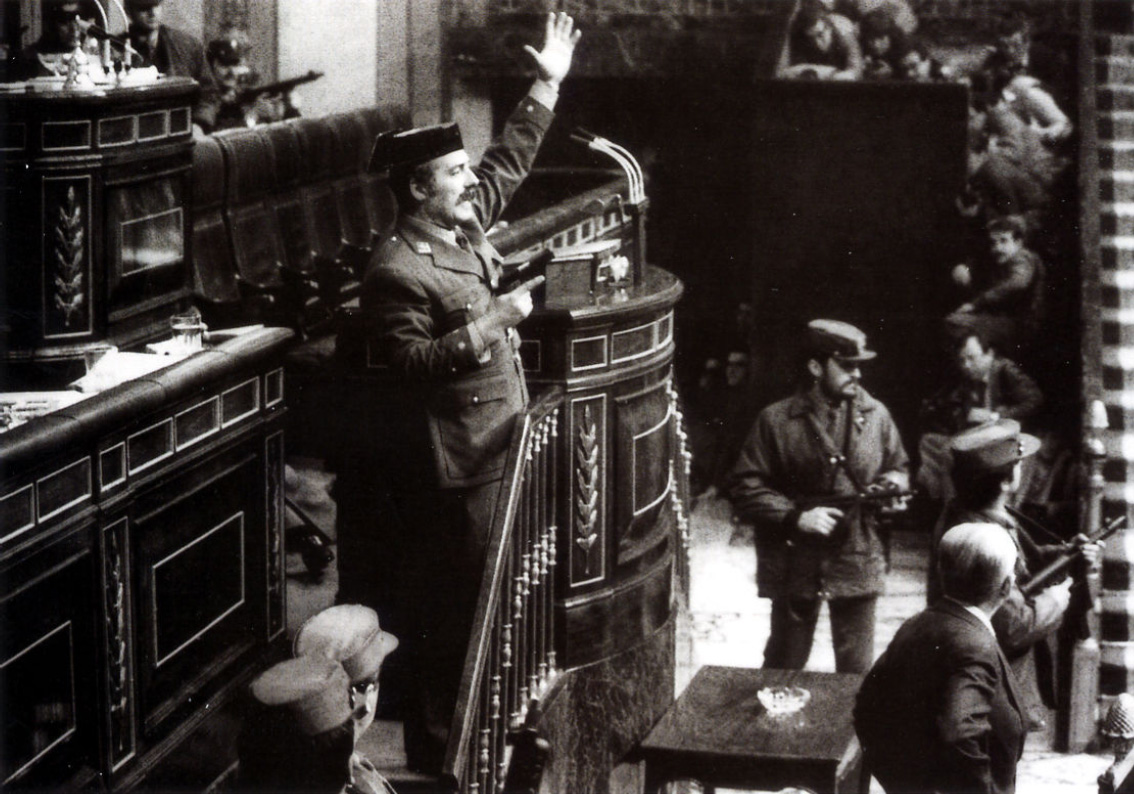
The 23-F coup attempt in Spain
Modern media’s need for simple, fast conclusions
Just try googling ‘[country name] transition failure’ and you will find that the media have a thing for predicting the outcome of revolutions. The Egyptian uprising? Ultimately a failure. Burma’s new leadership? Failing. There was a revolution in Libya? Think again. Tunisia’s is perhaps the only transition that is being lauded as a success, but in all these cases I have to say: it’s too soon to know. These countries have all been reforming for less than three years. What if Burma manages to bounce back? What if events in Tunisia take a turn for the worse? The media are loving every up-and-down in Egypt because it means that they can pronounce the transition dead, thus selling more newspapers or getting more viewers. But look at the precedents and you’ll realise that the ultimate outcomes of these transitions remain a mystery.
What should transitions be like?
Political science and history can help us understand these processes better. Firstly, transitions are confusing. When a dictator is overthrown, what is left behind is a vacuum of political power. Previous elites are removed from the picture, and very often the army and police forces are reformed to represent the country’s new ideals. With this lack of a clear authority, it is often difficult to tell just what is going on.
Furthermore, in some cases such as Egypt or currently Ukraine, there is the question of what to do with the previous leader. Punish him for his past actions, and you might anger his supporters. Set him free, and he might become an outspoken enemy of the transition process. Previous examples show that there is no good option, just one that is slightly less bad. Chile and Spain, for example, refused to punish their former dictators, and this created much tension. But a more aggressive strategy in these cases might have hurt the chances of a democratic transition succeeding in the long-term. In situations in which there can be no win-win solution, confusion is a given.

Pinochet, Chile’s bloodthirsty dictator during the 1970s and 1980s, was never punished for his crimes.
Secondly, transitions are usually violent. Spain during the late 1970s and early 1980s saw an average of 80 people die as a result of political violence every year. Egypt and Burma are seeing similar degrees of uncontrolled violence today. Why is this? Quite simply, because of the power vacuum mentioned above. A state in transition, with all its ministries and departments and natural resources, is essentially like an untouched cake. Every political force will want to take the largest slice of the cake, and many will use violence to achieve this. In fact, one of the most robust theories of international relations, the Democratic Peace Theory, has found that states in transition are very likely to engage in wars with other countries. Therefore, the violence inherent in large political reforms is both intra-state and international.
Finally, transitions are long – longer than the media can bear. Precisely because of the power vacuum, and precisely because of the fight for control of state structures, it can take a long time for things to fall into place. In most cases, the unity and co-operation that made the revolution possible breaks down as soon as there is no-one to fight against.
Spanish democrats of the 1970s and 1980s had an iconic phrase to explain this: “contra Franco vivíamos mejor”, roughly “life was better when we were fighting Franco”. This goes to show that it is easier to co-operate with others when you have a clear goal, such as overthrowing a dictator, than it is when you have to go through a complex political transition. The lack of unity among former allies in Egypt or Libya is nothing new, and neither does it mean that their transitions will fail.
In this article, I have put forward the argument that transitions are almost always confusing, violent and long. I claim that it is too soon to judge any of the processes that began during the last 2-3 years, and making predictions about them is impossible. In fact, many political scientists argue that a country cannot be considered to be an established democracy until it has gone through two consecutive elections in which the loser willingly admits defeat. The media will disagree: they will rush to conclusions now instead of waiting until 2020, because that is what it takes to attract an audience. I just hope that, the next time you read a heading claiming that “The transition in country X has failed“, your natural reaction is to say “it’s too soon to know”.
About the Author





