
Australia’s immigrant policies are arguably some of the toughest in the world, but the Australian Government’s latest attempt to deter asylum seekers sparked unparalleled international criticism. The new campaign features a graphic novel, depicting the challenging life of an Afghan asylum seeker in a compulsory detention centre, and a poster of a boat on rough sea, the slogan reads: ‘No way! They will not make Australia home’.
The campaign appeared on the websites of the Department for Immigration and Border Protection and the Customs and Border Protection in November, with the apparent aim to discourage asylum seekers entering the country by boat, and to discourage human trafficking.
Criticism
Members of the Australian Government, responsible for the campaign were unwilling to comment despite the large volume of criticism. Human rights activists deemed the campaign ‘distasteful’ and ’embarrassing’ propaganda. While some politicians also expressed dismay:
”This document is in incredibly poor taste,” said Greens Senator Sarah Hanson-Young. ”The fact that it came from the Australian government is a disappointing indictment on our once generous nation, which helped to draft the Refugee Convention”.
”When did the lucky country, the country of the fair go, become the country that threatens to break people’s spirits, including children, by locking them up on remote Pacific islands?”
Human rights advocate Jarrod McKenna deemed the latest immigration campaign ‘horrific’, while members of the public criticised the publication for being ‘uncompassionate’ to vulnerable people who risk their lives in hope of a safer future.
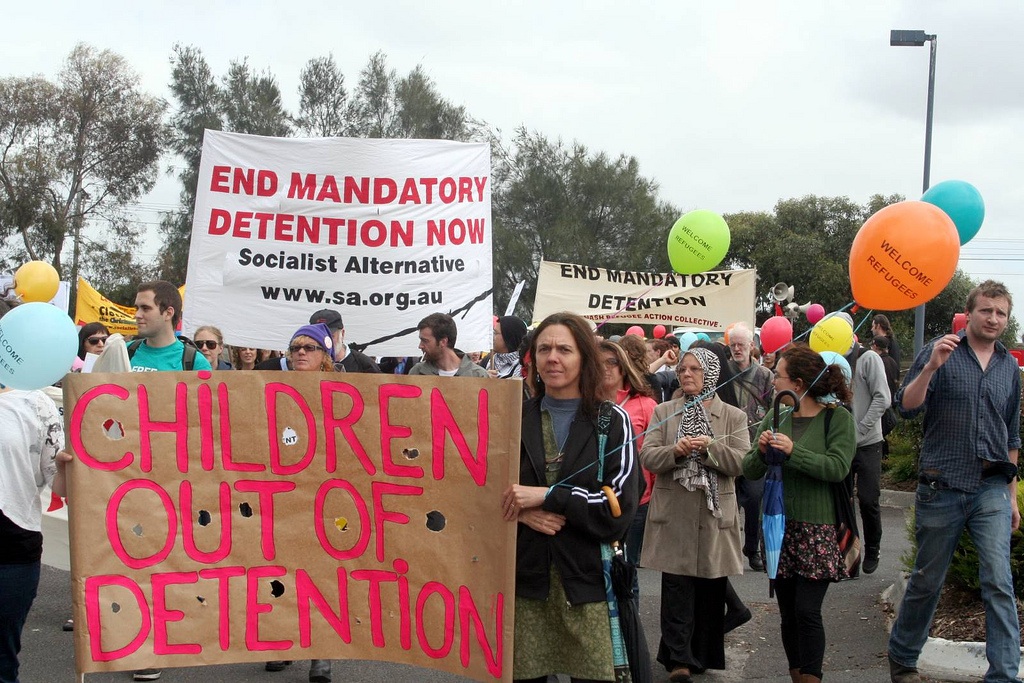
The Refugee Action Collective organised a march and protest on Saturday 2 April 2011 against children in immigration detention outside the Melbourne Immigration Transit Accommodation at Camp Road, Broadmeadows. Image credit: Takver
Propaganda?
Further criticism came from Australia itself: The Coalition labelled the campaign ‘propaganda’, for its appearance in national media before its circulation abroad began. Senator Sarah Hanson-Young accused the campaign of fear mongering among the general Australian public against immigrants, and demonization of potentially vulnerable people, some of whom possibly are attempting to escape death and torture.
These are not the only controversial details however, as stated earlier, the campaign’s official aim is to save lives by deterring immigrants from tackling rough seas. The newly updated Department for Immigration and Border Protection website however, states that navy personnel are now advised to immediately turn boats back upon judged safe to do so. Would this save lives? It seems unlikely.
Deterrence Campaigns
Aside from its ethically strongly questionable message, could this deterring campaign ever succeed?
The graphic novel tells the tale of a young Afghan man, whom upon becoming bored at home and dreams of greener pastures, decides to embark on a dangerous journey by sea, to Australia, just to end up in a detention centre suffering from a number of ailments, home sickness and depression and eventually wishes he stayed at home.
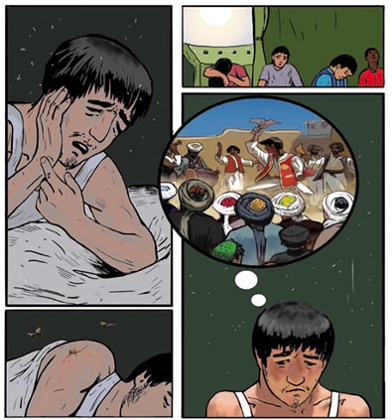
A page from the graphic novel apparently aimed at potential Afghan asylum-seekers. Image credit: theguardian
In the case of most asylum seekers however, this is not true. Immigrants arriving by boats tend to have very good reasons for crossing dangerous waters, often to escape torture and death.
As Julian Burnside, Australian human rights lawyer puts:
The campaign does not seem to have the potential to affectively deter asylum seekers from entering the boarders by boat, the core of its failure lies within its uncompassionate ideology. The campaign as observed by many, appears to have a motive other than asylum seekers welfare at heart. It pictures a rather xenophobe approach to dealing with a very sensitive issue.
Gentle Solution
What would deter immigrants from crossing rough seas? Information is power, and that is what asylum seekers are often denied of in their home countries. Information that is easily available and understandable could put the power of controlling their own lives back in their hands. Furthermore, offering asylum seekers alternative, safer modes of transport, and safer detention centres with shorter waiting times, could effectively offer them what they need the most, a safer place to wait for the decision that may change their lives.
About the Author





