
As the Crimean crisis and the missing Malaysian airline dominate headlines around the world, the sectarian violence that has been sweeping the Central African Republic for many months continues. Recent reports have confirmed that Christian militias have killed thousands of Muslims and forced more than a million people to be displaced or flee to neighbouring countries. Human rights groups are calling this latest African tragedy ‘Ethnic cleansing’. Does this mean that Central African Republic is the new Rwanda?
Few people can forget the horrors that took place in Rwanda 20 years ago when more than 800,000 civilians were indiscriminately killed. Hutus who made up 90% of the Rwandan population began to systemically kill Tutsis across the country. As the mass slaughter continued the international community stood by and watched 800,000 die needlessly. Another similar atrocity is currently taking place 853 miles north of Rwanda in the Central African Republic (CAR), were the Muslims have become the new Tutsis.
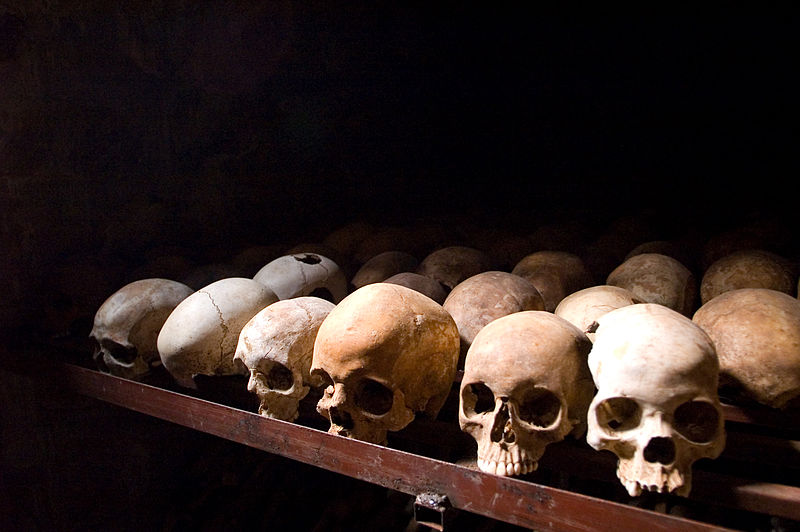
Nyamata Memorial Site, skulls. Nyamata, Rwanda. Image credit: Fanny Schertzer
Muslims, much like the Tutsis are only 10% of the population. Indeed, this eerie similarity doesn’t end there as both minorities have governed over the majority in their respective countries at one point, creating deep-rooted resentment amongst the masses. The Christian majority of CAR immediately began to resent their new Muslim interim president Michel Djotodia, when he seized power in March 2013. Jotodia with the help of his ruthless militia group ‘Seleka’ overthrew the previous government thus becoming part of the cycle of coup d’états that have plague the country since gaining their independence from France in 1960.
In September last year, Djotodia disbanded ‘Seleka’ causing its disgruntled ex-soldiers to go rogue and disperse into the countryside committing mass murders, rapes and looting with impunity. Consequently, a Christian resistance force propped up calling itself anti-balaka meaning ‘anti-machete’ to defend themselves from the out of control Muslim ex-Seleka soldiers. The unprecedented violence reached the capital city Bangui, where the reprisals wiped out whole Muslim neighbourhoods. The news network Al-Jazeera added: “Anti-balaka attacks on Muslim rebels have been no less vicious than those made by the Seleka”.
The bloodthirstiness and barbarity of these militia groups is a reminder of how evil the human race can be. On January 18th, more than 100 Muslims were killed in separate attacks that lasted just a few hours in towns such as Boali and Bossembele situated 157 miles north west of Bangui. Just last month in a city called Carnot, 70 muslims lost their lives including babies that were snatched from their mothers and those who survived sought refuge in catholic churches.
In the capital whole muslim neighbourhoods have been torched, looted and its inhabitants chased and killed mercilessly. In another neighbourhood, a Christian mob lynched two Muslims and burnt their corpses in front of the international media. Two months ago, a cannibalistic anti-balaka fighter who goes by the name ‘Mad Dog’ was filmed eating the flesh of his dead victims in front of an impassive crowd. Recent reports have also revealed that Muslims married to Christians were also targeted causing many to flee and break away from their families. Children who were captured were either killed or forced to fight alongside the other 6000 child soldiers currently trapped in the conflict. Those who remained in the country have taken up refuge in Muslim enclaves, mosques and even sympathetic churches. Last year the Muslim population of Bangui was 145,000 now it stands at just 900. The anti-balaka’s mission of eradicating the Muslim population from CAR will soon be a foregone conclusion. These militias want nothing short of a vengeance and are intent on creating a Muslim exodus according to Amnesty International.
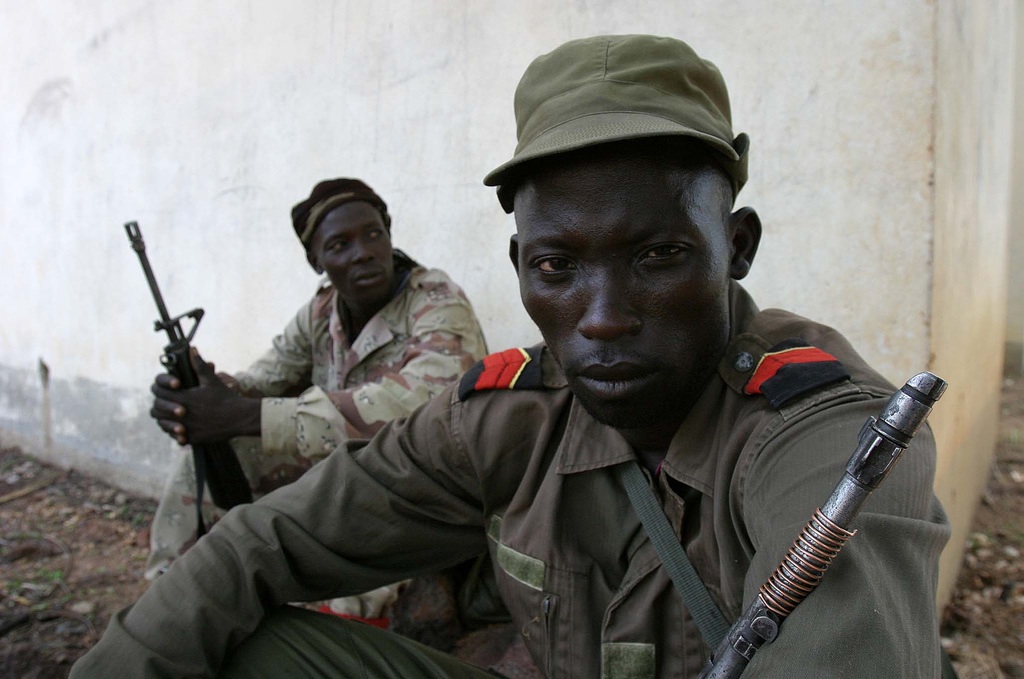
Rebel in northern Central African Republic. Image credit: hdptcar
By December 2013 it became apparent that CAR was spiraling out of control and that president Michael Djotodia’s grip on power was waning rapidly. As the sectarian violence escalated so did the international pressure calling for Djotodia to step down. On January 10th, the divisive ex-seleka leader Djotodia resigned thus going on a self-imposed exile. His decision to abdicate must have been a very difficult one for the power hungry individual who spent many years launching western-backed mutinies against the Francois Bozizie government. Nonetheless, his resignation was an attempt at appeasing the Anti-balaka militia and to end the bloodshed that spread through CAR like cancer. Just two weeks after Djotodia’s resignation, MPs elected Catherine Samba-Panza to become CAR’s first female president. She became the third African female president ever after Ellen Sirleaf of Liberia.
Undoubtedly, Just like Sirleaf, she has inherited the arduous task of staunching the sectarian violence that has engulfed the mineral rich country. President Samba-Panza, who declared war on the Christian militias last month, has rejected the label “ethnic cleansing” used to describe the violence in Bangui and instead claimed it is merely a ‘security problem’. Nevertheless, Catherine who is the daughter of a Cameroonian father and a Central African mother is in a better position than her predecessor at uniting the country that has been in a constant political turmoil for five decades. Dubbed ’mother courage’ by the local media, the new interim president has received the backing of France, its old colonial ruler.
Francois Hollande has sent 2000 soldiers to act as peacekeepers to support the 6000 African Union soldiers currently patrolling the streets of Bangui. Even if France is protecting its own interest in the region, the early deployment of its troops have considerably reduced the bloodshed. President Hollande in a speech in Paris last Friday, has urged that ‘the EU must send 450 extra troops and that efforts must be made to deploy many more’. The EU has been criticised for its insufficient response to the unrest in CAR instead it has been too busy at attempting to resolve the Crimean crisis. Averting a full-blown genocide and delivering aid to hundreds of thousands of people in an impoverished country supersedes any attempts to punish Russian officials responsible for the annexation of its former Crimean Territory. The UN on the other hand, has yet to deploy troops to CAR more than 7 months since the inter-religious violence erupted. Navi Pillay, the United Nations High Commissioner for Human Rights who visited Bangui last week, has called for the international community to contribute to a 12,000 strong UN peacekeepers to stop crimes which she said included acts of cannibalism and decapitations of children.
The UN will have the difficult challenge of policing a country that is bigger than France and with a population of more than 4.5 million people. However, it must act swiftly and learn from its catastrophic failings in Bosnia and Rwanda. Although large-scale mass killings have been halted, violence still occurs every day in Bangui and in the countryside. More than 15,000 Muslims currently trapped in enclaves in the capital city are being protected by foreign peacekeepers. It’s these foreign troops that the UN is heavily relying on while it currently investigates the ‘ethnic cleansing’ and draws up a list of suspects responsible for the violence for an eventual prosecution. ‘Genocide’ may not have been officially used to describe the anti Muslim violence that has been unleashed in CAR but it certainly has exhibited the hallmarks of one.
About the Author





