
Football is turning increasingly ugly but its defects are merely symptomatic of the wider flaws of a modern capitalist society out of control.
Football. A divisive topic at the best of times, an obsession for some and an irritation for others. As this season’s Premier League crescendo draws near it is increasingly hard to escape the onslaught of live matches advertised for TV viewing. Back when David Mitchell was sans beard and Robert Webb hadn’t made a foray into political commentary “That Mitchell and Webb Look” aptly and hilariously portrayed the state of the game in the modern televised era.
Aside from the fact that football coverage seems continually shoved down our throats, with BT the latest player to try and muscle in on Sky Sports’ golden goose, those who hate on the so called beautiful game have plenty of ammo. Recent times have seen players biting other players, managers head-butting opposing players, and more controversy, tantrums and bad behaviour than the average episode of Geordie Shore.
https://www.youtube.com/watch?v=GopdzPxE2gk
More seriously, the modern game has been dogged with racism scandals involving players and fans as well as more general problems with discrimination (Messrs Gray and Keys, I’m looking at you!). It has been hit with accusations of corruption both on the field, and at the highest levels of its organising bodies, contributing to a growing sense of unease regarding the integrity of the sport. Topping this off, tensions continue to rise in Brazil where the World Cup is to be hosted next summer. Last June’s Confederations Cup, a dress rehearsal for the main event that is the World Cup, was disrupted by impassioned protest by citizens against a government who are claimed to have ignored the plight of the poor in stark contrast with the pandemonium of spending devoted to the upcoming festival of football. If this weren’t enough, construction work on the stadium in Brazil has come to halt amidst condemnation of sub-standard conditions that have led to the deaths of several workers. The beautiful game seems to many observers to be in a rather ugly state.
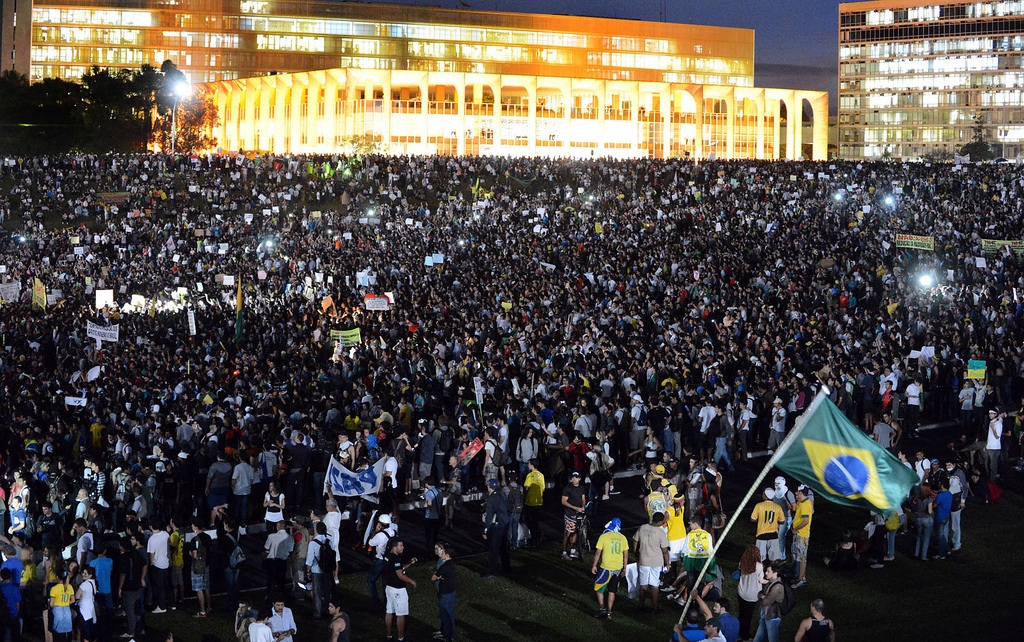
Thousands of students shout slogans during a protest of what is now called the ‘Tropical Spring’ against corruption and price hikes, at National Congress in Brasilia, on June 20, 2013. Brazilians took to the streets again on a new day of mass nationwide protests, demanding better public services and bemoaning massive spending to stage the World Cup. Image credit: Semilla Luz
Football tends to be castigated for very diverse reasons some of which simply are not alleviated by the kind of partial defence I put forward here. For example if you’re simply fed up of the pantomime performances and prima donna actions of the modern day footballer my protestations might fall on deaf ears. However the problems in football that are perhaps most universally condemned (and which, incidentally, most test the patience of this self confessed football obsessive) all exhibit a common tendency. They reflect general trends in modern society. Those ills that detract from the beauty of the game are in fact symptoms rather than the disease itself. Close consideration of these ills, how we perceive them and our attitudes towards them might tell us something about both the presence of and nature of the disease, but conflating one for another is ultimately counterproductive and leads to an unfair hatred of football.
Let us begin simply. Problems of discrimination (be it under the guise of racism, homophobia, xenophobia or sexism) remain dark marks clouding the outlook of football fans and casual or critical observers alike. Any attempt to defend football that completely ignores such lingering problems would be highly disingenuous. That said whilst such attitudes and behaviour associated with them are associated with the beautiful game they are all too prevalent in wider society to be a particularly exclusive criticism of it. Football provides the medium by which prejudiced attitudes can come to be expressed, a raw arena through which unsavoury or violent behaviour can be noticed. In this way football reflects society at large. Discrimination in all forms is upsetting, exasperating and rightly castigated, but football can perhaps be considered a scapegoat in many ways. When high profile individuals who are perhaps more educated or politically active in society wish to express similar sentiments, they hide them behind a wall of rhetoric and argument that render all that is unsavoury less accessible and obvious than when put forward by the average football fan. This in no way exonerates the latter group, but perhaps moves us to refocus our critique on that which is deplorable rather a single medium through which it might be commonly expressed.
In many ways this narrative is best applied to a consideration of football in conjunction with a critique of capitalism in our increasingly globalised society. Marxist considerations of the role of football are not new territory. The academic Terry Eagleton in a conversation-provoking piece claimed that football in many ways fulfils the same role Karl Marx attributed to religion as an “opiate of the masses”. An addictive, populist group endeavour distracting individuals from the injustice of the world around them. The idea here is that with our focus on the ultimately unimportant game in front of us, the powers that be can utilise football to placate hoards of people who might otherwise revolt at an organisation of society that currently benefits the few at the expense of the many. Such an argument to many is given a similar status to other Marxist musings, acknowledged to hold a fair degree of resonance, yet all to often dismissed as being mere conspiracy theory.
It is thinking from this Marxist tradition of political thought that ultimately provides the lens with which I seek to assess the game. Many of the defects seized upon thus far are symptomatic of the ills of global capitalism, the system in which football operates (much to the horror of many purists). Players holding teams to ransom for extortionate wages sounds rather like other industries in which executive pay exists at a stratospheric level, entirely disconnected from the real world. Wayne Rooney’s reported £300,000 per week deal does not exist in isolation, but in fact is only a small part of general trends of excess amongst celebrities and elites who revel in decadence whilst it remains the case that approximately 1.4 billion people live on less that $1.25 a day.
Corruption at FIFA mirrors high-level corruption found in big business, the media, the city of London and politics, issues we have been reminded of quite blatantly in recent times. Big teams exploiting smaller clubs for their young talent act exactly in the manner of big corporations and companies who dominate the landscape of the modern market economy, stealing away the ideas of potential competition for a fraction of their true value and bullying their way to an even bigger market share. Billionaire owners taking control of teams, raising ticket prices and trampling on the sentiments of people long associated with the club before their money came in matches the actions of companies ripping off the very consumers their product relies upon all in the name of the profit motive. And that motive, the unrelenting desire for more (or simply put, greed) is what Marx in Das Kapital claimed to fuel the “vampire like Capitalist” which sucks away the lifeblood of the labourer. The treatment of workers in Brazil, as expendable commodities exploited for profit fits so neatly with this narrative. Football is now a money-making machine operating within a messy capitalist paradigm and it acts as such. The opiate is coming to resemble the ugly symptoms it is ordinarily supposed to soothe.
Football has its more unique problems, and with many other areas of society, it is often held in poor regard due to the unpalatable actions of an unrepresentative minority. Most importantly, though, football is a reflection of society itself. The game is undeniably suffering from numerous symptoms rendering it increasingly ugly. Bet let us trace those symptoms towards the disease itself. That disease is the particular form of our current modern, capitalist society. If you don’t like these elements of football, you don’t like elements of the society we belong to and if I’m honest I don’t blame you. But if we want to make a change we ultimately need to try and do something about the root problem itself. The reform of football might even be a stepping-stone towards this wider reform. If certain, easily perceivable elements of football reflect the defects of global capitalism reaction to them might be more forthcoming than any wider backlash. In some ways we can already see this. Fans of Cardiff, Portsmouth and Hull City know all too well the tribulations that come with embracing the influx of big money. Could it be the case that football might show the need for activism in a way plenty of people can understand, turning undoubted negatives into the potential for positive, progressive reform? Perhaps. But if such reform ultimately isn’t forthcoming, there is of course another slightly more defeatist option.
With the world not being rid of its ills definitively any time soon perhaps there remains a case for retreating partially back to consumption of our various opiates. In a world that appears unfair, inaccessible, and seemingly unchangeable to the many can we really begrudge such a reaction? Opiates come in various forms, and to each their own, but let us never forget why they are needed. It is that which is most worthy of our criticism.
About the Author






Great piece!!!!!