
The United States and Iran have had a very difficult relationship since the Islamic Revolution in 1979, but things appeared to be improving when a deal was made between world powers over Iran’s nuclear program in November 2013. Yet, the US recently made a rare and controversial move that could jeopardize this progress. Last week, the US announced that it would not grant a visa to Iran’s proposed ambassador to the UN, Hamid Abutalebi, given the envoy’s ties to the 1979-1981 hostage crisis at the US Embassy in Tehran.
According to Al Jazeera, Abutalebi has admitted that he was an interpreter for the group that held the hostages, but claims that he was not part of the takeover of the embassy. The United State’s decision has drawn immediate criticism, and one wonders why they would risk crucial talks with Iran surrounding its nuclear program over an event that occurred 35 years ago. As the Washington Post notes: “The administration’s decision is likely to be viewed by some other governments as a breach of the United States’ responsibilities as the host country for the United Nations.”
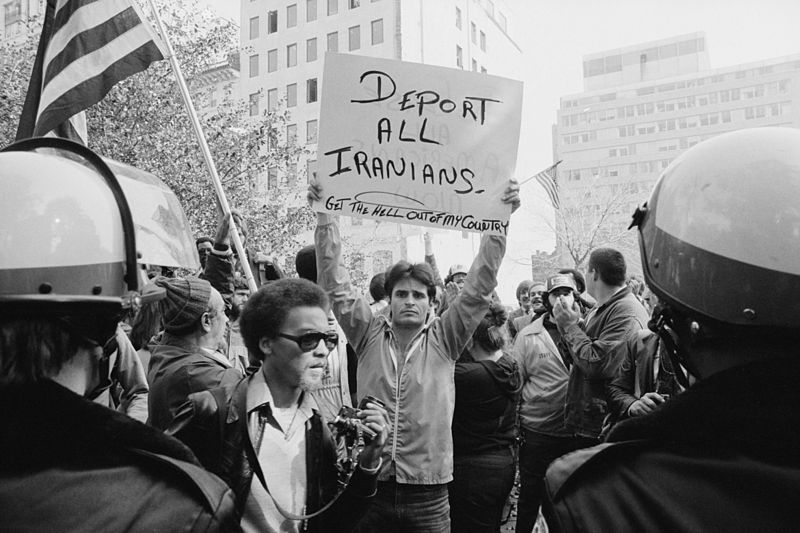
Iran Hostage Crisis student demonstration, Washington, D.C. Image credit: Trikosko, Marion S
US law allows for the government to bar diplomats that are considered national security threats, but is very difficult to characterize Abutalebi as such. From the looks of it, Abutalebi played a very limited and nonviolent role in the hostage crisis. Moreover, he is a veteran diplomat, having served as the Iranian ambassador to Italy, Australia, and Belgium. Thus, refusing his entry is a blatant insult to a country that the US already has historically poor diplomatic relations with. Accordingly, the United State’s decision appears to be a product of an inability to let go of the past and move forward.
This is not to say that the actions of the individuals responsible for the hostage crisis were somehow admirable, but one should remember that the crisis was largely a product of the complicated history of Iran in the 20th century. This includes a CIA orchestrated coup that deposed Mohammad Mosaddeq in 1953, which restored an absolute monarchy under the Shah:
.
The United State’s powerful position in the world means that it will almost always be included in important discussions between countries surrounding topics of global concern. Most countries do not have the same luxury, however, and it is troubling that the US is using its position to exert influence over the United Nations in this manner. After all, the United Nations is a forum for the world’s nations to come together and find common ground, not an exclusive club in which the US gets to decide who has the right to speak and who doesn’t.
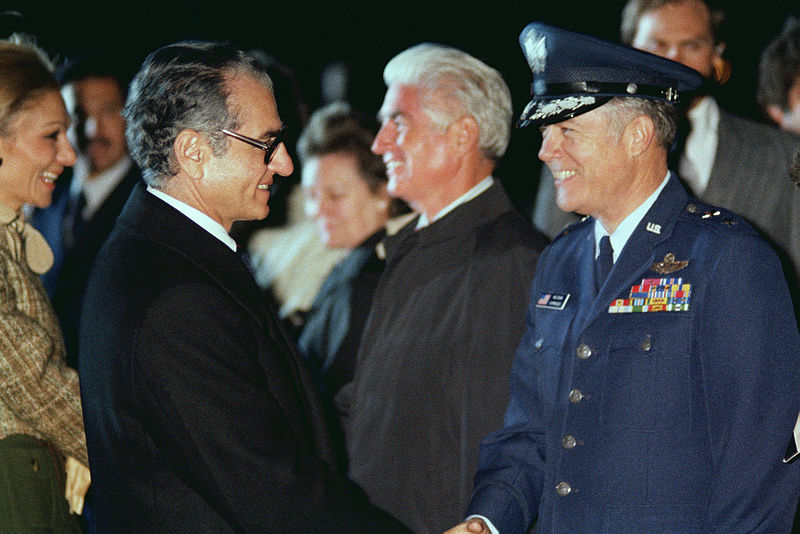
Mohammed Reza Pahlavi, Shah of Iran, shakes hands with a US Air Force general officer prior to his departure from the United States. Image credit: PD-USGov-Military-Air Force.
Richard Gowan, an international relations expert at New York University, makes an important point on the matter:
Consequently, Iran has complained to the UN about this decision. According to the BBC:
Iran’s deputy envoy at the UN in New York, Hossein Dehghani, wrote that the US had violated its legal obligations and set a dangerous precedent… Mr Dehghani wrote to the UN Committee on Relations with the Host Country to request an urgent meeting. He complained that the US had violated its legal obligations under international law, and under the agreement establishing Washington’s responsibilities towards UN headquarters. “This decision of the US government has indeed negative implications for multilateral diplomacy and will create a dangerous precedence and affect adversely the work of intergovernmental organisations and activities of their member states” he warned.
Under the 1947 Headquarters Agreement the United States is typically required to grant visas to individuals invited to the UN in New York.
On Monday April 14, Iran requested a special meeting of a U.N. committee on the United States’ refusal to grant a visa to Tehran’s new UN ambassador appointee. Cyprus U.N. Ambassador Nicholas Emiliou said a meeting would likely be held next week. Emilios chairs the 19-member committee dealing with issues including immigration and security.
It should be noted that the decision to bar Abutalebi is not exactly final, both the Senate and the House of Representatives have voted in favor of passing the bill that would make his entry into the US illegal but President Obama still has to sign it into law. President Obama has come under a lot of pressure to do so, according to Michelle Nichols:
At the moment, it is apparent that Abutalebi’s visa application has been denied, but Iran is not backing down. White House spokesman Jay Carney said the UN and Iran had been told “that we will not issue a visa to Mr Abutalebi”. Neither the White House nor the US State Department has provided any further details.
According to Barry Rosen, one of the hostages in 1979, the refusal of Iran to acknowledge the hostage crisis is one of the reasons that this issue is still relevant and controversial:
On Nov. 4th, 1979, a group of radicals seized the U.S. Embassy in Tehran and kidnapped the diplomats inside, flouting fundamental international law.
I and 51 of my colleagues then suffered through 444 days of fear, beatings, solitary confinement, mock executions and other horrors — some so unspeakable I prefer not to immerse myself in the memories. Some of us had teeth knocked out, bones broken and our bodies bruised. We lost weight and sanity. Some tried to kill themselves… No matter how Aboutalebi tries to minimize his past, he is as complicit as each vengeful radical who terrorized us… Before we can move forward, with serious nuclear negotiations as well as a rapprochement between our two countries, Iran must affirm that it committed heinous crimes against us, breaking and altering our lives forever.
Rosen may have a point, as noted above, the CIA recently admitted its role in the coup that removed a democratically elected leader and dramatically altered the history of Iran and the lives of its people. This acknowledgement is not necessarily an apology, but it is a start. Likewise, it might be beneficial for Iran to directly acknowledge the hostage crisis.
However, the fact of the matter is both countries have engaged in activities and behavior that has served the detriment of the other. Thus, without dismissing the horrors that Rosen and his colleagues faced, perhaps it is time for all parties to move forward. The individuals involved in the takeover of the American embassy were not representatives of Iran as a whole, but a group of radicals deeply impacted and enraged by actions of the US government and the Shah. That does not excuse their actions, but an entire country should not be punished for their transgressions. After all, the US government does not exactly have a perfect record either, and its relationship with Iran has been complicated. As societies, the differences between Iran and the US are many, but they must learn to coexist for the sake of the wider world. Focusing overwhelmingly on the past will undoubtedly ensure that this will never occur.
There are now generations of Iranians and Americans coming into adulthood that were not alive during the Islamic Revolution or the hostage crisis at the US Embassy, and the legacy of these events should not destroy their chance of living in a world in which their countries can interact with civility. While it might be fair and understandable for the US and Iran to harbor resentment against one another for what has happened in the past, the United Nations should not be compelled by these sentiments. It is no secret that the Iranian regime is guilty of serious human rights violations, but when the US gives it reasons to speak negatively about the West it reinforces their position and makes it less likely for the situation to change there. Diplomacy often requires reconciliation, and both countries would do well to remember that if they hope to see our world progress.
About the Author





