
In the months leading up to the Scottish Independence Referendum on September 18th – where Scotland will decide whether to remain a part of the United Kingdom or become an independent country – the MP and Scottish National Party (SNP) spokesperson Angus Robertson has argued an independent Scotland should join the Nordic Council. He previously stated to the Scotsman, “The time has come to rediscover our neighbourhood and the issues, interests, opportunities and challenges we share.”
Scotland achieved greater autonomy with the devolution of government and the establishment of the Scottish Parliament in 1999. Now, 15 years later, Scotland is preparing to make a profound decision about its future. It seems unclear to many, however, exactly what they are choosing. What would an independent Scotland look like? Published by the Scottish government, a document titled ‘Scotland’s Future – The White Paper on Scottish Independence’ details the fine print of an independent Scotland over 650 pages.
The Scottish National Party leadership further envisions Scottish membership in the Nordic Council, not just increased cooperation. According to Angus Robertson in a speech held in Dublin held on the 20th of January, “Scotland is a northern European nation with significant priorities shared with our Nordic regional neighbours including: Norway, Denmark and Iceland.”
These statements echo several remarks by Alex Salmond, the First Minister of Scotland since 2007 and leader of SNP since 2004. In 2010 he stated to the BBC that “Norway has breezed through recession more successfully than any other country in Europe … Guess which other country in northern Europe is backed by a trillion pounds of remaining value of oil and gas in the North Sea?”. The Scottish First Minister has praised ‘The Norwegian Model’, and drew comparisons between Scotland and the Nordic countries in areas such as oil and gas reserves, the fisheries industry and renewable energy. In addition, Scotland has established a social democratic system with more similarities to the Scandinavian countries than to the United Kingdom, exemplified by the National Health Service (NHS) Scotland and the Scottish Education System.
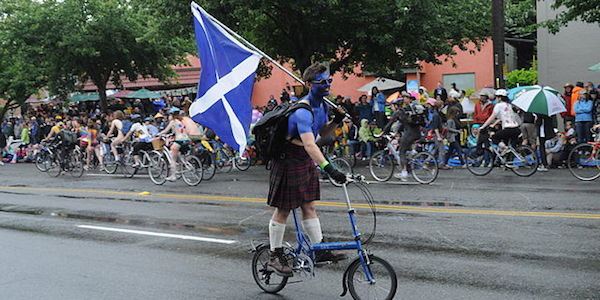
Image courtesy of Joe Mabel, © 2011. Some rights reserved.
Other analysts have pointed out Scotland’s shared history with its Nordic neighbours. Lesley Riddoch of The Guardian wrote an article called ‘Look north, Scotland’, in which she points out Scotland used to be part of the Nordic landmass (eons ago); shares more DNA with its neighbours to the North than other Britons; has Viking place names and share some cultural similarities. For example, the northernmost county of mainland Scotland, Sutherland, derives its name from Suðrland, the ‘southern land’ of Norse rule. Further, she says,
Such statements beg the important question of whether Scotland would be welcomed into the Nordic Council with open arms. Although the Nordic countries could certainly applaud another partner in the UN rallying for progressive environmental policies, the Nordic response seems quite ambiguous. Leaders of the Nordic countries have so far refrained from responding to the SNP’s courtship, mainly out of respect for their long-term ally, the United Kingdom. Secretary-General of the Nordic Council, Dagfinn Høybråten, similarly does not wish to comment on possible Scottish membership until after the referendum. Andrew Boyle and Allan Little of The Guardian seem to think that the Nordic countries would be very happy to accommodate a new southern neighbour, although they agree the countries are hesitant to risk offending the UK before the vote. Although Norway studies its Viking history with a degree of fondness, so too does it retain a high degree of loyalty toward Britain, the ally who hosted its royal family during the Second World War. Nevertheless, Andrew Boyle illustrates that public opinion in Norway seems to be that “Scots and Norwegians were always meant to play together”, while Allan Little quotes Swedish Activist Gunnar Wetterberg as saying “If the Scots phoned we’d be overjoyed!”. Incidentally Wetterberg doesn’t just wish for Nordic cooperation, but further a Nordic Union, of which it is doubtful Scotland would wish to take part should it choose independence at last.
Though SNP politicians such as Alex Salmond and Angus Robertson have made repeated reassurances that an independent Scotland would retain its close ties to the rest of the United Kingdom, Alex Massie (The Spectator) is skeptical,
It seems, therefore, that the Scottish national referendum to a degree is not only a choice of independence, but also a decision about the way of life Scots want to live. Does Scotland wish to look North or South? Is the Nordic model more persuasive than what the United Kingdom at present has to offer them in a union? The debate over Scottish independence from both camps (“yes” and “no”), keep circling back to the level of congruence between “Scottish” and “British” social and political life. Does Scotland really have needs that cannot be met in a British Union? And if so, can they be met by other political affiliations and structures? These are questions Scots will have to answer in their own minds before the elections on September 18th.
This article was originally published on St Andrews Foreign Affairs Review.
About the Author





