
Some of the most exciting and dramatic politics are centred on the democratic notion of elections. So with EU elections around the corner and a predicted low turnout, it seems that most of Europe is not quite as excited about these elections. At least, it certainly appears to not be as exciting as voting for Eurovision, X-Factor or American Idol!
As a non-European, the EU elections are definitely a foreign topic. Having no first-hand experience with EU elections, I conspire to break them down into a beginner’s guide. So what exactly are they? Well, having been born in 1979, the EU elections are exactly what it implies. The parliamentary elections for the European Union, the overarching body that calls the shots on things like those controversial bailouts. The 28 countries will vote on MEPs from their home-states to international candidates for President.
The main things to gather from these elections is that those candidates chosen will be in office for the next five years and the Parliament has the power to amend, veto or pass the legislation that comes from the European Commission. They provide the law that is obligatory for EU member states, therefore dictating where EU citizen’s money goes. Speaking of money, one of the main topics this year include: the consistent issue, the economy, and the issues that have arisen from the recession, the bailouts and unemployment. Immigration is also a well-known issue to be at the forefront and lastly, the power politics of the EU itself.
The 2 Biggest Party Groups: Where they deviate
Candidate platforms are essentially what you might expect. The eight political groups range from hard right to hard left, moderates and green.
The two most popular groups, are, predicted to be neck and neck for seats, which makes it seem like quite the battle to the finish. What does this really mean though?
The S&D and EPP are actually equally in favor of about 13 out of 20 of the major issues in question for this last few years, according to Electio2014. They deviated in some economic issues; their stance on GMOs; shale gas projects; nuclear energies; and women’s issues. The S&D is against the strengthening and extension of the internal market for services of the European Union.
The S&D also are for individual EU states to have more rights in regards to the restriction of those things that pretend to be entirely natural and safe to eat, cultivated Genetically Modified Organisms (GMOs). The always-controversial issue of nuclear energy and its sibling – shale gas – are both ‘econenergy’ issues that have stirred differences of opinions from the S&D and EPP.
The S&D are for nuclear energy to be phased out in all of the EU, they prefer for member states to not begin any new shale gas projects and instead and tend to be for alternative green energy.
Women, are of course, on the issue list with questions of an extension of maternity leave pay to 20 weeks (a 6 week extension). Lastly, the S&D, are for the right to a safe abortion that is guaranteed by respective EU Member States.
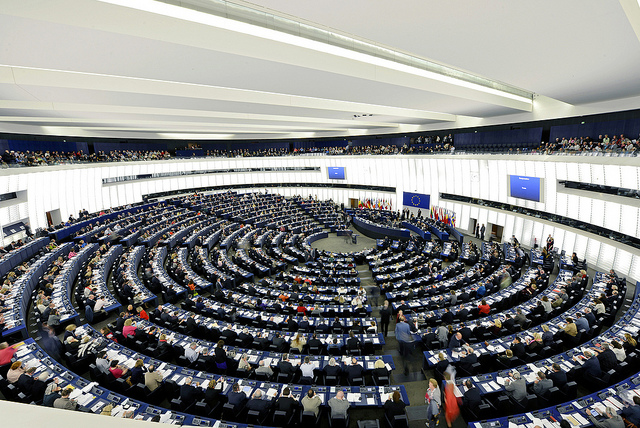
The European Parliament. Image courtesy of Flickr © 2014, some rights reserved.
Comparatively, if the EPP comes out with more parliament seats then EU citizens could expect for the strengthening and extension of the internal market for services.
The economic benefits and energy independency is not lost from the EPP group, their group party ideology stands against restricting new shale gas projects to emerge in EU Member States and for nuclear energy to still be a viable option, rather than a non-option altogether.
The EPP deviates from the S&D on the extension of EU member rights restriction on the cultivation of GMOs. Meaning that states would not be able to control a restriction of GMO food options from being cultivated in the agricultural business and sold in food markets for public consumption.
In regards to the women’s issues, the EPP is against the 6-week extension of paid maternity leave, which could be more of a stance against the economic burdens it could pose on business. Lastly, the EPP is against the guarantee to the right of a safe abortion.
Check out and compare all parties stance on issues here.
The Presidential Candidates
To go through all of the candidates would be an extreme task. So getting straight to the point, who is the big kahuna? The five front-runners for the position of President for the EU Commission from youngest to oldest:
Want to know more about everything EU elections 2014? Try visiting these sites to make a better-informed decision. Electio2014 and EUvox2014 or Votematch (quizzes designed to match your preferences to a party). The Eurovision debate is also available on YouTube and here.





