
As the Indian elections come to a close and we elect a man who outdid Tupac by using holograms for election speeches, Narendra Modi, a man who was once a street side tea seller, is now our Prime Minister. It seems like he achieved the American dream in a country that wants to steal the title of the world’s greatest and largest democracy. And like every bustling, thriving democracy, it is easy to judge the state of politics by the opinion of the youth, and by the transitive property, the state of their (and my) Facebook newsfeed.
And very much like the United States of America and American politics, Modi seems to have divided the youth of India. The current ruling party, the Indian National Congress party (known as Congress) has been blamed for a stagnating economy, for massive government corruption, and for its inability to handle women’s rights, homosexual rights, and the toxic rape culture in India. This ineptness is evident in the gaffe-prone, bumbling, and confusing speeches that Rahul Gandhi has humiliated himself with. Gandhi is akin to a modern John F. Kennedy – handsome, Harvard-educated, and from a political family whose history is blotted with assassinations, shady connections, and patriarchy.
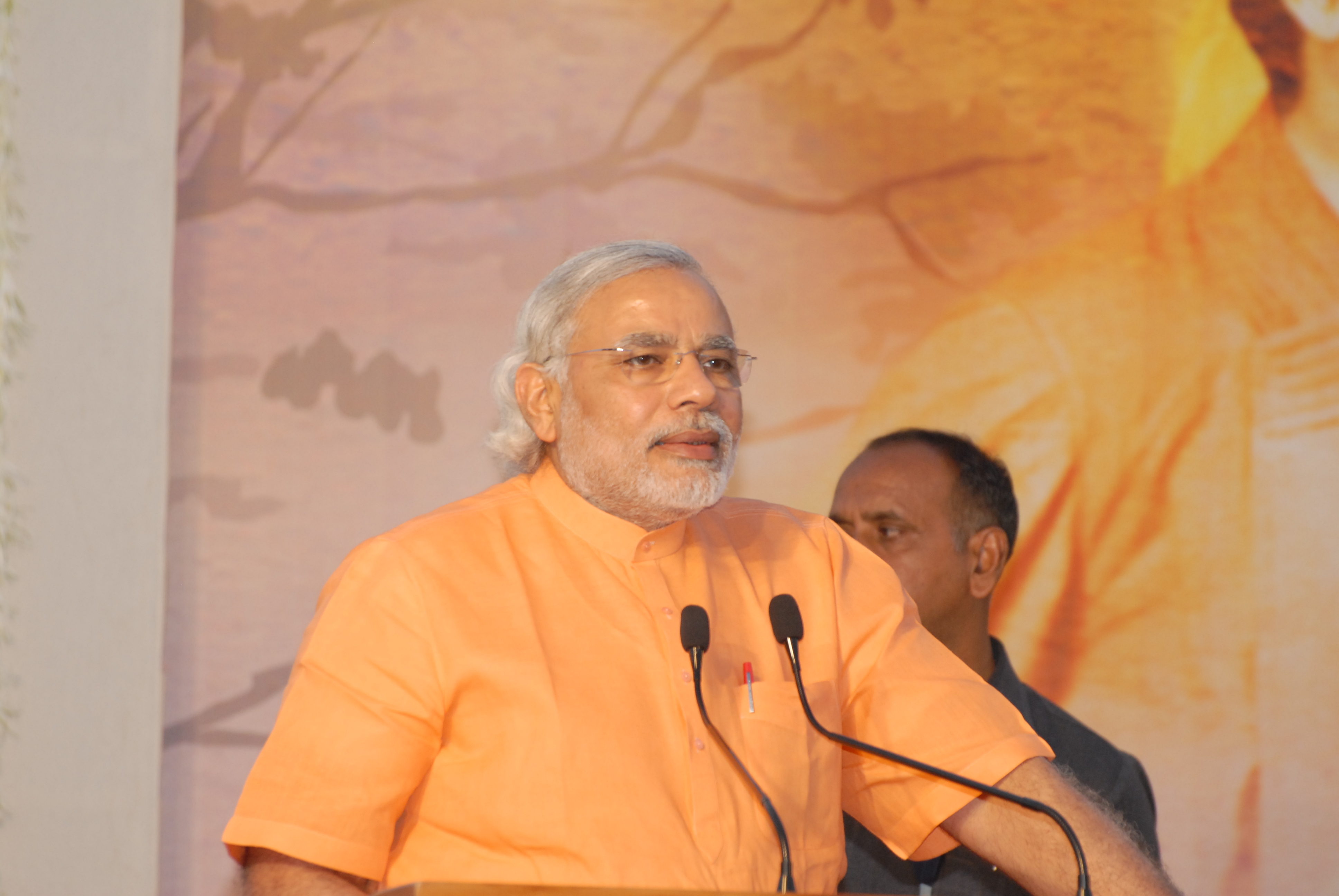
Narendra Modi in Sanand district. Image credit: Mayur Bhatt, Ahmedabad
While Gandhi and Congress are the epitome of ineptitude and have their own dark secrets, Modi too has a dark side – as a nationalist whose participation (or lack thereof) in the 2002 Gujarat riots which left more than a thousand Muslim-Indians dead and caused the US to revoke his visa, his history has left a dark stain on his otherwise white Kurtas. He is, after all, the leader of the Bhartiya Janta Party (BJP), or the Hindu Nationalist Party, and has never denied being anti-Islam or pro-Hindu. Many economic analysts say that his economic success in Gujarat is simply because of luck with good harvests, a growing Indian economy, and the rising tide of trade in the Indian subcontinent – and none of this economic growth has helped middle class Gujaratis. Modi is the equivalent of a right wing republican – belief in rags-to-riches stories; economically conservative; nationalist; and probably anti-Islam – an Indian version of Ronald Reagan.
And so, once more like America, India has the option to choose between two very different and controversial candidates. While India is famous from having thousands of parties, including the populist and previously famous Aam Aadmi Party (AAP – The Common Man’s Party), it boils down to the BJP versus the Congress. Yet this analogue of an American democracy doesn’t stop at the candidates; the news media seems eager to hype modest occurrences into snowballing controversies; from the AAP’s candidate, Arvind Kejriwal being slapped, to popular news hosts like Arnab Mukharjee denying he has been paid to favor a certain political candidate whose name rhymes with toady. Arnab Mukharjee himself is akin to a screaming, angry, Indian Bill O’Reilly.
So, for the youth of India, ever seeking to emulate America, from its amazing pop culture and civil liberties, to its consumerist culture of branding every moving object, we have achieved imitating the American democracy: once thriving, but now in a grinding deadlock between two parties, corporations that act like people and sway the government more than citizens do, and youth so divided that they’d rather type in caps lock on Facebook, than they would work to change the state of the union. And so it is in India: two parties, both corrupt, both with controversial ideologies – the BJP has raised more than a billion dollars for the massive PR campaign that supported Modi, and nobody knows where this money came from; and corporations like Tata and Reliance have been standard players with Congress. And my Facebook newsfeed is blown up with staunch pro-Modi teenagers who choose to look to the future and ignore the controversial, unsure past; and yet nothing actually changes.
So what can we look forward to in the next five years? For starters, the Indian economy is already booming; the Rupee is gaining steam against the Dollar; the stock market has been climbing like Spiderman, and inflation is finally slowing down – but this could be a side effect of the election bubble. If Modi’s success in the Gujarat economy is no fluke, then he is expected to use his majorities in both the upper and lower house to stem the stagnation of the economy. Yet this majority in both houses may allow him to take controversial actions in foreign policy regarding Pakistan and other Muslim nations; amusingly, the Pakistani Prime Minister has invited him over for chai, and the White House has retracted his visa ban. So he’s getting all the respect he deserves from the world, which is as unsure as the youth of the nation about what the future holds. The only thing we can be sure of is that we can believe in change, though that change may not reinforce our belief in Modi.
About the Author





As the world’s largest democracy, India did have a peaceful transition of power despite such a divided voting pattern and despite the money that poured in from other countries..
Whatever happened during election, now Narendra Modi is the Prime Minister of India and hopefully will remember that as he governs the nation. It is that respected Office that Pakistan and USA are respecting by their actions. And that is indeed the appropriate behavior.
As a country India progresses despite Government and/or lack of governance. In all this hoopla and rhetoric and dirt that gets thrown at election time, I am still proud of the changes initiated by Man Mohan Singh in various capacities that he served the nation – think back 1991, when India was on the verge of bankruptcy, and the start of economic reforms n India that has brought us to where India is today (including the growth of Gujarat, that Modi took credit for). Abolishing export subsidies, lengthy and corrupt permit processes, opening up of Telecom, Banking, Airlines industries (all the things that we all benefit from today…), Unique Id Card project etc. And despite the numerous attempts and money spent on throwing dirt at him, the corruption dirt did not stick to him. As an Indian, I am thankful for the foundation he laid for India’s economic progress.
[…] Hindu Nationalist party), Narendra Modi came out on top, but not without consequence. There is a division from younger voters, the classic troubles of corruption and poverty and potentially aggressive religious divisions […]