
Fifty years ago, Peru’s National Stadium in Lima became the site of what is today considered the worst tragedy to ever happen at a football stadium, during which 320 people were killed and 500 were wounded.
On May 24, 1964, Argentina’s national team was winning 1-0 in a qualifying match for the Tokyo Olympic Games. Just two minutes before the end, the Peruvian team scored a goal to tie, but Uruguayan referee Angel Eduardo Pazos disallowed it. This decision enraged fans, and Víctor Vásquez, known as “Negro Bomba” (Black Bomb), jumped onto the field. Many other fans followed him, with the intention of attacking the referee. In turn, police officers released dogs, who jumped on the fans.
Supporters of both teams who, minutes before, were peacefully watching the game began to fight with sticks and blades. In an attempt to control the situation, police threw tear gas. Hundreds tried to flee the stadium away from the gas, but the doors in the north gallery were closed, trapping people inside. Police had, in fact, closed them to try to persuade the spectators to calm down and go back to their seats.
Víctor Vásquez was arrested two days later. Another leading player in the tragedy, Police Commander Jorge de Azambuja, said later, “I ordered tear gas bombs to be thrown into the galleries. I can’t say how many. I could have never imagined the terrible consequences.” Commander Azambuja was sentenced to thirty months in jail. There was no punishment for the referee Pazos, who continued working in Uruguay.
The cause of death for many of the victims was internal bleeding or suffocation, almost all of them in the stairwells. Those who stayed inside the stadium were saved. On nearby streets, houses and businesses were destroyed.
The Curiosidades del fútbol (Curiosities about football), a spanish blog about football, offered details about what happened that day:
Meanwhile, the blog Jorge de Jesús Kbdto, also in Spanish, shared how Héctor Chumpitaz recalled it. Chumpitaz was a Peruvian football player who was part of the national team that day at the National Stadium:
After we arrived at the lockers, there were people who went out and told us there were two dead. Two dead? we asked, thinking that one would have been too many.
The blog Historia, tradición y fútbol, in Spanish, listed other incidents that happened at the same stadium and analyzed the causes of the events on May 24, 1964:
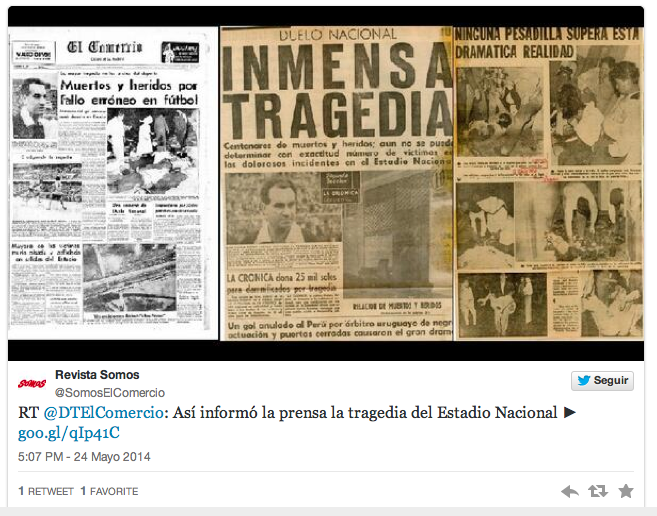
On Twitter, there were many users who remembered the date, and shared images and reflections:
This article was originally published on Global Voices.





