
It is increasingly clear that British politics is becoming more about leadership personalities and less about party policies, this can only be a move in the wrong direction.
The phenomenon has been best represented in recent years by the televised leadership debates that preceded the 2010 General Election. Borrowed from the US-style platform, the debates pitted the three main party leaders head to head, in what became a personal battle that often had little relevance to actual party policy. Live debates may be a good test of PR skills, but their relevance to day-to-day politics remains highly questionable. The real-time opinion polling of the events were the real give away that populist competition had replaced policy scrutiny; no longer were the public being asked to evaluate the parties, they were asked to evaluate the leaders. The party with the highest scoring leader was invariably declared the ‘winner’, which more often than not meant they were able to offer the best sharp come-backs or put-downs, rather than win out on a key policy.
The televised debates were met with a mixed, but largely positive reception by both public and pundits. Certainly, in terms of public engagement with politics, the concept of widely accessible cross-party campaigning has its merits. The 2010 General Election turnout was 65.1%, up from 61.4% in 2005, and the highest since 1997, whether or not this had anything to do with the introduction of the debates is unknown, yet surely it can only have helped. However, wider public exposure often necessitates wider appeals to populism. A sound-byte of a memorable one-liner directed at a political opponent will go far further than tweaks to a mid-level policy position, and so leaders, not policies, take centre stage.
The position of Prime Minister is, of course, a vitally important one. However, to base a vote choice even slightly on a leaders’ personality is nonsensical, yet we continue to see more and more emphasis placed on the personalities rather than the policies. One possible explanation for this is that politics has (in the eyes of many) become so overly complex, removed and out of touch from the electorate that it becomes a far simpler and more attractive choice to simply weigh up options between leaders and perhaps a few of the key policies they stand for most fervently.
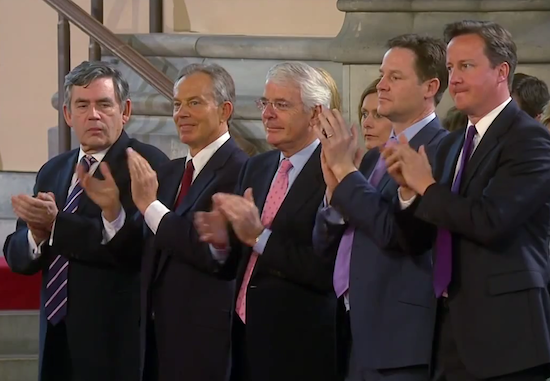
Former British Prime Ministers Gordon Brown, Tony Blair, Sir John Major, Deputy Prime Minister Nick Clegg and Prime Minister David Cameron during U.S. President Barack Obama’s address to Parliament. Image credit: White House
The recent European and Local Elections saw an unprecedented new level of leadership cult emerge in the UK; the Farage effect. In the case of the UK Independence Party (UKIP), the party became more or less synonymous with it’s leader. Very few other high-level UKIP members were presented to the public, not that they or the media wanted them, and so Nigel Farage has been by far and away the most in-demand politician in the country in recent months. Every national, regional and local outlet has been clamouring for his attention, regardless of their or their audience’s attitudes towards the party itself or their policies, purely because the leader’s charismatic performances are likely to be popular public consumption. UKIP’s success at both European and local level demonstrated everything that characterises the new framework of ‘reality show politics’; a dominant leadership character, a focus on a (very) small number of hard-hitting policies, and endless PR exercises to promote the character rather than the party.
Whether Farage and UKIP can scale-up this model to a general election campaign remains to be seen, for now attention switches back to the three main party leaders and their various grapples with public support and opinion. Ed Miliband has perhaps the greatest challenge ahead of him of all the current party leaders in terms of potential vs ability. He and his party simply have the most to lose. Labour currently leads the polls, and thus it is now up to Ed to attempt to prove to the electorate that he is not in fact ‘goofy’, ‘weird‘ or ‘weak’ – all criticisms that are constantly levelled at him by both public and presses. The terrible irony of Miliband’s situation symbolises the confused nature of contemporary leadership politics; people consistently claim they want someone who is something different from the polished, robotic and image obsessed ‘political class’ (see, David Cameron), and yet when along comes Ed with his slightly out of line image, he is mercilessly ridiculed for it.
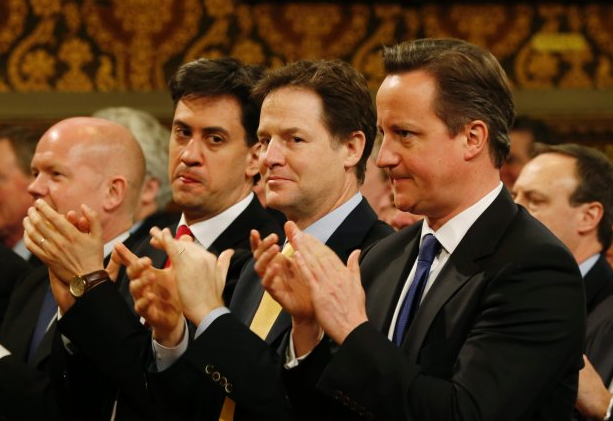
Image credit: wyborcza.pl
David Cameron meanwhile continues to struggle with the perennial Tory image crisis; ‘out of touch’, ‘posh’, and ‘catering to the 1%’. In his case however, these negatives appear outweighed by a general perception of strong leadership, indicating that perhaps the public obsession with the ‘political’ class is only skin deep.
Last (and in the eyes of the public, least) is Nick Clegg. The 2010 General Election was undoubtedly a peak in both the history of the Liberal Democrats, and the career of its leader – a Sunday Times poll after the first televised debate that year even found that Clegg was the most popular leader since Churchill, and that the Liberal Democrats were enjoying the highest public support in their party’s history. In a story of spectacular popular decline, the most recent polls show historic lows in opinion of both the party and Clegg, more evidence that the fates of leaders and their parties are linked perhaps more closely now than ever.
It is clear that we, the public, care deeply about who leads our political parties and thus has a chance at the top jobs, and there is nothing inherently wrong with that. What is a cause for concern is how this interest in personality appears to be occasionally overshadowing what politics is really about; the policies that govern the country, its institutions, and its people. A dangerous precedent is being set where characters, not policies may begin to act as the driving force behind the political direction of the country, and it is something we should all be very wary of allowing to continue.
About the Author





