
For Spain, the big news in the European elections is the triumphant emergence onto the political scene of “Podemos” [es] (We Can) (@ahorapodemos), a political entity created four months ago, led by the charismatic Pablo Iglesias, professor at the Universidad Complutense de Madrid. With an electoral programme that brings together the main demands made by the different social movements that arose during the wave of opposition to austerity policies, Pablo Iglesias has managed to position himself as the fourth largest political power in the country.
The results of the European elections, held on the 25th of May 2014, have drawn a political map marked by abstentionism and the rise of right-wing nationalist parties on the old continent. In countries like France with the Front National (FN) as winner, the Netherlands where the anti-Muslim party is gaining relevance, Denmark, Finland, Italy and Hungary, the rise of extremists paints a desolate landscape.
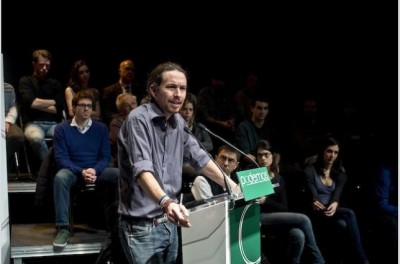
Meeting with Pablo Iglesias, leader of Podemos, in Madrid – Image from Diagonal. Used with permission.
In Spain, although the Partido Popular (People’s Party) returned to the lead in the European election results, and the PSOE, the social democrat group, is still the country’s second largest party, an unprecedented crisis of the two-party system is emerging. For the first time in Spain’s democratic history, the two main parties only managed to win half of the votes between them. This is especially important in the face of the general elections that will be held next year on the Iberian Peninsula.
From the indignados’ cry of “yes it is possible” to “We can”, there is a step. The party represents the coming of age of the protests and new ideas that have occupied the streets of Spain in recent years. Although its leader may reject the indignado movement’s legacy, it is almost impossible to ignore the close link between the anti-crisis movement and the new party. The most well-known of the young but powerful Podemos’ proposals are: the creation of a maximum salary as well as a universal basic income, an earlier retirement age, the reduction of the working week to 35 hours, and more protection for workers against dismissal, among others.
The objective is to dismantle the austerity measures put in place by the different governments that have been in power. To strengthen and increase citizens’ rights to political participation, education, housing, health and the fight against corruption are the core elements of the party’s programme. Citizens have expressed their support for these measures at the ballet box, on the streets and on the internet.
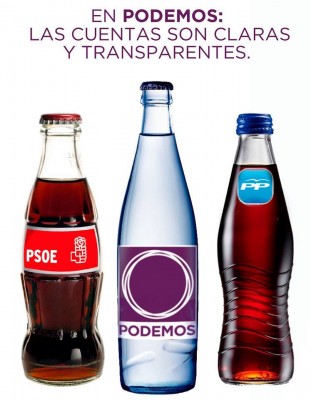
Image taken from Imagen tomada de la cuenta de Facebook de “Podemos”.
Among the keys to the success [es] of this party, which won 11.29% of the vote last Sunday, is its ability to connect with citizens. Funded through various crowdfunding campaigns [es], “Podemos” is the party with the most followers on social networks, compared with the two main parties, and keeping in mind its recent creation: more than 238,000 followers, compared to 141,000 for the Partido Popular and 140,000 for the PSOE.
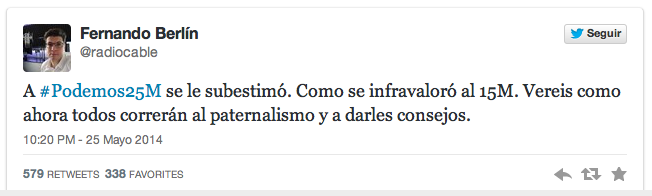
With the hashtag #Podemos25M twitter users discussed the surprising Spanish result in the European polls. Some even predicted reactions:
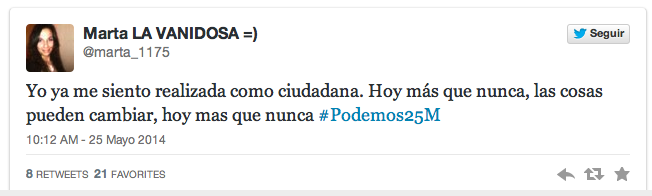
Others expressed their excitement on Sunday:
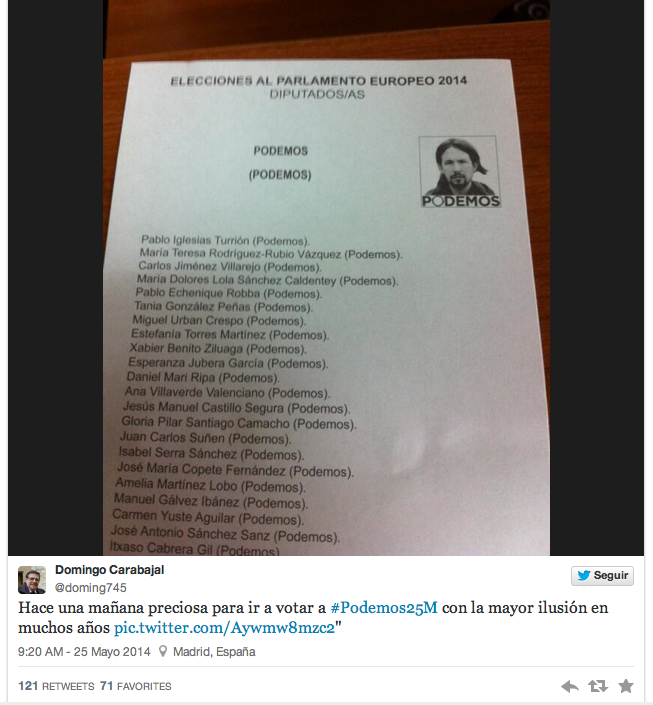
While others recounted their voting experiences:
The electoral and online support shown for “Podemos” has allowed them to gain five seats in the European Parliament, a surprising result given their lack of resources and experience. Now citizens and rival parties are watching Podemos’ first steps at both the European and national level very closely.
This article was originally published on Global Voices.
About the Author





