Eurasia

June 4, 2014

It Never Rains In Central Asia, But When It Does, It Pours

On May 30-31st torrential rainstorms caused chaos on Kazakhstan’s Almaty, Uzbekistan’s Tashkent and Kyrgyzstan’s Bishkek. While damage was mostly limited to floating cars and flooded houses, for Kyrgyzstan there was a more tragic outcome, when people died in the flooding. 

Almaty, Kazakhstan
Kazakh mass media reported[ru] on May 31st that the country’s largest city, Almaty, home to roughly 1.4 million people, was literally awash. The city sewage system, which has seen few updates since Soviet times, could not cope with the deluge as traffic jams formed in the main streets of Almaty and residential areas, construction sites and the downtown business district all experienced flooding. Apart from fate, citizens blamed [ru] poor irrigation networks and fast-paced urbanization for the floods.

In comparison with the Soviet era the area that does not absorb rain water – rooftops and buildings, paved areas and roads – has increased. The irrigation system, constructed decades ago, now simply cannot cope with the volumes of water. [Another problem] is that the irrigation canals are blocked with rubbish, but the main issue is that the flooding itself is much heavier.

Tashkent, Uzbekistan
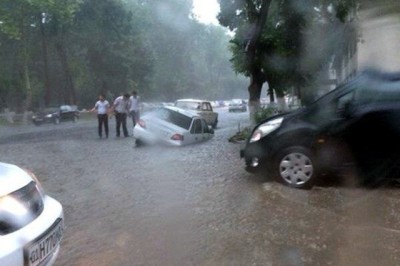
The capital of Uzbekistan, Tashkent, which has a population of over 2 million people, was flooded on May 30th. Everything from parking lots to playgrounds was plunged underwater as huge traffic jams formed along the main intersections of the city. Commenting on a report published by Gazeta.uz, a Tashkent local, Vyacheslav wrote [ru]:
Our road services just screwed up. This was not a PR show for local authorities, but a serious issue wherein they should have demonstrated what they could do to help the city cope with the rain. Where were the storm drains? Where were the cars, equipped with water pumps that could pump the water out of the tunnels and subways? Will someone be punished for this?

International Political Forum

Heavy rain in Tashkent. Photo taken from the public Facebook group Drivers of Tashkent.

Shukhrat Alymbaev, another citizen of Tashkent, disagreed [ru] that the municipality could have combated the floods any better:

No one could have been ready for this kind of rain. It was an element of nature, force-majeure. There are a lot of people who criticize the work of the city public services, but, actually, I saw them doing their best to solve the problem at the time of the flooding.

Once the storm had calmed Uzbek mass media took stock [ru] of the carnage: several felled trees, multiple car crashes and flooded houses, but no people injured or dead. Further south in Tajikistan, damage was limited to congestion on the city’s roads. In Kyrgyzstan, however, the wild weather had tragic consequences, claiming the life of one man, injuring another and tearing the national flag that flies in Bishkek’s main square.

Bishkek, Kyrgyzstan
On May 31, Bishkek’s city council announced [ru]:
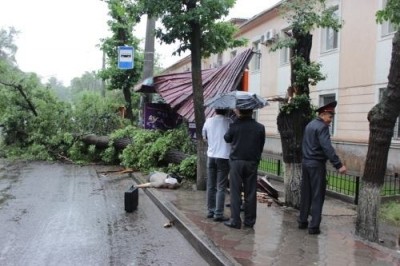
6 trees fell due to the gusty winds and rainy weather in Bishkek on May 30-31. As a result of the falling trees one person was killed, two cars destroyed… the flag in Ala-Too square was ripped, and in several other parts of Bishkek engineering works and other objects were damaged.

International Political Forum

A man lies dead in central Bishkek on May 31 after a tree falls on his head. Photo from vb.kg/azzatyk.

Bishkek officials were quick to respond to criticism that the unnamed man’s death was avoidable and a consequence of municipal neglect:

Mobile teams have been organized in order to clean the city after the storm. A special tour to define the trees which are in critical condition was organized. Currently, work is underway.

The banality of the man’s death has resonated with Bishkek residents. Reportedly he was waiting for the arrival of one of the city’s ubiquitous minibuses when a gust of wind uprooted a nearby tree that suddenly collapsed on him. Another man struck by the same tree was taken in an ambulance to a city hospital and is recovering. Against a background of social media panic that Bishkek, an honored “green city” during Soviet times, is full of old trees waiting to fall down at any moment, one commenter on Vecherni Bishkek’s website mused [ru]:
I was going home from work and we were standing for almost two hours in traffic near [the shop] 1000 Small Things. I was so angry at the whole world but it emerges that there were victims of that vile weather. My god, now I understand that [what I experienced] was so trivial, and someone else lost their loved one.

International Political Forum

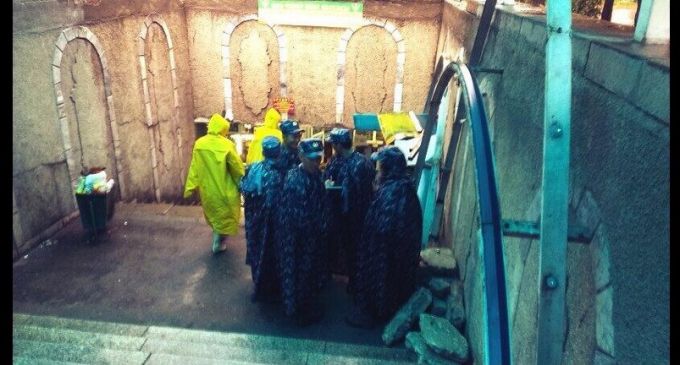
Police in raincoats take shelter in Almaty. Photo uploaded onto Twitter by @4144777

Although few expect the freaky meteorological events of May 30-31st to repeat themselves in the near future, for many citizens of Central Asia’s key cities, the storms have simply re-affirmed a belief they are living in a self-help world while public services recede in the face of disaster. As Aleksandr Tikhonov surmised [ru] in a comment on gazeta.uz:

Our public services don’t work in these circumstances. Of course it is easier to say that “saving the drowning is the problem of the drowning”, but this raises the question: Why do we need a state, laws, and various organs of administration?

This article was originally published on Global Voices.


About the Author

Global Voices
Global Voices is an international community of bloggers who report on blogs and citizen media from around the world.


0 Comments


Be the first to comment!


Leave a Reply

Your email address will not be published. Required fields are marked *