
Bangladesh’s controversial, elite anti-crime and anti-terrorism force, the Rapid Action Battalion (RAB), have been accused of extortion, extra-judicial killings and even assassination against payment. Are the country’s ‘men in black’ essentially an effective, super group of law enforcers or have they metamorphosed into an elite force of mercenaries?
Drawing personnel from the police and the military, the RAB was formed in 2004 to combat the rising crime rate in the country. It was soon dubbed ‘the elite force’ of Bangladesh. However, over the years, it has become controversial, being stalked by allegations of human rights violations. In a recent high profile abduction and killing of seven men, RAB members were accused [bn] and three RAB officials, officers from the armed forces of Bangladesh, were sacked and detained in this connection. In a separate incident nine RAB members were sued for torture and killing of a businessman. In another recent case, a court in Brahmanbaria, a district in east-central Bangladesh, has ordered the police to accept a case of murder against RAB personnel.
On April 27, 2014, a group of unidentified men abducted Nazrul Islam, a businessman and ward councillor, a few kilometers from the Narayanganj district court in central Bangladesh. An accused in many criminal cases, the councillor was travelling along with four associates all of whom were abducted along with him. Chandan Sarker, a senior lawyer, whose car was trailing that of the councillor, was also abducted, along with his driver. The RAB came under scrutiny when eye-witnesses said that the abductors were clad in RAB uniform. However, RAB officials denied the accusations.
The RAB had been accused of human rights violations even earlier, when they shot an innocent college student and caused permanent disability.
Journalist Anis Alamgir shared an experience in his column in the online newspaper Bangla Tribune. He wrote [bn]:
Human Rights Watch has alleged that the RAB is behind a spate of torture and extra-judicial killings. The RAB have denied the accusations and have attributed some of the deaths to “crossfire”.
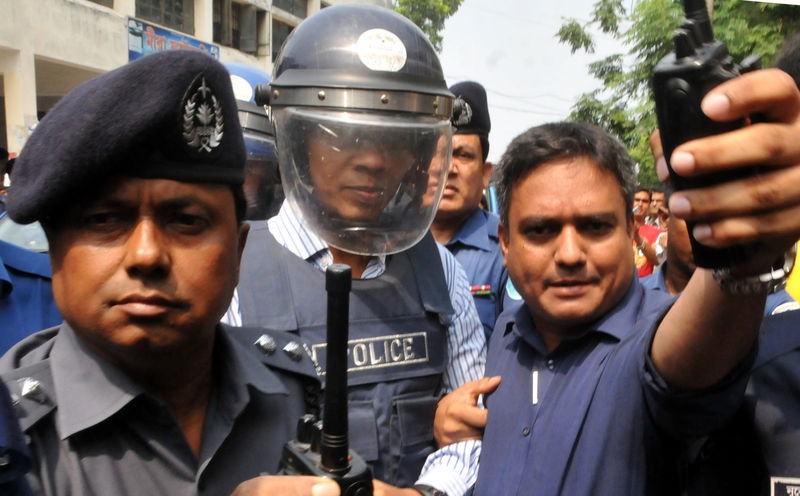
Law enforcers take former RAB official Lt. Col. Tareque Sayeed to the Senior Judicial Magistrate’s court in Narayanganj, Bangladesh. Image by Indrajit Ghosh. Copyright Demotix (17/5/2014)
In the same column [bn], Anis Alamgir also pointed out that despite being under scrutiny for these kind of killings, the RAB had a positive image among citizens, who believed that the RAB was working for the greater good of the public by combating crime and terrorist activities in the country. He wrote:
Bangladesh has had over fifteen years of military rule. Many military officers then infiltrated government administration to maintain their political leadership. Sultan Mahmud Zakaria at Kathakata blog blamed RAB’s audacity on the lack of democratic practices in the country. He pointed out [bn]:
According to a report by ASK (Ain O Salish Kendra), a human rights organization in Bangladesh, there have been 268 cases of abductions in the country between 2010 and 2014. Twenty-four among them were later released and bodies of 43 people were recovered. 14 had been handed over to police and there are no trace of 187 persons.
Journalist Masud Kamal thinks [bn] that there are political pressures behind the RAB going rogue. According to him:
Professor Ali Riaz writes [bn] on the Kathakata blog about the close connection between RAB and some political leaders:
The information Minister of Bangladesh has informed that so far 1949 members of RAB have either been punished or sacked for different criminal and unethical activities. However, instead of scrapping the RAB, the government has reiterated the usefulness of the RAB and has asked civil society to propose alternative solutions.
This article was originally published on Global Voices.
About the Author





