
Hungary’s tumultuous political sphere seems like a never ending topic for democracy advocates. Right after the governing party’s much criticised actions (alterations in the country’s constitution, forced retirements and other human rights violations) international attention turns on the new ‘advertisement tax’, accepted by the parliament on the 11th of June, 2014.
The new tax is to affect media outlets that have the annual revenue of HUF 20 Billion from advertisements, and proposes a 40% maximum threshold to the biggest broadcasters. However most agree that tax shall be paid in equal measure by all, the problem with the government’s latest legislation – as it seems again – is the motive behind the move.
Prime Minister Viktor Orban’s close-knit political circles have been receiving wide-spread international criticism since 2010. Upon gaining power, the party embarked upon a journey of radical political re-design. Constitutional changes, press limitation, alterations in the private pension scheme and a myriad of other undemocratic changes have been appearing one after the other. Not surprisingly, therefore, did the international community and especially Hungarian media receive the new tax with scepticism.
Media Response
Representatives of the Hungarian media expressed disappointment over the proposal. Media outlets threatened with actions, but upon receiving no willingness of conversation from Fidesz (Hungary’s major national conservative party), several TV channels went off air for 15 minutes, while print media protested with a blank page. Most surprising still was the daily Magyar Nemzet’s clearly voiced dismay, as the publication is widely considered Fidesz’s mouthpiece.
Fidesz, however, may have underestimated its opposition this time. The advertisement tax affects, above all, the German operated RTL, a television channel with national availability that did not conceal its ability to show the influence of broadcast media on voter attitudes. The previously politically neutral RTL no longer misses an opportunity to present its viewers with clear political criticism. Introducing angles that often remain unreported, the channel could seriously damage Fidesz’s carefully built image.
Nevertheless, it was not only Hungarian media that responded critically to the media tax. Süddeutsche Zeitung [german] a German liberal publication notes that ‘4 years after the much criticised media legislation, Fidesz attacks media again’, while alongside many others, the Financial Times observes a ’fear of media clampdown’ among international observers.
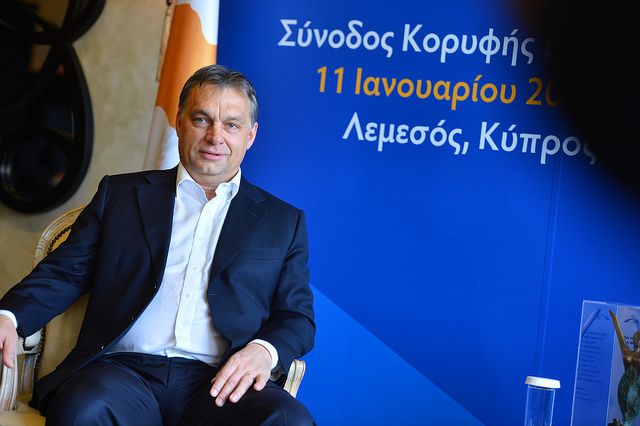
Viktor Orban, PM of Hungary. Image courtesy of European People’s Party / Flickr © 2013. Some rights reserved.
What was Fidesz’s official response to the international criticism?
Fidesz’s Antal Rogán’s retort was plain and simple: ‘Whether this tax will be implemented or not is not up for discussion. The only aspect still to be decided upon is its execution’. With this statement Rogán sent a clear message: Fidesz no longer relies on the opposition’s opinion and does not consider the parliament a democratic institution. After this, János Lázár’s response that ‘the tax has nothing to do with repressing press freedom’ seems like a rather sarcastic remark.
Does this mean that the governing Fidesz party wishes to gain moral and financial control over commercial television channels?
It seems so. Those critical voices that suspect a future moratorium over media have further reasons to do so. The infamous dismissal of liberal Origo’s editor-in-chief, upon a controversial article questioning Fidesz party politician János Lázár’s travel expenses is seen as just one of the countless attempts to silence opposing critiques.
Media Responsibility
Critical attention also turns to the Hungarian media’s moral and social responsibility. Media organisations should actively participate in the political conversation and critical attitudes should be a must. RTL’s slow reaction time and its willingness to participate only upon financial threat indicate serious problems with the Hungarian media’s motivation to take on moral and social responsibility.
Despite this, the most concerning aspect of the recent news remains Fidesz’s decreasing efforts to practice democratic governance. More and more aggressive measures are being taken to control the country’s moral landscape, as the party puts decreasing efforts into concealing their often undemocratic aims.
How is this possible in a modern European country?
Brussels already expressed concerns over limitation of media freedom in 2013 – during the party’s first term of governance – but as it seems, it did little to deter Fidesz from further abusing the country’s press.
Fidesz’ undemocratic political decisions are endangering the country’s international relations, but more importantly damages its citizens’ most basic human rights.
About the Author





