
The issue of “gendered toys” has plagued the media recently as people are coming out on both sides of the debate to discuss why there seem to be only two aisles at toy stores: “girl’s toys” and “boy’s toys”. These two aisles, while seemingly harmless, have, it has been argued, discouraged children from playing with certain toys because of their gender, hindering their psychological development and their identity expression.
It is true that even those who believe in rigid gender roles would be more likely to chastise a boy for wanting a pink fairy doll than a girl for wanting a train set; but this could be for the simple reason that we still have, embedded in our culture, the idea that being a girl is automatically a demotion and that boy’s things are, by default, the best things. Nevertheless, gendered toy marketing negatively affects all children, which is why the topic of marketing toys by gender has hit a nerve with some, who have decided to act.
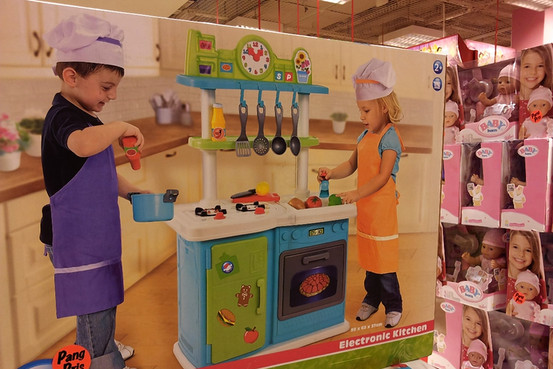
I decided to interview Megan Perryman, founder of the Let Toys be Toys campaign, to find out her personal views on the subject.
Q: When was that moment when you decided to set up this campaign?
A: It all started on Mumsnet in November 2012, with several posters complaining about gendered marketing aimed at children. One of the group said “Why don’t we start a campaign?”, and we just took it from there. Most of us are parents and we were particularly shocked at the change in marketing compared to our own childhoods.
Have we divided toys into gendered categories for a long time?
The truth is, although sexism has been around a long time, the insidious gendered marketing you see today only really started in the 1990s. Companies realised that if they could convince us there are two types of child, we’ll end up spending more because we’ll stop handing toys down between brothers and sisters (Elizabeth Sweet did some interesting research on this).
What do you think does the most long-term damage in children when toys are segregated by gender?
To develop into a rounded individual you need to have lots of different skills and interests. The damage that can be done by limiting children’s interests is that they never realise their full potential. For example, to get more girls in STEM careers we need girls playing with science toys; for boys to grow up to be rounded fathers we need more boys with baby dolls.
When you were a child, what kind of toys did you mostly play with, and how did they impact/shape your own identity?
My parents were aware of the limitations of only playing with toys associated with your gender, so I grew up with a range of toys including superheroes, robots, the Beano and a much-loved skateboard. I grew up knowing my gender shouldn’t stop me from doing anything in life. The potential downside was that, as much as I loved my toys, I also longed for toys I wasn’t ‘allowed’ such as a fashion doll. So I decided with my children that no toys would be off-limits; I’d just make sure they understood that their gender wasn’t relevant to their toy choice.
Do you think change needs to come from a social, grassroots level, or do you also think there needs to be legislation enforcing the end of gendering the marketing and retail of toys?
We’ve never pushed for a legislation change, and so far it hasn’t been necessary. We were delighted to see that most toy retailers have been prepared to remove sexist toy signage when asked, and a number of publishers have agreed to stop publishing sexist children’s books. However, equalities legislation does exist and perhaps some need to remind themselves of that!
How successful is the campaign so far in your opinion, in terms of changing people’s mindsets?
As mentioned above, we’ve had some great successes with toy retailers and publishers, and hope to see manufacturers follow their example this year. In terms of parents, I’ve had countless people approach me to say that they had never thought about the damage caused by gendered toy marketing before, but now that the issue is being discussed, they’re thinking about it for the first time.
The related Let Books Be Books campaign has also had recent success in pressuring Paperchase, Usborne and Parragon to stop categorising books by gender.
–
In related news, Lego have lately made a political U-turn in terms of ‘gendered toys’. In 2012, there was backlash from the feminist community, and many parents, when Lego’s decision to market their toys “to girls” disappointingly meant releasing a “Lego friends” neighbourhood where the female Lego characters could (rather than explore Lego City and go on exciting missions like the male characters) go to the mall, get their nails done, groom their poodle… and so on and so forth. It was a condescending effort on Lego’s part, assuming all girls who like Lego required 1950s suburbia. Although many blogs have criticised the attack on the Lego Friends product range, arguing that in reality the pieces can achieve more than demonstrated in the original commercial and marketing campaign, Lego has perhaps listened to the outcry- for it recently announced it would release a range of female scientist figurines.

This is positive news. As Megan suggested, many toys have taught girls that science is mainly for boys, damaging social and technological development to a huge degree; and Lego’s new product line challenges this. This sentiment has also been expressed by manufacturers such as Goldieblox, and their somewhat revolutionary toy commercial for aspiring girl engineers. I feel, however, that while it is good to have such encouraging and progressive product lines, this may have missed the point. We shouldn’t need “girl’s engineering sets”, because this, while at least a step in the right direction, still unnecessarily conforms to binary gender labels. The argument being made by campaigns like Let Toys be Toys instead wants all toys simply to be marketed and stocked by interest category (“transport”, “kitchen”, “animals” etc.), and consequently for children to be encouraged to play with whatever interests them, and whatever helps them grow and develop.
About the Author





