
Hundreds of thousands of Cambodian migrant workers and their families have fled Thailand in the past two weeks after Thai coup leaders issued a warning that they will launch a crackdown against illegal foreign workers.
According to the International Organization for Migration (IOM), about 180,000 workers have already crossed the Poipet border between Thailand and Cambodia; although many reports pegged the number at 220,000. There is an estimated half a million Cambodians of both legal and undocumented status in Thailand.
The mass exodus is also fueled by rumors that Thai soldiers have been attacking Cambodian workers. Sithi, a human rights group in Cambodia, is probing the issue:
According to the IOM, family members have been separated during the ordeal. Shelters and latrines are needed to accommodate returnees.
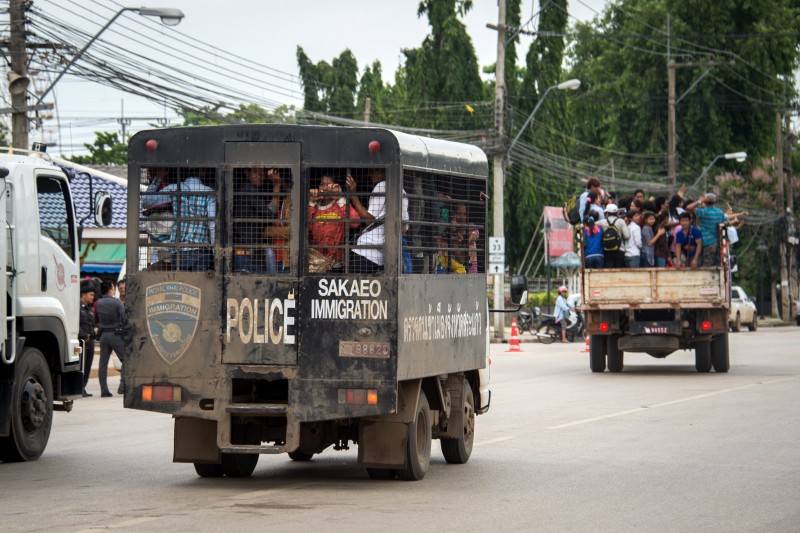
Cambodians are transported to the border from Aranyaprathet, Thailand, the last town before the border near Cambodia. Photo by Lee Craker. Copyright @Demotix (6/17/2014)
“No heartache, just movement,” Joe Lowry of the IOM wrote after he witnessed the arrival of migrant workers at the border:
Humanitarian organization Caritas Cambodia is appealing for help for the returning migrants, some of whom are pregnant workers and are “struggling to look for food, water and transportation.”
Cambodia-based expat blogger Lina also documented the return of the workers at the border:
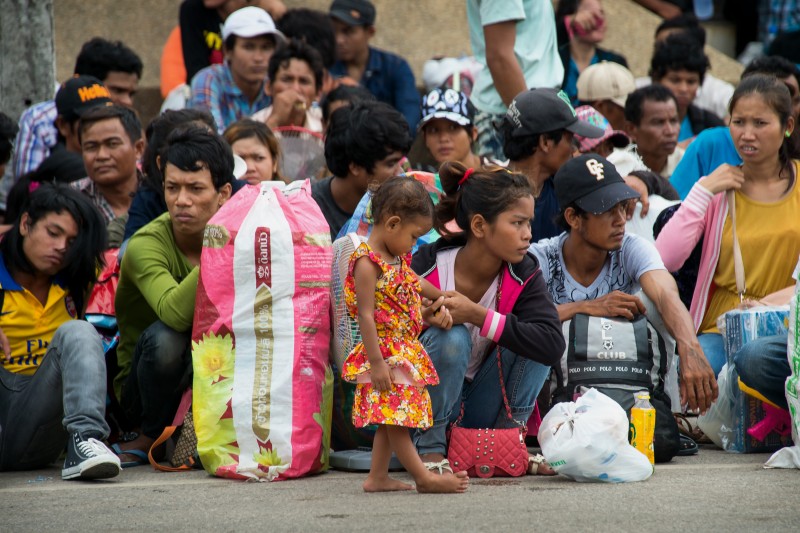
Cambodian migrant workers who fled Thailand. Photo by Lee Craker. Copyright @Demotix (6/17/2014)
Photojournalist John Vink wrote that the unexpected return of workers from Thailand will put a pressure on Cambodia’s economy:
Thousands of Cambodians prefer to work in Thailand where there is a minimum wage of $10 per day. In contrast, Cambodia has no fixed wages. In fact, it has one of the lowest wages in the Southeast Asia region. Garment workers receive a monthly salary of $100.
Opposition leader Mu Sochua argued on her blog that the current crisis exposed the failure of the government’s economic policies:
To facilitate the speedy return of the workers to Thailand, Cambodia has slashed the price of passports for migrant workers from $124 to $4. It also established a one-stop office at the border to process the papers and other concerns of workers.
Writing for the Southeast Asia analysis website New Mandala, Charlie Thame observed that the Thai coup regime is serious in sustaining the campaign against illegal foreign workers:
The exodus of workers has posed a problem for both Thailand and Cambodia; the former is already experiencing a shortage of workers in some industries, while the latter could not provide employment to all returning workers.
It is a concrete example of how Thailand’s coup is affecting its neighbors, but the humanitarian crisis at the Poipet border isn’t simply a regional issue — it requires global attention and assistance.
This article was originally published on Global Voices.
About the Author





