
Crime, particularly in its most violent form, is perhaps the most political of topics. Few issues can spark more lively debates than policing and imprisonment, punishment and rehabilitation. At any given election all parties will present their own ways of tackling crime, which often focus on tougher sentencing, better policing or better rehabilitation measures. In the United States, Michael Dukakis’ soft stance on violent crime is considered one of the main reasons why he lost the 1988 Presidential Election. Still today, every political party will claim to know that their policies are the only ones that can effectively tackle criminality.
Source: The Economist
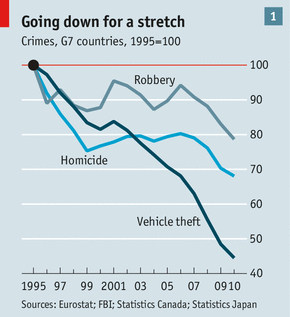
Over the past few decades, violent crime has fallen dramatically throughout the Western world. The decrease is so large and sustained that it cannot be attributed to simple luck or statistical exceptions. The most politically-minded among us might have thought of the usual reasons why such a reduction took place. For example, lower inequality; improved education; fewer people carry cash in their pockets; better policing and improved rehabilitation and/or punishment. And yet, some observers have recently come up with an alternative explanation that few would have expected: lead.
Lead is a chemical element that has been used for millennia, its features being particularly helpful in the construction and painting industries. The negative effects of this element on humans have also been known for many years, and include kidney damage, anaemia, and a wide range of psychological symptoms. During the 20th century humanity became increasingly concerned with the effects of lead poisoning on society, and eventually reduced or banned the use of this material in petrol, paint and construction. Several decades later, some scientists are telling us that these policies did not only have the intended consequences, but also reduced rates of violent crime to record lows. The current working hypothesis is that childhood exposure to lead causes problems in brain development, which may weaken an individual’s impulse control and make him/her more likely to engage in violent crime.
The strengths of the lead-crime link

Source: BBC
While I know that the link between lead and violent crime sounds slightly crazy, the fact is that it is a well-supported observation. The correlation between lead use and levels of violent crime is very strong – allowing for a 20-year delay between childhood exposure to this element and violent crime during adulthood. This correlation also works internationally: countries such as the USA or Canada limited the use of lead before European countries, and saw an earlier reduction in violent crime. Furthermore, this reduction stands in countries with contrasting crime policies, from the tough United States to the more rehabilitation-focused Nordic countries. Some have even found strong historical links to the theory, given the widespread use of lead during the final, violent years of the ancient Roman Empire.
Why we have trouble accepting this theory
No matter how strong the link between lead and violent crime, this theory is not widely discussed in political circles.
What we have so far is an observation – that lead exposure and violent crime are correlated with a 20-year time-lapse – and a hypothesis – that the first of these factors directly causes the other. But in order for this hypothesis to become a theory we would have to better understand the underlying mechanisms that link lead and crime, something that can only be achieved through experimental work.
However, part of the problem is political rather than academic. The mechanism that allegedly led to a dramatic reduction in violent crime is so un-political that it almost seems ridiculous. No-one can take credit, no-one’s policies led to this great result, there is no lesson that can be exported to the rest of the world.
There are no big conclusions to this story, no lessons to learn or arguments to make. If the hypothesis that links lead to violent crime is confirmed, the natural reaction will be to say “that went better than expected”. However, now lead exposure worldwide is approaching negligible levels and this reduction in crime is slowing down – this is when politics starts again. It is unlikely that chemistry will come to the rescue again, and it is now up to us to tackle crime through the usual mechanisms of politics. Which strategy will we choose?
About the Author





