
There were two headline-grabbing events on Thursday, July 17: the downing of Malaysian Flight MH17, presumably by separatists in eastern Ukraine, and the beginning of Israel’s ground assault into the Gaza Strip. While the former received immense attention on the Russian Internet, the latter incident went decidedly less noticed. There are obvious reasons for this. MH17 crashed in Russia’s backyard, and the fact that Moscow might have provided the missile makes the story front-page news. Also, the media onslaught in Russia, which attempts to hawk any conspiracy theory to cast doubt on the possible guilt of separatists and Moscow, makes the catastrophe ripe for online discussion.
The current crisis in the Israeli-Palestinian conflict doesn’t arouse as much passion as MH17. It is only tangentially connected to Russian interests, and though Putin is personally sympathetic to Israel, he stops short to condoning the Jewish state’s war on Hamas. Indeed, a perusal of RT coverage of the conflict puts Russia mainly on the side of the Palestinians. Also, the latest back and forth between the Israelis and Palestinians is easily cast off as just the latest round of violence in a never-ending conflict. Despite a mounting death toll on the Palestinian side (at the time of writing, the figure is 620), few RuNet users are writing substantive comments.
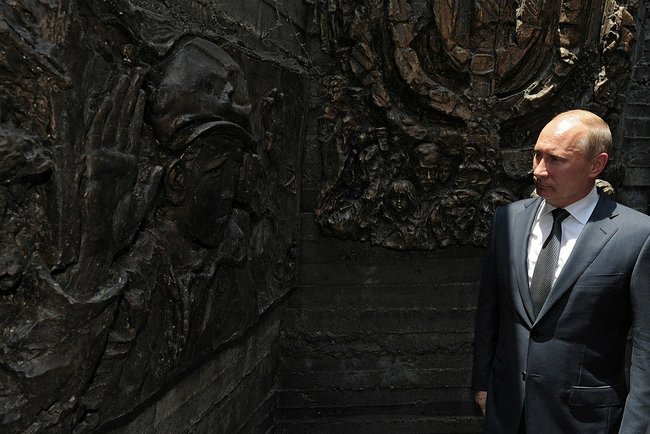
Vladimir Putin in Israel, visiting a memorial dedicated to the Red Army’s victory over Nazi Germany. June 25, 2012. Kremlin press service, public domain.
This doesn’t mean that there isn’t some chatter about the conflict. It’s common for Russian users of Twitter, for instance, to post regular updates about the conflict. Tweets counting Palestinian deaths are routine. A typical tweet reads:
Or to highlight the intensity of the death, some have tweeted:
Another user pointed to the fact that Gaza is essentially an open-air prison.
Another Twitter user simply said:
Aside from these and other news-headline tweets, not all, of course, are pointing to Israeli-inflicted death. For updates from an Israeli perspective, Russian language users can follow the Israeli Defense Forces’ official Russian Twitter feed,@Tsahal_Rus. There, you find tweets like the following:
Since the beginning of the ground operation, the IDF has liquidated 110 terrorists and bombed 1,302 terrorist targets.
Besides chronicling the war casualties, some RuNet users have pondered the apparent hopelessness of the age-old conflict. Blogging on Ekho Moskvy, political analyst Mikhail Osherov argues that Israelis are unwilling to give up the spoils of the Six Day War. Reflecting on the Israeli saying, “There are no solutions,” Osherov writes:
Instead of delving into the debate about the Israeli-Palestinian conflict, some users used the opportunity to make comparisons to Ukraine, mostly to point out the hypocrisy of world opinion.
@Schrodinger1986 tweeted:
In a post on his Vkontakte wall, Sergey Gostev wrote:
Another Vk user, Vladimir Vladimirov, asks
Dark humor on the Web is never hard to find, and the news from Ukraine and Gaza is no exception. Playing off the Russian word for gas (“gaz”) and the literal name of the Gazа Strip in Russian (“the sector of gas”), some users joked,
Putler [a play on “Putin” and “Hitler”] is establishing in the Donbass a sector of shale gas.
Israel—the Gas Sector, Ukraine—the No-Gas Sector.
And:
Not everyone was laughing on July 17. @isma_mustafaev tweeted:
How the headlines put me in a shitty mood!!! #news #politics #russia #ukraine @palestine #gaza
This article was originally published on Global Voices.
About the Author





