
Recently George Osborne visited India on a mission to encourage further trade links. There was much talk of the economic potential of India, to match the weight of expectation the Indian people have placed on Narenda Modi’s new government. But in the midst of all this talk of progress, India is still battling against an epidemic of dangerous misogyny. Sadly, and despite the outraged demands for change from India and around the world, little has changed since the horrific gang rape in New Delhi in 2012. Worst of all, India’s new BJP ministers are part of this problem, in the last two weeks there have been countless examples of a worryingly commonplace, bigoted attitude to women, from those who should know better and who are setting a poor, even dangerous example to India’s billion-strong population.
From insidious ‘Eve-teasing’, the seemingly innocuous ‘teasing’, or rather harassment, of women, to the horrific gang-rape and lynching of two young teenage cousins who were hanged from a tree, this is a country-wide problem, but until the attitudes of the politicians supposedly leading this country into the twenty-first century are challenged, nothing will change and these outrages will continue. Indeed, ministers from the state of Uttar Pradesh, were the girls were attacked, have been criticised for failing to visit the scene and for accusing the media of hyping the story. Harsher punishments for sexual offenders, and broader legal definitions of rape and sexual assault (including for the latter stalking and voyeurism) are a start but not enough, when in vast rural swathes of the country, women are still seen as second class citizens, and a raped women is encouraged to marry her rapist (if he’ll have her) to absolve herself of her shame and be accepted back into society. But, worse than ill-educated rural workers, it is the politicians, the elite in India, helping to perpetuate these attitudes.
Just days before the two cousins in their early teens were raped and killed, Mulayam Singh Yadav, head of the regional Samajwadi party that runs Uttar Pradesh, criticised the proposal that the death penalty be introduced for gang rape, saying: “Boys commit mistakes: will they be hanged for rape?” More recently, Babulal Gaur, the BJP home minister responsible for law and order in the state of Madhya Pradesh described rape as “a social crime which depends on men and women.” Gaur went further saying, “Sometimes it’s right, sometimes it’s wrong.” Instead of reprimanding him, Modi’s party defended Gaur’s right to express his personal views, and so let the fact that an educated, senior politician, responsible for upholding the law, and believes rape is sometimes a crime, and sometimes not, pass unchallenged.
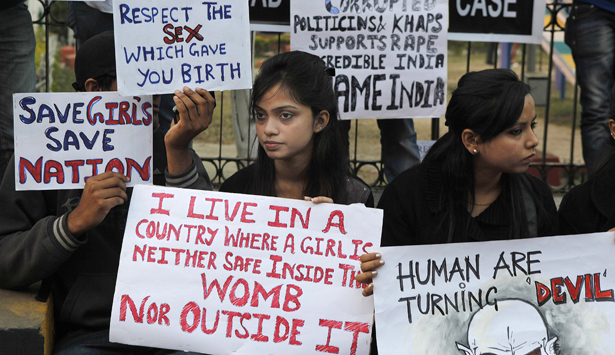
Indian students participate in a protest against a leader of the ruling Congress party on accusations he raped a woman in a village in the early hours of the morning, in Gauhati, India, Thursday, Jan. 3, 2013. Footage on Indian television showed the extraordinary scene of local women surrounding Bikram Singh Brahma, ripping off his shirt and repeatedly slapping him across the face. A Dec. 16 gang rape on a woman, who later died of her injuries, has caused outrage across India, sparking protests and demands for tough new rape laws, better police protection for women and a sustained campaign to change society’s views about women. (AP Photo/Anupam Nath)
Meanwhile, Sudin Dhavalikar, Goa’s public works department minister, recently called for a ban on bikinis and short skirts in public places as way of preventing sexual attacks. Goa is a very popular tourist destination but there have been a number of high profile attacks, including the rape and murder in 2008 of Scarlett Keeling. Dhavalikar’s comment that “we should not allow girls with bikinis to enter public places because it is very difficult to control people who arrive in Goa from different states… It is better to control such type of activities on the beaches” in order to protect women, practically admits to government impotence and an inability to prevent such crimes, or protect tourists and India’s own women while he resorts to blaming the victims, and indeed women in general, and hiding behind the cowardly excuse of cultural differences. This is laughable when you consider how reliant Goa is on tourism, if they can’t act to protect women, why should foreign women holiday there?
Many conservative Hindus will welcome these words, as part of a reaction against the ‘looser morals’ associated with western culture, which they feel have pervaded India, and this move would be poplar with those who feel that traditional Indian culture needs protecting from foreign ‘immorality’. Certainly, this is an attitude many Western women will have encountered while travelling in India, especially in the North, where apparently having white skin is synonymous with being ‘loose’, and an invitation to be harassed and groped, no matter how modestly you dress. Behaviour like this is part of the same problem of ‘slut-shaming’ and victim blaming that we face at home in Britain, which sees victims of sexual abuse, or even just those who are perceived to be promiscuous or insufficiently modest stigmatised, while their attackers are partially excused. So this is not just India’s problem, but as long as women are held responsible for inciting attacks against them, whether that is by wearing a bikini or venturing into a field at night because they do not have a lavatory at home (as with the two cousins raped and hanged) real progress will not be made: women will be silenced, justice will be denied and any changes to the law will be ineffectual in the face of this taboo.
In his first speech to parliament last week, Modi spoke of the need to protect women, and stressed that women deserve respect and dignity. We will see if these are empty words, or if he really will act not just to change the law to safeguard women, but to challenge these backward attitudes, even within his party, because it is only with better education that real change can begin to make women safe in India. Sadly, given Modi’s own hard-line conservative attitudes, and the BJP’s reputation as moral policemen, this seems unlikely, and women will see more attacks on their freedom purportedly for their own protection, and the Indian patriarchy further entrenched. This has already happened at certain universities, where female students are now required to obtain permission before going out with friends and provide details of the people they are meeting. Curfews have also been introduced not just on campuses, but in cities too, where women are strongly advised to go straight home (after finishing work earlier than normal) rather than having a social life. This as well as the repeated ‘advice’ to dress modestly, so as to be invisible to would-be attackers.
Many of India’s government ministers are sadly out of touch with the modern world they are striving to become part of, as comments like this show. Worse, while politicians get away with saying such things, the perpetrators will feel invincible, while their victims are shamed and stigmatised. Instead of measuring progress by economic markers, instead we should focus on how women are treated. Deep rooted structural social change is what is required, rather than a return to the ‘traditional values’ of purdah to protect women; far from solving the problems of sexism and sexual violence, it will turn back the clock on all the hard-fought for freedoms and equalities that women have won, hardly ‘progress’ worthy of a twenty-first century nation. Tradition is not an acceptable excuse for entrenched misogyny and hatred of women. ‘Cultural difference’ must not be used as a cover-up, violence against women is never acceptable, no matter which creed, nation or religion it is hidden behind.
About the Author






[…] http://archive.the-ipf.com/indian-politicians-are-at-the-heart-of-the-countrys-misogyny-… […]