
Libya’s former leader Muammar Gaddafi was one of the earliest dictators to be ousted by civil uprisings in the context of the Arab Spring. Once the nation’s capital Tripoli fell to rebel forces on 20 August 2011, it was only a matter of time until Gaddafi would be found and killed exactly two months later. In the immediate wake of these events, the international focus turned to other countries that were experiencing serious uprisings or outright civil wars, particularly to Egypt and Syria.
However, order was not achieved in Libya and the situation has deteriorated rapidly in the past few months. The country’s government is incapable of disarming and pacifying the numerous militia groups that have lingered on from the fight against Gaddafi’s troops. The only thing that united these militiamen – the ousting of Gaddafi – has long disappeared and the ideological divides between them have become blatantly apparent. However, most armed groups have another common objective: chaos. The only way to maintain their power is through spreading chaos and disorder, undermining the reconstruction of peaceful political dialogue and keeping the government powerless. For this purpose, different groups have briefly kidnapped the prime minister and several foreign representatives, recurrently attacked parliament and the eastern oil ports.
The past two weeks have seen the death toll rise to 150 according to government figures, even though the fighting is mainly limited to Benghazi and Tripoli. This spike in violence has been sparked by retired general Khalifa Haftar’s call to rise up against the elected parliament with the aim of ridding Libya from terrorism and extremism. The Islamist militia named Ansar al-Sharia, which aims to impose Sharia law across Libya, opposes the general and his followers. Caught in the middle of this struggle is the impotent central government, which tried to calm the situation by organising parliamentary elections in June 2014. Half of eligible Libyans cast their vote – a disastrous result for any bid to reconcile the warring parties or build a central authority capable to restore order throughout the country. Even worse, the government is paying many of the militias, seeking to turn their allegiances.
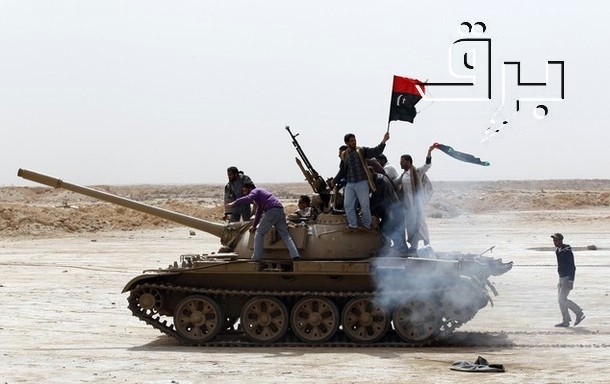
Rebels wave a Kingdom of Libya flag as they ride on top of a tank on the outskirts of Ajdabiyah, on the road leading to Brega, March 2, 2011. The flag which was used when Libya gained independence from Italy in 1951, has been used as a symbol of resistance against Libya’s leader Muammar Gaddafi in the recent protests. REUTERS/Goran Tomasevic
The losers of continuing power struggles and armed confrontations, of course, are civilians. In January of this year, the United Nations High Commissioner for Refugees (ONHCR) counted over 25.000 refugees and more than twice as may Internally Displaced Persons (IDPs). With the on-going violence and gunfire in the two major cities of the country, this number is very likely to have risen since then, and can be projected to continue rising for the foreseeable future. It is a picture that – unfortunately – is reminiscent of many other countries in the Middle East. In Iraq, already before the push by the Islamic State of Iraq and Syria, there were close to a million IDPs and half a million refugees. Israel’s ground offensive in the Gaza Strip is very likely to increase the number of IDPs in this area, for all the borders around the Gaza Strip are closed. Finally, Syria’s civil war has torn the country apart with more than 2 million refugees and more than 6 million IDPs.
Yet, apart from covert operations against individuals, there is very little Western countries want to (or can) do. The EU is preoccupied with the Ukrainian crisis on its borders and containing Russia, while the United States under President Obama has shown a general hesitation to get involved too deeply in Middle Eastern politics. Even though the Libyan government is sounding out the possibility of a UN-sanctioned international coalition, it is unclear who would pledge troops to this cause. It is a bad sign that the UN, alongside other countries such as France or the United States, has already withdrawn its staff because of security concerns. The African Union has very little influence in the country since it opposed the NATO offensive to expel Muammar Gaddafi.
So it seems that the situation in Libya will get worse before it gets better. The country is awash with weapons and coupled with the extremely divisive ideologies of the main protagonists (General Haftar, Ansar al-Sharia, and the government), this presents a combustible mix. To make matters worse, there are many small groups and tribes that use the violence and chaos for personal enrichment, making the life of common people ever more difficult. All of this reminds one of a failed state, where no side is able to control the whole country and where law and order mean nothing.
About the Author






1) There are rebels and militias. Rebels are to thank for ousting Gaddafi. They are the very definition of legitimacy (themselves armed of course) in Libya. Armed rebels are the main guard against reactionary and anti-revolutionary forces like Haftar’s militias(you mentioned his call to dissolve parliament as if it was just another fact) . Talk of disarmament is condescending to the Libyan people (represented by their armed rebels). Otherwise disarmament only favours the Gaddafi regime that lost the revolutionary war.
The Libyan state is to be built by Libyans who oppose Gaddafi and aspire for freedom and democracy (including their armed branch, the rebels).
2)That half of eligible voters showed up, during tumultuous conditions, is actually reason to congratulate Libyans. Not much more show up in stable democracies like Britain’s.
3)generally, oversimplifications that ignore the revolutionary dialectic in Libya are mere reflections of Orientalist racist views (the savages are fighting and calling our help) rather than balanced commentary (there is a revolution being fought).