
When Elizabeth Cochran was just twenty years old she read a particularly upsetting editorial in her local paper entitled What Girls Are Good For. In short, the column effectively considered the answer to be nothing.
Elizabeth, nicknamed Pinky, was the daughter of a wealthy landowner in Pennsylvania. The town they lived in, Cochran, in fact, was named after her family. When he passed away during her childhood, Elizabeth became determined to grow up and support her mother and family. She began her studies to become a teacher, essentially the only thing a young woman could expect to do for employment in the 1880s, at the age of fifteen.
As she approached her twenties, having not found independence as a teacher or any other odd-jobs she undertook, she frequently read disturbing columns in her local paper by Sir Erasmus Wilson that insisted women belonged in the home – and that any woman who sought to have a life and – God forbid – a sense of purpose outside the home was “a monstrosity.”
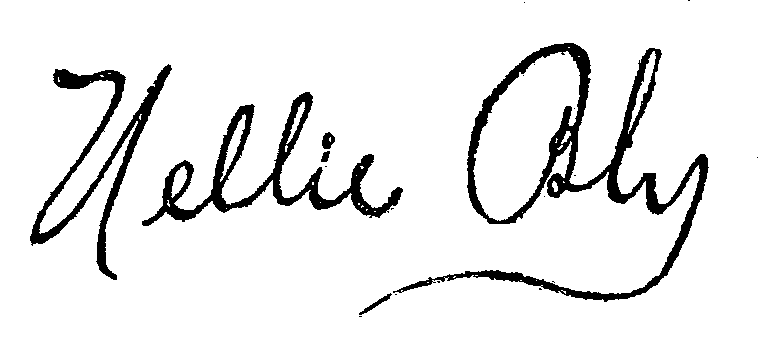
Feeling particularly enraged by this assertion, she retorted by writing an editorial calling out Wilson on his blatant misogyny. She wrote the editorial under “Poor Orphan Girl” – leaving the newspaper’s editorial team, who was thoroughly impressed by her article, to try to track her down. When she revealed her identity, they hired her on the spot and provided her with a pen name – Nellie Bly. Though they did sequester her to the women’s page only, leaving her with slim chance to advance or write anything particularly interesting.
It didn’t take long for Nellie to find her voice in what would be called investigative journalism. She enjoyed writing meaningful, human interest pieces and wanted very much to travel and report about women’s issues from all over the world. Knowing she would not be achieving that in Pittsburg, she took off for New York City and proceeded to knock on the door of every major editor until one day she found herself in front of the man himself, Joseph Pulitzer.
Whether it was motivated by his own dubious reaction to Nellie or he simply wanted to provide her with a ridiculous task, Pulitzer told Nellie to get herself into the local insane asylum and write an article about her findings.
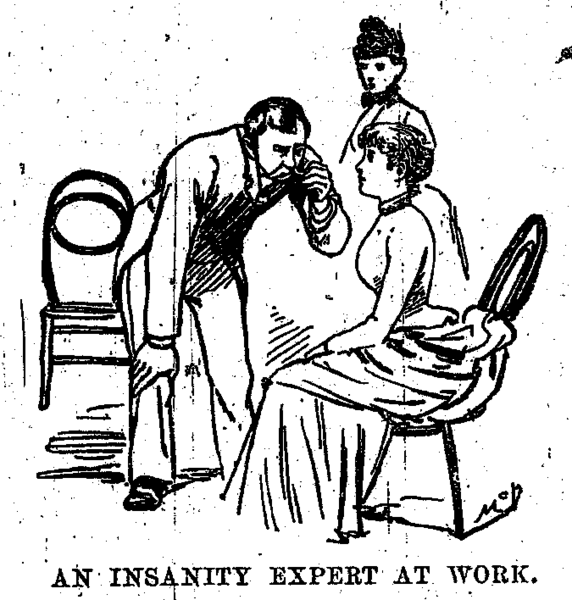
Nellie went home and began dutifully practicing her crazy face in the mirror, packed up a few personal effects and went to a local boardinghouse where she began to put on her act. It didn’t take long for her to begin to get negative attention from the other boarders and eventually she was put before a judge. Feigning amnesia, the judge insisted she be examined by physicians who unanimously agreed that she was “positively demented” – and within days, Bellevue Hospital had pronounced her “undoubtably insane.”
Nellie went to the women’s asylum on Blackwell Island in the midst of a fury of media attention – apparently, New York’s major news outlets ran a story called “Who Is This Insane Girl?” where they postulated the identity of the “pretty, crazy girl” who had been committed to Blackwell Island.
Almost immediately, Nellie discovered that the conditions at the asylum were far worse than anyone would have imagined. Not only were the patients treated like prisoners but they were hardly cared for with even basic human decency – the food was spoiled and the drinking water unclean. Patients were tied up with ropes and some of them were locked up entirely, completely isolated. There was filth and feces near where the patients ate their “meals” and everything stank with illness and decay.
The medical staff were unapologetically abusive – both verbally and physically – and abuse was just part of the daily routine. Nellie, somewhat startled by merely her own observations, began to talk to the other patients only to discover that some of them weren’t insane at all. There were a handful of a women whose only struggle was that they didn’t speak English. Having emigrated from Europe (many of them German) they had been mistakenly locked up because their inability to speak proper English was interpreted as being the babble of the emotionally unstable.
Nellie stayed at the asylum for only ten days and that proved to be more than enough fodder for her article – in fact, it spurred an entire book; complete with illustrations.
Ten Days in A Mad House was published in 1887 and not only brought about instant and lasting fame for Nellie Bly, but also a significant reform of the New York asylum system – including a thorough and complete investigation of the asylum on Blackwell Island.
Nellie Bly’s in-depth reporting and subsequent book were just the beginning of her varied and successful writing career. She went on to attempt to replicate the route of Jules Verne’s Around the World in Eighty Days, writing about her journey of course, and managed to complete it in Around in the World in Seventy-Two Days.
Eventually, she married a millionaire who was forty years older than she, became an inventor and industrialist for a time (only to lose her earnings to employee embezzlement), went back to reporting in her later years, took an interest in fostering orphans and died of pneumonia at age fifty-seven in 1922, having left behind a legacy of a notable journalist and suffragette.
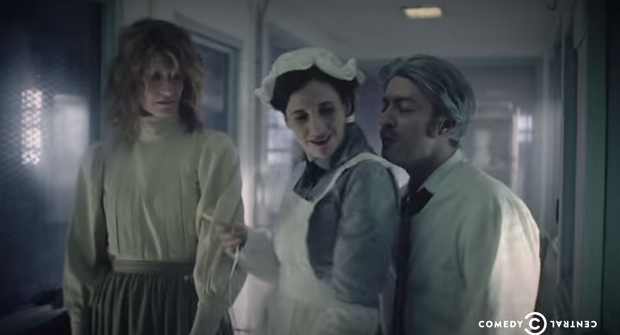
So much so that her story was even featured in a Drunk History episode.
This article was originally published on Urban Times.
About the Author





