
In 2004, the BBC released filmmaker Adam Curtis’s documentary, The Power of Nightmares. In its three episodes, he carefully and convincingly made the case for the threat of international terrorism being greatly exaggerated;
In the light of recent events in Iraq, however, this conclusion is quite simply dated. The Islamic State in Iraq and Syria (ISIS), has made advances, taking key locations in the country. They also threaten the very existence of the Iraqi government; in July, they were pushing towards the capital Baghdad. More alarmingly, they have threatened the christian minority group, the Yazidi, who have fled northwards, with death, if they do not convert to ISIS’ virulent branch of Islam.
These are not empty threats. The recent murder of James Foley, alongside the varied and numerous atrocities they have perpetrated brutally encapsulates the violent and depraved nature of ISIS, and the lengths they are prepared to go to to promote their poisonous message of hatred. In addition, they have threatened to attack US citizens at any opportunity – the danger they pose is quite obvious. Some observers have argued that intervention should not go ahead, or that it will not prevent harm from coming to the Iraqi people.
The first justification is humanitarian grounds. We pride ourselves as western democracies on our advocation of individual freedom of political and religious beliefs, and how we are free to live our lives as we wish. ISIS’ repugnant philosophy offers no such promise at all. Instead, they threaten to kill those who do not wish to follow their ideology, they willingly murder innocent civilians, and are on the verge of committing acts of genocide. That we are standing by as these atrocities continue, yet at home we champion our love of freedom, ranks of hypocrisy.
Double standards aside, on a purely human level, the band of savage criminals that comprise ISIS violate the very fabric of our humanity. The vast majority of the Earth’s population understand that such despicable actions are unacceptable, and are alien to how we live our lives. Practically all sovereign states of the world have laws that outlaw murder, torture, assault, and rape, and we rightfully met out punishments as response to these crimes. So why do we not extend it to here.
In conjunction with protecting innocent people, the confrontation of ISIS is not just to put a halt to their slaughter, but for our state security as well. The Middle East is a region of conflict and instability, admittedly caused in part by our actions over a decade ago. We see this in not just Iraq, but in the Arab states, Pakistan, Afghanistan, and Yemen, to name a few. In each and every case, these states’ respective governments vye against insurgencies that threaten to overthrow them, many of whom are affiliated with al-Qaeda or some other fundamentalist group. In equal measure, the western allies, most notably the United States, and the United Kingdom have invested billions of pounds and dollars into stopping these insurgent groups. Be it through large scale deployment, the use of UAVs, or simply providing monetary aid to the governments afflicted by terrorists.
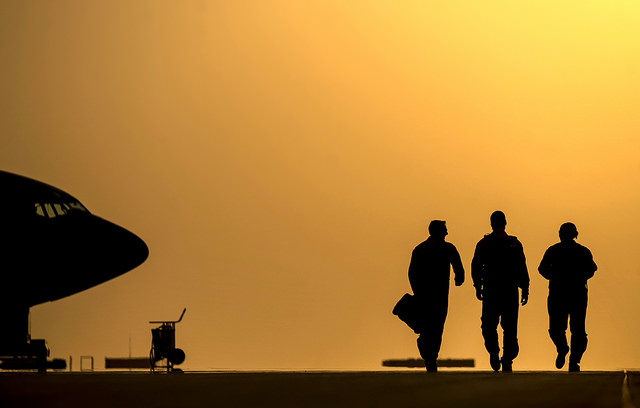
U.S. Soldiers on a refuelling stop in Iraq. Image courtesy of Stuart Rankin © 2014, some rights reserved.
So, we understand the potential dangers that would befall us if our regional allies were abandoned. al-Qaeda has already attempted attacks on Western targets, which originated from these troubled areas; the perpetrators of the 7/7 bombings in London were trained in Pakistan, and the man behind the attempted Detroit bombing originated from a Yemeni branch of al-Qaeda. The same can be extended to the ongoing situation in Iraq. As noted previously, one of ISIS’ leaders has voiced a desire to attack the United States.
The final justification for some form of involvement is more of an opportunity than a necessity. Simply put, it is not a requirement for our security, but not taking advantage of this chance would be misguided to say the least. The opportunity in question is the mending of relations between Iran and Russia, as both have interests in preventing ISIS from gaining control of Iraq. Iran is currently providing aid to the Iraqi government, as is Russia. That they are doing so demonstrates a commonality between the West and themselves, and Russia-NATO and Iran-NATO relations are not what one could describe as ‘warm’ either.
UN sanctions, championed by the US, and supported by the UK, in reaction to Iran’s nuclear programme, has crippled their economy. The ongoing crisis in Ukraine has put the Russian Federation at odds with NATO, and the recent downing of the Malaysian Airlines plane only poisoned relations further, despite the Russian military not being responsible. However, Islamic terrorism is a threat the Russians are acutely aware of, hence why they too are involving themselves in the current crisis.
This conflict provides the chance to mend these relations.
We all want to see the current Iraqi government remain in place, and we all see the threat posed by militant groups. The coming together of these three parties could spark a change in relations, not just for the short term, but for the long haul. The current concerns the US has with Iran are by no means finished, and Russia will not sink into obsolescence any time soon. If relations are repaired between the West and these two states, then it could pay dividends in the future. Both for the previously mentioned concerns of security and stability, and perhaps for economic reasons too.
Overall, whether the UK will commit its air power to the conflict is not yet decided. But the fact remains that ISIS is a severe danger to our security, regional stability, and to the lives of countless thousands of innocents who it has plans to target. Not confronting them would be foolhardy, and would render our proud proclamations of love for freedom and democracy as simply lies we tell ourselves to help us sleep at night, rather than tenets we believe should apply to all people, of all creeds and colours.
About the Author






The issue with ISIS,ISIL, or whatever they are calling themselves today.
Is that they are a threat that civilized countries are not Equipped to handle.
Because they are by any standard you wish to use. Religious Fanatic’s and as such logic and reason cannot be understood or even contemplated by them.
And if you think I am wrong in that assessment remember that even Al Queada.
Has disavowed them for being too radical. An enemy such as they are has not been encountered by the Civilized World. Since the days when the group the word Assassin is derived from. And that group had to be rooted out by several Kingdoms working together. That group had to be destroyed using a scorched earth no holds barred (forget mercy or humane treatment) total war. The threat we face is no less as fanatical. worse they now have the independent resources of a nation. when considering the amount of monetary and population gains. They have acquired in the last year. (how long till we have dirty bombs or chemical weapons going off in our respective countries.) For they see us in the west as the great Satan. Something for which they will show no mercy or compassion. It is only a matter of time until the consolidate their gains. And start reaching out to eliminate the Infidels. And for those of our countries that are of the Muslim Persuasion. They will go after you for consorting with the enemies of Allah. So no Saudi Arabia nor you Yemen not even you Bahrain. Will escape unscathed from the firestorm of hate and death that is coming. So please by all means waste time by using sanctions. Do try to start a dialogue. Imagine walking a mile in their shoes. And all that other civilized claptrap.
It only serves to give them more time to finalize their plans. The ones where they knock you off the chessboard. And take your women and children as prizes of war.
For Allah has told them to annihilate you all.
Leonard, thank-you for the feedback! The intention of this article was to advocate for armed force. Forgive me if you see differently, but I essentially agree with what you are saying.