
The state of West Bengal, India, which conjures up images of art, music, quietude, literary greats like Rabindranath Tagore, and the historic site of early Indian nationalism, is widely regarded as a peaceful place by many Indians. The capital city of Calcutta is fondly referred to as “The City of Joy”, after the novel by Dominique Lapierre, but the past month has revealed the biting irony of that title, not just of the writer’s fictional account, but of the shocking events that have transpired.
On the night of 28th August, a female student of Calcutta’s renowned Jadavpur University (JU) was dragged into a boys’ hostel and molested by a group of young men.
One imagines these young men were a bunch of victim-blaming, misogynists claiming a woman’s body as public property, theirs for the taking; a group of young men assured of impunity by a little thing called rape culture.
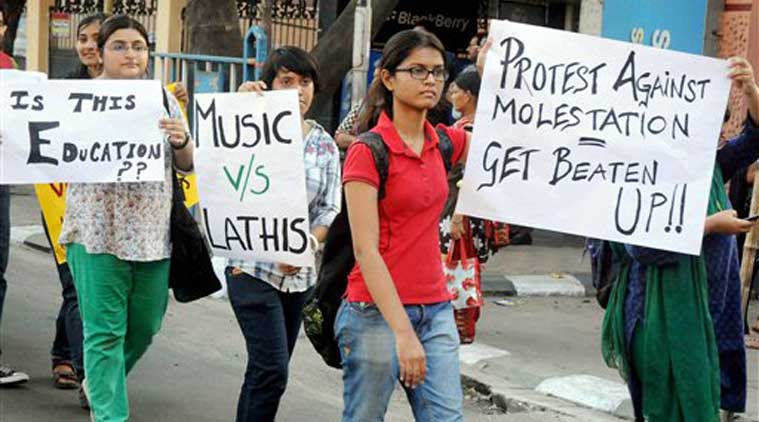
Jadavpur University students protest. Image Credit: IndianExpress
When plied to take up the matter formally, the University’s response was slow and suspicious. Not only were the Vishakha Guidelines flouted (when two representatives of the university arrived to question the sobriety and dress of the victim), but the Vice Chancellor’s subsequent inaction is evidence of how deep-rooted prejudice against women is in the country. Molestation or sexual assault of any form is far from uncommon in India, in public as well as private institutions. Nonetheless, the response to this case from both the powers that be and the student community as a whole, has been singular.
Peaceful protests met with tear gas
A peaceful protest, comprising of dancing, singing and street theatre, was organised by the students, to call out the administration and police on their refusal to act, but on the night of 17th September, JU quickly became a site of sexual assault and state-mobilised violence upon unarmed students. Since seven o’clock that night, members of West Bengal’s ruling political party (Trinamool Congress Party) had been stirring trouble for protesters, but all hell broke loose when the Rapid Action Force (RAF) (established specifically to contain riots) arrived on the scene along with Calcutta police and brutalised the students with tear gas, water canons and lathis (large sticks). At two o’clock in the morning, the lights were cut and RAF and men in plain clothes assaulted the students once again, molesting females, and leaving several individuals in critical condition. Arrests were made and students were landed in the ICU. Kolkata Police Commissioner Surajit Kar Purakayasth justified police violence and sexual assault as a preventive measure. The Chief Minister of West Bengal, Mamata Banerjee, dismissed it all as a “small incident”, just as she decried the Park Street rape as as “conspiracy”. Encouragingly, Indian citizens presented a resounding opposition to such callous stances.
“the farce of democracy that exists both at the state as well as the national level has been abundantly challenged“ – Yashaswini Basu, Student
Many students expressed outrage at the largely fabricated claims made by the Vice Chancellor, who called in the RAF and police on the suspicion that there were “armed miscreants” on the campus. In truth, the only persons with arms, at liberty to use those arms, and who did in fact use them, were the RAF and the police. Asmita Kundu, former JU student had this to say: “The VC is an ignorant, irresponsible government employee who is also a subject of the common phobia against student politics.” Kundu maintans that the Vice Chancellor ordered the attack on unarmed students for this very reason. She also expresses her concern about the Chief Minister’s routine downplaying of these incidents, because acknowledging even a single case of sexual violence in the West Bengal, would mean admitting the prevalence of rape culture and the ruling party’s incompetence at combating it.
Yashaswini Basu, student at Jawaharlal Nehru University, attributed the Vice Chancellor’s nonchalance to his allegiance to the Trinamool Congress Party. There was an attempt to mask his own inaction and indifference by falsely showing up protesters as threatening enough to merit an armed crackdown in the middle of the night. She notes a similar pattern between the actions of the Chief Minister and the Vice Chancellor of JU. Had immediate action been taken on the 28th August molestation, it “would directly implicate a few students from Trinamool Congress Party as well as unveil the inaction and sense of irresponsibility on part of the warden.”
Nationwide student movement
The incidents of 28th August, and 17th September were veritable catalysts for a nationwide student movement as people took to the streets to register their protest, and to demand justice for every victim of sexual harassment, as well as condemning unjustifiable state violence and concerted efforts to deny Indian citizens’ inalienable rights to freedom to protest. The events that followed reveal the Indian state’s reluctance to lend an ear to its people’s voices, and a downright rejection of the common citizen’s political power.
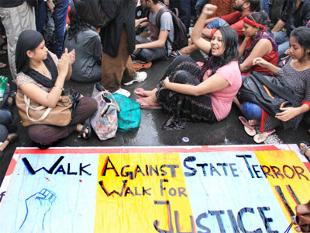
Solidarity protests in Delhi. Image Credit: Economic Times
On the 20th of September, solidarity marches were held in New Delhi, Bombay and Hyderabad, at the same time as a 1,00,000 strong march in Calcutta. Protesters in New Delhi had a run in with the police again, who were deployed even before the march could begin. At the same time, a few streets away, a bus carrying students from Jawaharlal Nehru University was accosted on Tughlaq Road by a plain-clothes officer, who, refusing to identify himself, allegedly attempted to impose Section 144 of the state’s penal code (prohibiting an assembly of more than 10 people in a given area) within the vehicle itself. A van full of policemen was called to escort the protesters before the bus was allowed to move again. Around the same time, a vague message was issued from the office of the Vice Chancellor on the official JU website, saying simply “I am sorry”. The administration has accused hackers and has since removed the page from the website altogether.
“The fact is that the farce of democracy that exists both at the state as well as the national level has been abundantly challenged and such redundant restrictive actions – stopping buses and presence of the police force at our New Delhi protest – bear testimony to that,” says Yashaswini Basu.
Calls for resignation
In JU, the demand is clear – the resignation of the Vice Chancellor and Mamata Banerjee, the setting up of an independent student body to address the issue of sexual harassment, and a probe into the whole debacle that started in August, the last of which is expected to be pushed for by the Governor of West Bengal. Asmita Kundu justifies the demands for resignation, as “such incidents will continue to happen and, while they are in power, such incidents will continue to be shielded.”
The Vice Chancellor tried to undermine the students’ movement by speculating about “outside” elements and grossly miscalculating participation as amounting to only 20% of the student body, but the word around social media is that 73 institutions and counting, from across Indian cities, have lent their support to JU. Every possible effort is being made by the student community to not let this die out, a fate that so many social movements have suffered, whether because of a lack of organization or intimidation and thwarting by lumpen elements and vitriolic governments. JU student Mohona Bhadra and friends organised performative arts all over campus on the 15th of September, to sustain the discussions.
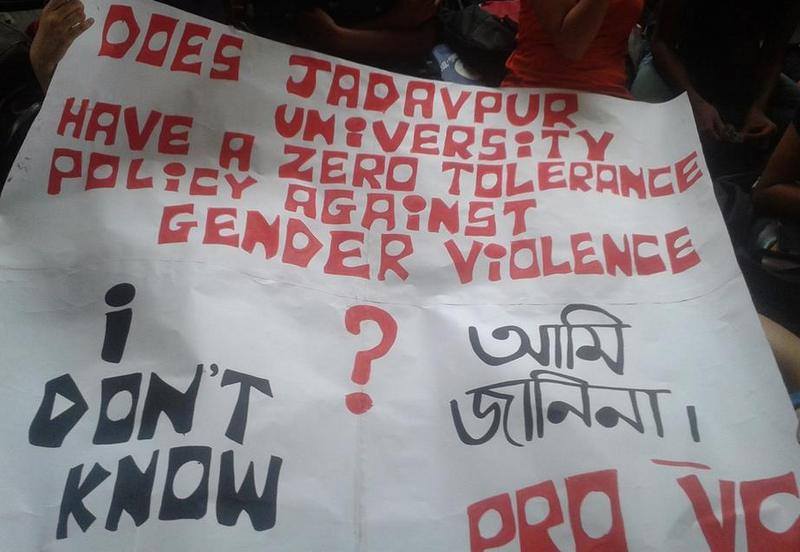
Jadavpur University protests treatment of gender violence. Image Credit: Youth ki awaaz
The political consciousness of both the student community and those who march in solidarity appears to have peaked in the past few weeks. Do students have a lot to be mad about? Do they ever! When it comes to administration responsiveness, on-campus sexual harassment is only one of many problems faced by students. News of caste-discrimination in IIT Bombay, and unfair fee hikes and eerily similar attacks on protesters in Himachal Pradesh University came just days after the JU incident, while the pasts of many educational institutions in India are peppered with similar stories. In New Delhi, students of Delhi University have
demanded the sacking of lazy, xenophobic, homophobic and classist professors from the Department of English who have made wild, inaccurate and objectionable statements during lectures.
Singing, peace chains, open discussion
Despite the unprecedented state muscle power being used against them, students have remained peaceful and particularly innovative in their mode of protest. Singing and peace chains are becoming common sights. Film screenings and open discussions are being organised by Calcutta-based digital magazine, “Eye“. Perhaps the most significant aspect of the solidarity marches has been how spontaneous and organic they are, planned at short notice, but still garnering a substantial crowd. Protesters have certainly not lost track of the origin of their protest – sexual harassment, which is practically an epidemic in India.
Students have promised not to give up the ghost any time soon, on the protest front, and will continue to agitate in an increasingly coordinated manner until justice is served to all those who have been wronged, not only in Jadavpur, but all over the country.
About the Author






[…] India’s Armed Crackdown on Student Protesters […]